
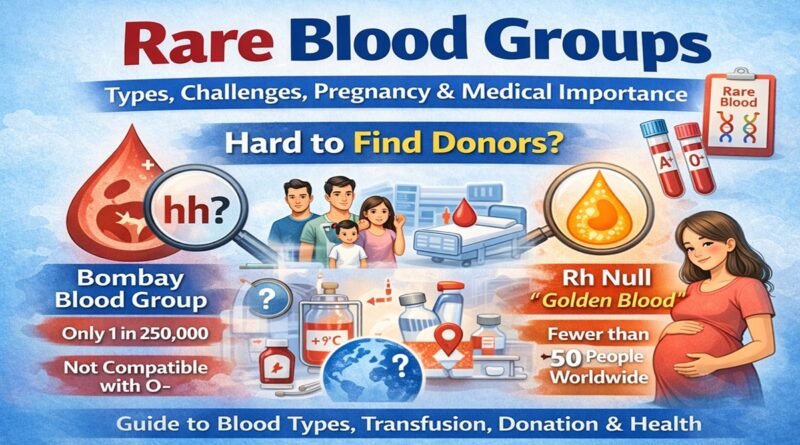
Rare Blood Groups: Types, Genetics, Availability & Medical Importance (Complete Guide)
Most people know only the common blood groups — A, B, AB, and O.
But in medical science, there are hundreds of blood group variations, and some are so rare that only a few people in the entire world have them.
These are called rare blood groups, and in emergencies they can literally become a life-or-death situation.
What is a Rare Blood Group?
A blood type is considered rare when:
- It occurs in less than 1 in 1,000 people
- Compatible donors are extremely difficult to find
- Normal blood banks may not have it available
Sometimes patients must search across countries to find a matching donor.
Why Blood Groups Become Rare
Blood group rarity happens because of genetics and missing antigens on red blood cells.
Normally blood is classified by the ABO system and
👉 Rh factor
But actually, humans have over 40 blood group systems (Kell, Duffy, Kidd, MNS etc.).
Rare combinations in these systems create unique blood types.
Most Important Rare Blood Groups
1. Bombay Blood Group (HH / Oh Phenotype)
One of the most famous rare blood types — first discovered in Mumbai (1952).
👉 Bombay blood group
What makes it special?
People with this type:
- Do NOT have A, B, or O antigen
- Even O blood is incompatible
- Can receive blood only from Bombay group donors
Frequency
- Worldwide: ~1 in 250,000
- India: ~1 in 10,000 (higher in Maharashtra & South India)
Why dangerous?
In an accident:
Even O− blood cannot be transfused
Doctors must urgently locate a registered donor.
2. Rh Null — “Golden Blood”
The rarest blood type on Earth.
👉 Rh null blood type
Features
- No Rh antigens at all
- Universal donor for Rh system
- Extremely valuable for research
Frequency
Fewer than 50 people worldwide recorded.
Medical issue
People may suffer:
- Chronic anemia
- Fragile red blood cells
3. Rare Rh Subtypes
Some people are Rh positive but missing specific Rh antigens.
Examples:
- Weak D
- Partial D
These patients may react to normal Rh+ blood, making transfusion complicated.
4. Kell Negative / Kell Null
Kell is another blood group system after ABO and Rh.
Rare Kell phenotypes are critical in pregnancy because they can cause severe fetal anemia — sometimes more dangerous than Rh incompatibility.
Rare Blood Groups in Pregnancy
Most people know about
👉 Rh incompatibility
But rare antigens (Kell, Duffy, Kidd) can also cause:
👉 Hemolytic disease of the newborn
Sometimes even when mother is Rh positive.
That’s why advanced pregnancy care includes antibody screening, not just blood typing.
Why Finding Blood is Difficult
For common blood groups:
Blood bank → immediate availability
For rare groups:
Nationwide search → donor registry → international request
Many countries maintain frozen rare blood units for years.
Rare Donor Registries
Hospitals maintain special databases:
- National rare donor programs
- International blood networks
- Frozen blood storage at −80°C
India also maintains rare donor registries in metro cities.
Importance of Rare Blood Donors
If a rare donor registers:
- They may save lives across continents
- Sometimes called urgently during surgery
- Often contacted directly by hospitals
A single donor may be the only compatible match for a patient.
How You Can Know if You Are Rare
You may have a rare blood group if:
- Cross-matching repeatedly fails
- Blood bank says “compatible donor not found”
- You belong to families with similar uncommon types
Advanced blood typing test identifies it.
Myths About Rare Blood Groups
| Myth | Reality |
|---|---|
| Rare blood means weak body | False |
| Rare blood causes infertility | False |
| Rare blood cannot donate | Very valuable donors |
| O negative is rarest | Not true (Bombay & Rh null rarer) |
Final Conclusion
Rare blood groups are medically crucial because compatibility matters more than availability.
Key points:
- Hundreds of blood antigens exist beyond ABO
- Some people can receive blood only from extremely few donors
- Rare donor registries save lives globally
- Testing and awareness are essential
Your blood type is not just identity — it may be someone’s only hope in emergency.
