
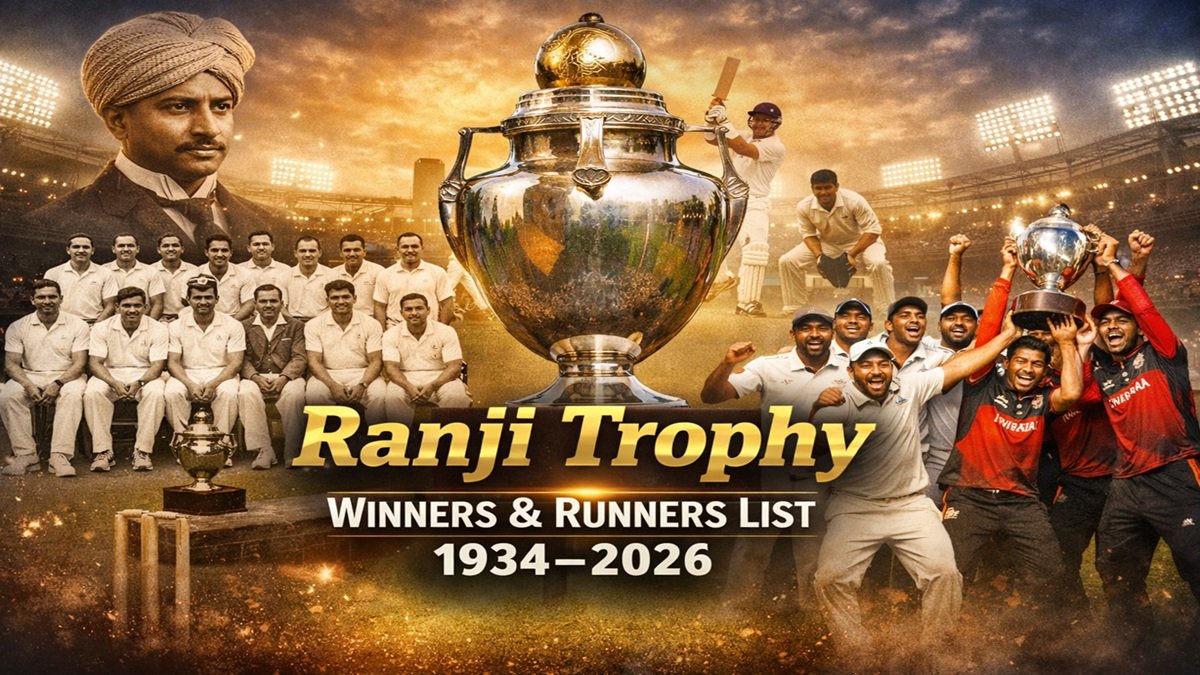
Ranji Trophy Winners & Runners-Up List From 1934 To 2026
The Ranji Trophy is the backbone of Indian domestic cricket and one of the oldest first-class tournaments in the world. First played in the 1934–35 season, the competition has been the primary platform for identifying, testing, and refining cricketing talent in India for over nine decades.
Named after Kumar Shri Ranjitsinhji, the Ranji Trophy has evolved with Indian cricket itself. From regional rivalries in the pre-Independence era to a highly competitive multi-team structure today, the tournament continues to shape the future of Indian cricket.
In the most recently completed season (2024–25), Vidarbha lifted the trophy after drawing the final against Kerala and winning on the basis of a first-innings lead—an outcome that once again underlined the tactical depth of red-ball cricket. The 2025–26 Ranji Trophy season is currently underway.
What Is the Ranji Trophy?
The Ranji Trophy is India’s premier first-class (red-ball) cricket tournament, organized by the Board of Control for Cricket in India (BCCI). Unlike shorter formats such as T20s or ODIs, Ranji matches test a player’s technique, temperament, fitness, and patience over multiple days.
For selectors, performances in the Ranji Trophy remain one of the strongest indicators of a player’s readiness for Test cricket.
Ranji Trophy Winners & Runners-Up (1934–35 to 2025–26)
Below is the complete season-by-season list of Ranji Trophy winners and runners-up from the tournament’s inception to the current season.
Note: The 2020–21 season was not held due to the COVID-19 pandemic. The 2025–26 season is ongoing.
Complete List
| Season | Winner | Runner-up |
|---|---|---|
| 1934–35 | Bombay | Northern India |
| 1935–36 | Bombay | Madras |
| 1936–37 | Nawanagar | Bengal |
| 1937–38 | Hyderabad | Nawanagar |
| 1938–39 | Bengal | Southern Punjab |
| 1939–40 | Maharashtra | United Provinces |
| 1940–41 | Maharashtra | Madras |
| 1941–42 | Bombay | Mysore |
| 1942–43 | Baroda | Hyderabad |
| 1943–44 | Western India | Bengal |
| 1944–45 | Bombay | Holkar |
| 1945–46 | Holkar | Baroda |
| 1946–47 | Baroda | Holkar |
| 1947–48 | Holkar | Bombay |
| 1948–49 | Bombay | Baroda |
| 1949–50 | Baroda | Holkar |
| 1950–51 | Holkar | Gujarat |
| 1951–52 | Bombay | Holkar |
| 1952–53 | Holkar | Bengal |
| 1953–54 | Bombay | Holkar |
| 1954–55 | Madras | Holkar |
| 1955–56 | Bombay | Bengal |
| 1956–57 | Bombay | Services |
| 1957–58 | Baroda | Services |
| 1958–59 | Bombay | Bengal |
| 1959–60 | Bombay | Mysore |
| 1960–61 | Bombay | Rajasthan |
| 1961–62 | Bombay | Rajasthan |
| 1962–63 | Bombay | Rajasthan |
| 1963–64 | Bombay | Rajasthan |
| 1964–65 | Bombay | Hyderabad |
| 1965–66 | Bombay | Rajasthan |
| 1966–67 | Bombay | Rajasthan |
| 1967–68 | Bombay | Madras |
| 1968–69 | Bombay | Bengal |
| 1969–70 | Bombay | Rajasthan |
| 1970–71 | Bombay | Maharashtra |
| 1971–72 | Bombay | Bengal |
| 1972–73 | Bombay | Tamil Nadu |
| 1973–74 | Karnataka | Rajasthan |
| 1974–75 | Bombay | Karnataka |
| 1975–76 | Bombay | Bihar |
| 1976–77 | Bombay | Delhi |
| 1977–78 | Karnataka | Uttar Pradesh |
| 1978–79 | Delhi | Karnataka |
| 1979–80 | Delhi | Bombay |
| 1980–81 | Bombay | Delhi |
| 1981–82 | Delhi | Karnataka |
| 1982–83 | Karnataka | Bombay |
| 1983–84 | Bombay | Delhi |
| 1984–85 | Bombay | Delhi |
| 1985–86 | Delhi | Haryana |
| 1986–87 | Hyderabad | Delhi |
| 1987–88 | Tamil Nadu | Railways |
| 1988–89 | Delhi | Bengal |
| 1989–90 | Bengal | Delhi |
| 1990–91 | Haryana | Bombay |
| 1991–92 | Delhi | Tamil Nadu |
| 1992–93 | Punjab | Maharashtra |
| 1993–94 | Bombay | Bengal |
| 1994–95 | Bombay | Punjab |
| 1995–96 | Karnataka | Tamil Nadu |
| 1996–97 | Mumbai | Delhi |
| 1997–98 | Karnataka | Uttar Pradesh |
| 1998–99 | Karnataka | Madhya Pradesh |
| 1999–00 | Mumbai | Hyderabad |
| 2000–01 | Baroda | Railways |
| 2001–02 | Railways | Baroda |
| 2002–03 | Mumbai | Tamil Nadu |
| 2003–04 | Mumbai | Tamil Nadu |
| 2004–05 | Railways | Punjab |
| 2005–06 | Uttar Pradesh | Bengal |
| 2006–07 | Mumbai | Bengal |
| 2007–08 | Delhi | Uttar Pradesh |
| 2008–09 | Mumbai | Uttar Pradesh |
| 2009–10 | Mumbai | Karnataka |
| 2010–11 | Rajasthan | Baroda |
| 2011–12 | Rajasthan | Tamil Nadu |
| 2012–13 | Mumbai | Saurashtra |
| 2013–14 | Karnataka | Maharashtra |
| 2014–15 | Karnataka | Tamil Nadu |
| 2015–16 | Mumbai | Saurashtra |
| 2016–17 | Gujarat | Mumbai |
| 2017–18 | Vidarbha | Delhi |
| 2018–19 | Vidarbha | Saurashtra |
| 2019–20 | Saurashtra | Bengal |
| 2020–21 | Not held (COVID-19) | — |
| 2021–22 | Madhya Pradesh | Mumbai |
| 2022–23 | Saurashtra | Bengal |
| 2023–24 | Mumbai | Vidarbha |
| 2024–25 | Vidarbha (1st inns lead) | Kerala |
| 2025–26 | TBD | TBD |
History and Evolution of the Ranji Trophy
The Ranji Trophy began in 1934–35 with Bombay (now Mumbai) emerging as the inaugural champions. Over time, the tournament expanded geographically and structurally, reflecting the growth of cricket across India.
Format Changes Over the Years
- Zonal era: Initially divided into North, South, East, West (Central zone added later).
- 2002–03 reform: Introduction of Elite and Plate divisions.
- Current structure:
- 38 teams
- Multiple Elite sub-groups
- Plate group for emerging teams
This system ensures competitive balance while allowing newer associations to grow.
Most Successful Teams in Ranji Trophy History
- Mumbai – 42 titles (most dominant team in tournament history)
- Karnataka – 8 titles
- Delhi – 7 titles
Mumbai’s sustained dominance across eras remains unmatched in world domestic cricket.
Memorable Records and Iconic Moments
One of the most astonishing moments in recent Ranji Trophy history came in the 2023–24 season, when Tanush Kotian and Tushar Deshpande, batting at No. 10 and No. 11, both scored centuries in the same innings for Mumbai—a first in first-class cricket history.
Ranji Trophy as a Launchpad for Legends
The Ranji Trophy has been the foundation for many of India’s greatest cricketers, including:
- Sunil Gavaskar
- Sachin Tendulkar
- Rahul Dravid
- Virat Kohli
Consistent Ranji performances often paved their path into the Indian Test team.
Why the Ranji Trophy Still Matters
Despite the rise of T20 leagues and franchise cricket, the Ranji Trophy remains irreplaceable because it:
- Tests technique and temperament over long durations
- Prepares players for Test cricket conditions
- Rewards discipline, patience, and tactical awareness
For Indian cricket, it remains the true examination of a cricketer’s ability.
Conclusion: Vidarbha’s Rise and the Road Ahead
The Ranji Trophy continues to be the heartbeat of India’s red-ball cricket. From Mumbai’s historic dominance to the modern rise of teams like Vidarbha and Saurashtra, the tournament reflects Indian cricket’s depth and diversity.
Vidarbha’s 2024–25 triumph—decided by first-innings lead—once again highlighted the strategic richness of first-class cricket. As the 2025–26 season progresses, new talents are emerging, teams are redefining their identities, and the Ranji Trophy continues to shape the future of Indian cricket.
In an era of fast formats, the Ranji Trophy remains where true Test cricketers are made.
