
Ramjet vs Scramjet vs Rocket Engines: Complete Comparison Guide
Modern aerospace engineering relies heavily on advanced propulsion systems to achieve high speeds, long ranges, and efficient flight. Among these systems, ramjet and scramjet engines represent some of the most fascinating and complex technologies ever developed. These engines operate without traditional compressors or turbines and are essential for supersonic and hypersonic flight.
This article explains what ramjets and scramjets are, how they work, their differences, advantages, limitations, and future applications, along with other related propulsion concepts.
What Is an Air-Breathing Jet Engine?
An air-breathing engine uses oxygen from the atmosphere for combustion instead of carrying an onboard oxidizer (as rockets do). This significantly reduces weight and increases efficiency for atmospheric flight.
Examples include:
- Turbojet
- Turbofan
- Ramjet
- Scramjet
Among these, ramjet and scramjet engines are designed for very high speeds, where conventional jet engines fail.
Ramjet Engine: Basic Concept
What Is a Ramjet?
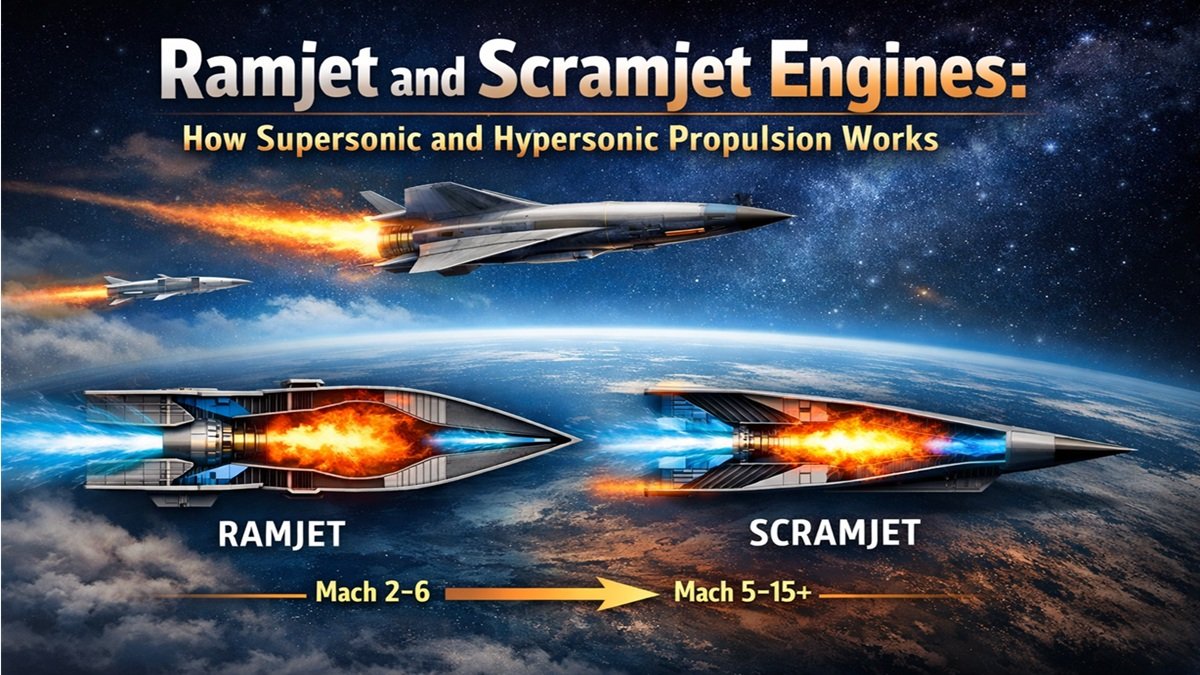
A ramjet is a jet engine that has no moving parts. It relies entirely on the forward speed of the aircraft to compress incoming air before combustion.
Key Principle
“Ram” compression occurs when high-speed airflow is forced into the engine inlet, increasing pressure naturally.
Main Components
- Inlet (Diffuser) – Slows and compresses incoming supersonic air
- Combustion Chamber – Fuel is injected and burned
- Nozzle – Expands exhaust gases to produce thrust
How a Ramjet Engine Works
- Air enters the inlet at supersonic speed
- The inlet slows air to subsonic speed
- Fuel (usually hydrocarbon) is injected
- Combustion occurs at high pressure
- Hot gases exit through the nozzle, producing thrust
⚠️ Important Limitation:
A ramjet cannot operate at zero or low speed. It must be boosted to high speed using:
- Rockets
- Turbojets
- Aircraft launch
Performance Characteristics of Ramjets
| Parameter | Typical Value |
|---|---|
| Operating Speed | Mach 2 to Mach 6 |
| Combustion Speed | Subsonic |
| Moving Parts | None |
| Efficiency | High at supersonic speeds |
Scramjet Engine: Supersonic Combustion
What Is a Scramjet?
A scramjet (Supersonic Combustion Ramjet) is an advanced version of the ramjet where combustion occurs at supersonic speed.
This makes scramjets suitable for hypersonic flight (Mach 5 and above).
How a Scramjet Engine Works
Unlike ramjets, scramjets do not slow incoming air to subsonic speed.
Working Steps
- Hypersonic air enters the inlet
- Air remains supersonic throughout the engine
- Hydrogen fuel is injected
- Combustion occurs in milliseconds
- Exhaust produces extreme thrust
🔥 Combustion happens in less than 1 millisecond, making control extremely difficult.
Key Differences: Ramjet vs Scramjet
| Feature | Ramjet | Scramjet |
|---|---|---|
| Combustion Speed | Subsonic | Supersonic |
| Speed Range | Mach 2–6 | Mach 5–15+ |
| Engine Complexity | Lower | Extremely High |
| Fuel | Kerosene / Hydrocarbon | Hydrogen |
| Cooling Requirement | Moderate | Extreme |
Why Scramjets Are So Difficult to Build
Scramjets face several engineering challenges:
1. Extreme Temperatures
- Skin temperature can exceed 2,000°C
- Requires advanced materials like ceramics and carbon composites
2. Combustion Stability
- Air moves faster than flame propagation
- Fuel mixing must be ultra-fast
3. Structural Integrity
- Hypersonic shockwaves stress the airframe
- Engine often integrated into the vehicle body
Other Related High-Speed Propulsion Systems
1. Turbojet
- Uses compressors and turbines
- Effective up to Mach 2.5–3
2. Rocket Engine
- Carries both fuel and oxidizer
- Works in space and atmosphere
- Extremely fuel-intensive
3. Combined Cycle Engines
These engines combine multiple propulsion modes:
- Turbojet → Ramjet → Scramjet
- Known as TBCC (Turbine-Based Combined Cycle)
Military and Space Applications
Military Uses
- Hypersonic cruise missiles
- Rapid global strike weapons
- Missile defense evasion
Space Access
- Hypersonic spaceplanes
- Reduced launch cost
- Reusable launch systems
Advantages of Ramjet and Scramjet Engines
✔ No heavy compressors or turbines
✔ High efficiency at extreme speeds
✔ Lower fuel mass than rockets
✔ Ideal for long-range hypersonic flight
Limitations and Challenges
✖ Cannot take off from rest
✖ Requires booster systems
✖ Extreme material requirements
✖ Very complex control systems
Future of Hypersonic Propulsion
Research is ongoing in:
- Reusable hypersonic vehicles
- Single-Stage-to-Orbit (SSTO) concepts
- Advanced fuels and cooling techniques
Scramjet technology is expected to play a major role in:
- Next-generation space access
- Ultra-fast global travel
- Advanced defense systems
Read This: Hypersonic, Ballistic, and Cruise Missiles: Which is More Lethal?
Conclusion
Ramjet and scramjet engines represent a paradigm shift in propulsion technology. While ramjets dominate supersonic flight, scramjets open the door to true hypersonic travel. Although engineering challenges remain immense, continued research is rapidly pushing the boundaries of what is possible.
These engines are not just theoretical concepts—they are the foundation of the future of aerospace and defense technology.
