
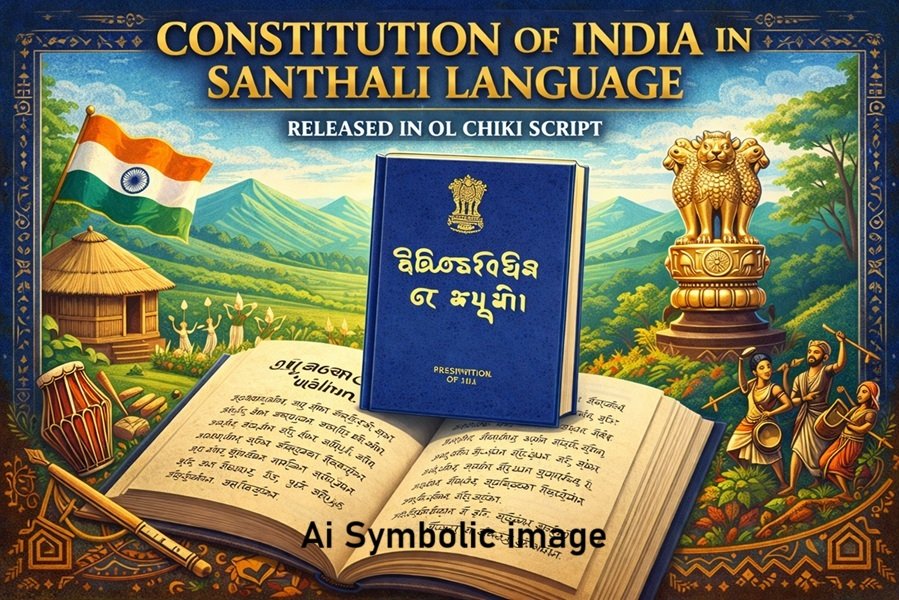
President of India Releases the Constitution of India in the Santhali Language
On 25 December 2025, a historic and culturally significant event took place at Rashtrapati Bhavan, where the President of India, Smt Droupadi Murmu, formally released the Constitution of India in the Santhali language written in the Ol Chiki script. This milestone marks a remarkable achievement in making India’s foundational legal document accessible to one of its ancient tribal communities in their native script and language—a development resonating with the core ethos of linguistic diversity and cultural inclusion enshrined in the Indian Constitution. (Press Information Bureau)
A Celebration of Cultural Identity and Linguistic Inclusion
The release of the Constitution in Santhali holds deep symbolic and practical importance for the Santhali-speaking tribal population, which is spread across states such as Jharkhand, Odisha, West Bengal, and Bihar. For these communities, gaining a version of the Constitution in their language means not only having legal content translated but making the spirit and values of Indian democracy truly comprehensible in their own cultural context. (Press Information Bureau)
During the release ceremony, President Murmu emphasized that this development brings “pride and joy for all Santhali people.” She observed that when people read and engage with the Constitution in their mother tongue, it fosters a deeper understanding of their rights, duties, and the democratic framework that governs the nation. (Press Information Bureau)
The Ol Chiki Script and Its Centennial Celebration
This year also marks the centenary of the Ol Chiki script, which was specifically developed for the Santhali language in the early 20th century. The President highlighted the significance of this anniversary, noting that the timing of the Constitution’s release in Ol Chiki adds to the celebration of the script’s 100 years. (Press Information Bureau)
The Ol Chiki script—distinct in its alphabet and design—was created to provide a dedicated writing system for Santhali, which previously relied on oral traditions and multiple borrowed scripts. Its centenary is not merely a historical milestone but a testament to the sustained efforts of Santhali speakers and scholars to preserve and elevate their linguistic heritage. (Press Information Bureau)
Dignitaries and Their Presence
Several dignitaries attended the event, reflecting its importance on both cultural and national levels. The Vice President of India, Shri C. P. Radhakrishnan, was present, alongside Shri Arjun Ram Meghwal, the Union Minister of State for Law and Justice. Their presence underscored the government’s commitment to promoting linguistic diversity and ensuring constitutional awareness reaches all segments of Indian society. (Press Information Bureau)
Santhali Language’s Constitutional Journey
Santhali holds a special place among India’s tribal languages. It was included in the Eighth Schedule of the Constitution through the 92nd Amendment Act, 2003, a legislative recognition that affirmed its status as one of India’s scheduled languages. This inclusion enabled official usage and preservation efforts at the national level. (Press Information Bureau)
However, inclusion in the Schedule and having the Constitution available in one’s language are distinct achievements. The availability of the Constitution in Santhali now removes language barriers to legal comprehension and empowers Santhali-speaking citizens to engage with the Constitution directly. (Press Information Bureau)
Why This Release Matters
Making the Constitution available in Santhali is far more than a symbolic exercise—it contributes to legal empowerment, increased political participation, and strengthened cultural identity for a community with deep roots in India’s soil. India is home to hundreds of languages and dialects; ensuring that a constitutional document as paramount as this one is accessible in Santhali sets an example for further translations into other indigenous languages. (Press Information Bureau)
This effort aligns with the vision of a truly inclusive Republic, where citizens—regardless of linguistic background—can understand the rights guaranteed to them and the obligations they hold as part of the Indian democratic fabric. (Press Information Bureau)
Looking Ahead
The translation and release of the Constitution in Santhali may serve as a catalyst for further linguistic preservation initiatives and elevate the visibility of tribal languages in educational curricula, legal systems, and public discourse. For many tribal communities, this development represents the recognition of identity, dignity, and equal participation in national life.
Conclusion
The release of the Constitution of India in the Santhali language signifies a milestone in India’s journey toward linguistic inclusivity and constitutional awareness. Through the leadership of President Smt Droupadi Murmu and the support of key government officials and institutions, this historic step ensures that one more linguistic community can access the foundational document of India’s democracy in their language and script—strengthening the democratic principles of equality and cultural respect. (Press Information Bureau)
Reference
- “President of India Releases the Constitution of India in the Santhali Language,” Press Information Bureau, Government of India, 25 December 2025. (Press Information Bureau)
