
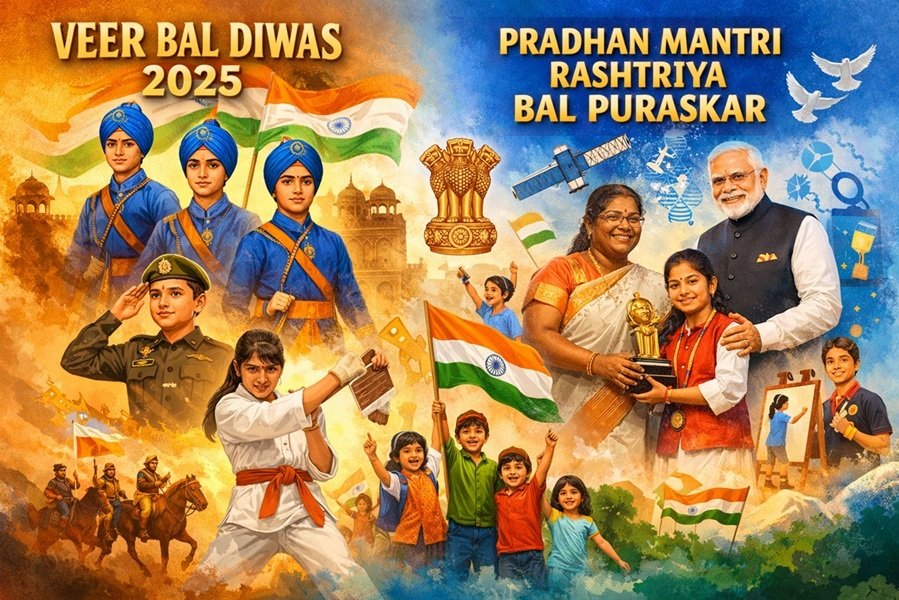
Pradhan Mantri Rashtriya Bal Puraskar: India’s Highest Civil Honour for Children
Introduction
Children are the foundation of a nation’s future, and when young minds display extraordinary courage, creativity, compassion, and excellence, it becomes the responsibility of the nation to recognise and nurture such talent. The Pradhan Mantri Rashtriya Bal Puraskar (PMRBP) is India’s highest national honour dedicated exclusively to children who demonstrate exceptional achievements across diverse fields.
Instituted by the Government of India and administered by the Ministry of Women and Child Development, the award celebrates children who rise above limitations and inspire society through their bravery, innovation, and service.
What is Pradhan Mantri Rashtriya Bal Puraskar?
The Pradhan Mantri Rashtriya Bal Puraskar is a prestigious civilian award conferred annually on children of India for outstanding contributions in specific domains that reflect courage, talent, social responsibility, and intellectual excellence.
It represents a shift from merely recognising academic success to celebrating real-world impact created by children, reinforcing the idea that age is not a barrier to leadership or nation-building.
Evolution and Purpose of the Award
Earlier known as the National Child Award, the honour was restructured and renamed as Pradhan Mantri Rashtriya Bal Puraskar to:
- Broaden the scope of recognition
- Encourage holistic excellence among children
- Align child achievements with national priorities such as innovation, environment, and social service
The award aims to:
- Inspire children to pursue excellence with integrity
- Promote role models among peers
- Recognise courage, creativity, and compassion at a young age
- Strengthen the culture of innovation and service
Eligibility Criteria
To be eligible for the Pradhan Mantri Rashtriya Bal Puraskar, a child must:
- Be an Indian citizen
- Be below 18 years of age as on the qualifying date
- Have demonstrated exceptional achievement at national or international level
- Exhibit qualities of leadership, courage, creativity, or service
The selection process is rigorous, transparent, and merit-based.
Categories of Pradhan Mantri Rashtriya Bal Puraskar
The award is conferred in six broad categories, reflecting the diverse potential of India’s children.
1. Bravery
This category recognises children who have shown extraordinary courage, often risking their own lives to save others or confronting dangerous situations with remarkable presence of mind.
Examples include:
- Saving lives during accidents or disasters
- Standing up against social evils
- Demonstrating moral courage in difficult circumstances
2. Art & Culture
Children who excel in preserving, promoting, or innovating India’s rich cultural heritage are recognised under this category.
Includes achievements in:
- Classical and folk arts
- Music, dance, theatre, and visual arts
- Literature and creative expression
3. Environment
This category honours young environmental champions who contribute towards sustainability and ecological protection.
Recognised efforts include:
- Conservation initiatives
- Climate action and awareness campaigns
- Waste management and biodiversity protection
4. Social Service
Children who work selflessly for the welfare of society, especially marginalised communities, are honoured under this category.
Areas include:
- Education and literacy initiatives
- Child rights advocacy
- Community service and social reform
5. Science & Technology
This category celebrates young innovators whose ideas and inventions contribute to scientific progress or solve real-world problems.
Includes:
- Innovations and research projects
- Technological solutions for social challenges
- Excellence in STEM fields
6. Sports
Young athletes who bring pride to the nation through outstanding performance in sports are recognised under this category.
Covers:
- National and international sporting achievements
- Excellence, discipline, and sportsmanship
Selection Process
The selection process of PMRBP is comprehensive and transparent:
- Online nominations invited from across the country
- Screening and verification of achievements
- Multi-level evaluation by expert committees
- Final approval by the Government of India
This ensures that only the most deserving candidates are honoured.
Award Ceremony and Recognition
The Pradhan Mantri Rashtriya Bal Puraskar is conferred during a formal ceremony in New Delhi, usually around December each year.
Key Features of the Ceremony
- Awards are presented by the President of India
- Venue: Vigyan Bhawan, New Delhi
- Attendance by senior government officials, educators, parents, and children
Awardees receive:
- A medal
- A certificate
- National recognition and visibility
PMRBP 2025: A Snapshot
In 2025, the Government of India selected 20 children from 18 States and Union Territories for the Pradhan Mantri Rashtriya Bal Puraskar, highlighting the vast geographical and cultural diversity of talent in the country.
These awardees represent excellence across all categories and serve as role models for millions of children nationwide.
Role of the Ministry of Women and Child Development
The Ministry of Women and Child Development (MWCD) plays a pivotal role in:
- Policy formulation related to child welfare
- Organising the PMRBP process and ceremony
- Promoting child-centric development initiatives
Through PMRBP, the ministry reinforces its commitment to nurturing confident, capable, and compassionate citizens.
Importance of PMRBP in Nation-Building
The Pradhan Mantri Rashtriya Bal Puraskar contributes significantly to India’s long-term development vision by:
- Encouraging leadership from a young age
- Promoting innovation and scientific thinking
- Strengthening values such as courage, service, and responsibility
- Supporting the vision of Viksit Bharat@2047
Children recognised through PMRBP become ambassadors of positive change and inspiration.
Conclusion
The Pradhan Mantri Rashtriya Bal Puraskar is more than an award—it is a national affirmation of faith in the potential of India’s children. By recognising bravery, talent, compassion, and innovation at an early age, India sends a powerful message that every child can be a change-maker.
As the nation marches towards a developed future, these young achievers stand as symbols of hope, resilience, and limitless possibility.
