
Payment Banks in India – Meaning, Features, and Complete Guide
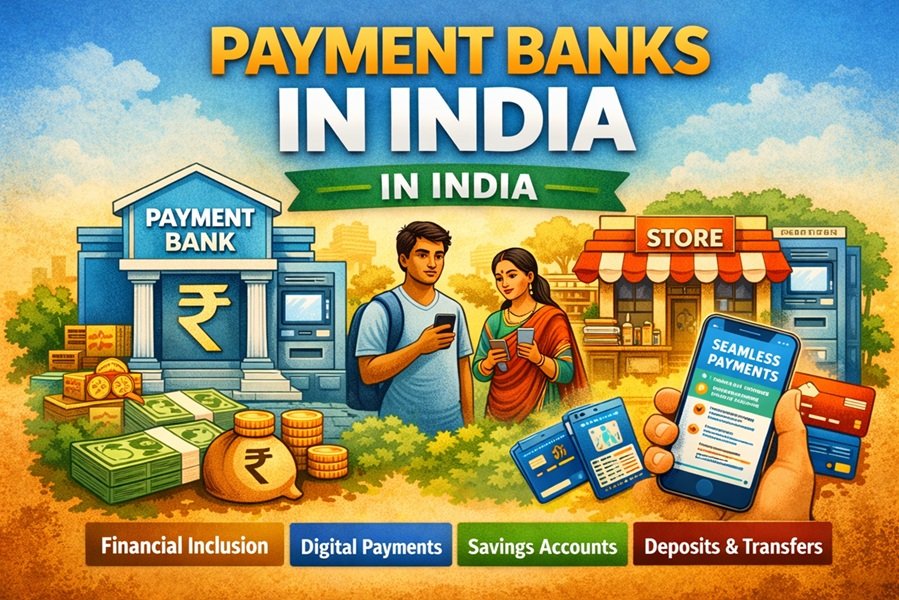
Payment Banks are a unique type of banks in India introduced by the Reserve Bank of India (RBI) with the aim of providing basic banking and digital payment services to the masses. These banks mainly focus on facilitating small savings accounts and smooth remittance services rather than traditional lending operations.
The concept of Payment Banks is a major step toward building a cashless and digitally empowered India.
What is a Payment Bank?
A Payment Bank is a differentiated bank that can perform the following activities:
- Accept deposits
- Provide payment and remittance services
- Issue ATM / Debit Cards
- Offer internet and mobile banking
- Facilitate UPI, NEFT, IMPS transactions
However, Payment Banks are not allowed to issue loans or credit cards.
Their structure is designed for people who need simple, low-cost, and fast banking services.
Read This: Small Finance Banks in India – Meaning, Role, and Complete Guide
Why Were Payment Banks Introduced?
Before Payment Banks:
- A large population had no access to formal banking
- Migrant workers faced problems sending money home
- Digital payments infrastructure was limited
To solve these issues, RBI launched Payment Banks to target:
- Small income households
- Migrant laborers
- Students
- Small shopkeepers
- Rural and semi-urban population
As you run a multi-niche platform like bharatarticles.com, this banking reform fits perfectly into your economics and fintech categories.
RBI Guidelines for Payment Banks
Payment Banks operate under specific RBI norms.
Minimum Capital Requirement
- Minimum paid-up capital: ₹100 crore
Deposit Limit
- Maximum balance per customer: ₹2 lakh (as per current RBI limit)
CRR and SLR
- They must maintain CRR like other banks
- A major part of deposits must be invested in government securities
Promoters
Allowed promoters include:
- Telecom companies
- Pre-paid card issuers
- Fintech firms
- NBFCs
- Corporate houses
Key Features of Payment Banks
Let’s understand their main characteristics:
1. No Lending Activity
- Cannot provide any kind of loans
- Cannot issue credit cards
2. Focus on Deposits and Transactions
- Mainly savings accounts
- High volume – low value transactions
3. Digital-First Model
Most Payment Banks rely heavily on:
- Mobile applications
- UPI payments
- Wallet integration
- Minimal physical branches
4. Easy Account Opening
- Simplified KYC
- Paperless onboarding
- Fast activation
List of Payment Banks in India (2025-26)
Currently operating major Payment Banks are:
- Airtel Payments Bank
- India Post Payments Bank (IPPB)
- Paytm Payments Bank*
- Jio Payments Bank
- NSDL Payments Bank
- Fino Payments Bank
*Paytm Payments Bank operations have faced restrictions in recent years, but it still remains part of the Payment Bank framework conceptually.
What Services Do Payment Banks Offer?
Payment Banks provide limited but highly useful services:
- Savings Account
- Current Account (small businesses)
- Domestic Remittances
- Bill Payments
- Recharge Services
- FASTag
- Insurance distribution
- Mutual fund distribution in some cases
- Government scheme DBT facilitation
What They Cannot Offer
- Business loans
- Personal loans
- Overdraft facility
- Credit cards
Difference Between Payment Banks and Small Finance Banks
Since you asked earlier about Small Finance Banks, here is a quick comparison:
| Basis | Payment Bank | Small Finance Bank |
|---|---|---|
| Objective | Payments & Remittance | Inclusion + Lending |
| Deposits | Allowed | Allowed |
| Loans | NOT allowed | Allowed |
| PSL norms | Not applicable | 75% mandatory |
| Deposit limit | ₹2 lakh | No such limit |
| Credit cards | Not allowed | Mostly not issued |
| Target users | Digital payments users | MSME and rural borrowers |
Are Payment Banks Safe?
Yes.
- They are regulated by RBI
- Follow banking-grade security
- Deposits are insured under DICGC up to ₹5 lakh
- Subject to audits and compliance norms
So from a customer perspective, they are as safe as any scheduled bank for deposits.
Benefits of Payment Banks
Payment Banks deliver many advantages:
A. Faster Money Transfer
- Instant remittance
- Easy for migrant workers
B. Boost to Cashless Economy
- Encourage digital transactions
- Promote UPI adoption
C. Low-Cost Banking
- Almost zero fees
- Simple products
D. Rural Reach
- Banking access in villages
- Support to government DBT transfers
Challenges Faced by Payment Banks
Payment Banks also face limitations like:
- Low profitability due to no lending
- Heavy dependence on transaction income
- Regulatory restrictions
- Competition from wallets and neo-banking apps
Future of Payment Banks in India
Payment Banks are expected to grow as:
- Digital payments expand
- Smartphone penetration increases
- Government services become online
- Rural fintech ecosystem strengthens
They may collaborate more with:
- Universal banks
- NBFCs
- E-governance platforms
But their core identity will remain—facilitators of payments, not lenders.
Conclusion
Payment Banks are one of the most innovative banking models of modern India. They act as the backbone of everyday digital financial services.
While they do not replace traditional banks, they perfectly complement them by providing:
- Last-mile connectivity
- Seamless payment infrastructure
- Financial inclusion through technology
FAQs on Payment Banks
Q1: Can Payment Banks accept fixed deposits?
A: Yes, they can accept FD and savings deposits.
Q2: What is the maximum deposit limit?
A: ₹2 lakh per customer.
Q3: Can Payment Banks give loans?
A: No, lending is not permitted.
Q4: Do Payment Banks issue debit cards?
A: Yes, ATM/debit cards are allowed.
Q5: Which form is used for registration amendment?
A: Amendments are filed through RBI/GST as applicable.
