
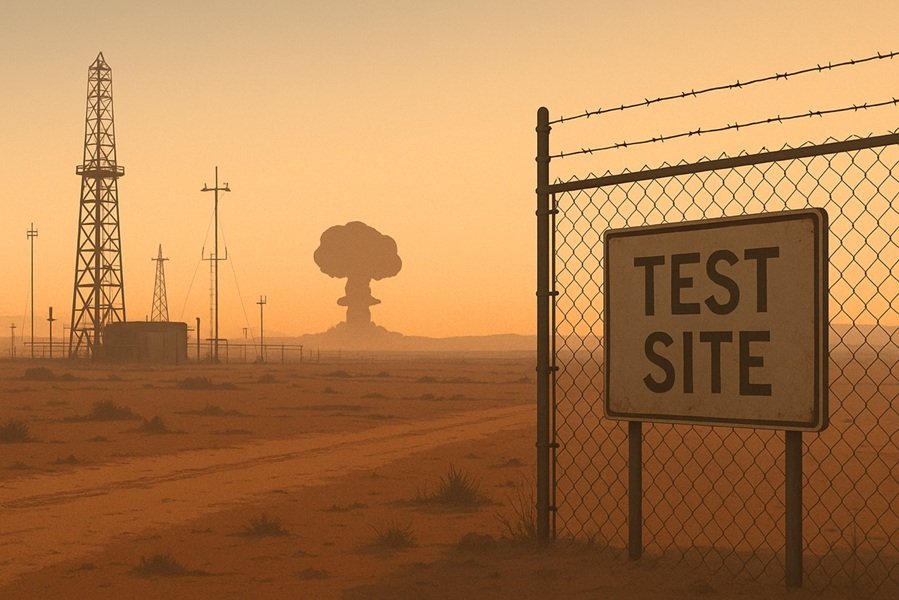
Nuclear Weapons Testing: History, Science, Effects, Treaties, and Modern Concerns
Introduction
Nuclear weapons testing — the deliberate detonation of nuclear devices to evaluate design, yield, delivery, or effects — changed modern warfare, geopolitics, science, public health, and the environment. From the first test in 1945 to thousands of subsequent detonations, tests have left scientific knowledge and profound human and ecological scars. This article explains the technical categories of tests, traces the historical arc, lists major sites and milestones, assesses health and environmental impacts, summarizes arms-control efforts and verification technologies, and reviews contemporary developments and risks. Where helpful, primary sources and respected research organizations are cited.
What is a “nuclear test”?
A nuclear test is any deliberate detonation of a nuclear explosive device for military, scientific, or technological purposes. Tests can be conducted in different environments and for different objectives:
- Atmospheric tests — detonations above ground, on towers, at surface level, or in the air; produce large visible mushroom clouds and widespread fallout.
- Underground tests — detonations in tunnels or shafts; became the preferred method after international pressure reduced atmospheric testing.
- Underwater tests — detonate devices in or under the sea; create unique shock and contamination hazards.
- Exo-atmospheric/space tests — detonations at high altitude or in space; produce electromagnetic pulse effects and ionospheric disturbances.
Each environment produces different measurement challenges and environmental consequences.
How many nuclear tests have been conducted?
Over the historical period since 1945, states conducted thousands of tests to develop and validate nuclear weapons. Authoritative tallies place the worldwide total of nuclear tests at roughly 2,000–2,200 detonations, involving additional sub-devices and variations in counting methods (e.g., some multi-device events counted separately). For example, detailed tallies list the United States with over 1,000 tests and the Soviet Union/Russia with over 700 tests. These counts document both atmospheric and underground tests and remain foundational to understanding testing’s global footprint. (Arms Control Association)
Major milestones and iconic tests
- Trinity (USA), July 16, 1945 — the first nuclear detonation, a plutonium implosion device, conducted in New Mexico; ushered in the atomic age.
- Hiroshima & Nagasaki (1945) — wartime combat use of nuclear weapons (not tests but central to their history).
- Tsar Bomba (USSR), October 30, 1961 — the largest nuclear device ever detonated; estimated yield ~50 megatons and detonated above Novaya Zemlya. Tsar Bomba remains the single most powerful nuclear test in history and demonstrates the theoretical upper limits of high-yield thermonuclear design. (Wikipedia)
- Extensive test series — the U.S., USSR/Russia, France, the U.K., and China carried out hundreds of tests during the Cold War; India, Pakistan, and North Korea conducted later, smaller test programs with political and regional implications. (Wikipedia)
Where were tests conducted? — Major test sites
Some of the most significant testing locations include:
- Nevada Test Site / Nevada National Security Site (USA) — continental U.S. underground and atmospheric tests. (Arms Control Association)
- Bikini and Enewetak Atolls (Marshall Islands, USA tests) — extensive Pacific atmospheric and underwater testing with severe local impacts. (Wikipedia)
- Novaya Zemlya (Soviet Union) — site of many Soviet atmospheric and underground tests, including Tsar Bomba. (Atomic Archive)
- Semipalatinsk (Kazakhstan, Soviet tests) — major land-based Soviet test range with serious health legacies. (Wikipedia)
- Reggane & Tam-Tamy (Algeria), Mururoa & Fangataufa (French Pacific sites) — venues for French tests with regional controversy. (Atomic Archive)
These test ranges were chosen for perceived remoteness or political control, but many tests produced fallout that crossed borders and affected local populations for decades.
Scientific objectives of testing
Nuclear tests historically served multiple technical and military purposes:
- Proof-of-concept and yield measurement — confirm that designs perform as predicted and measure explosive yield.
- Weapon reliability and safety — ensure warheads function as intended under environmental and aging conditions.
- Effects testing — study blast, thermal, radiative, and electromagnetic pulse (EMP) impacts on structures, electronics, and human physiology.
- Weapons physics research — better understand fusion and fission stages, tamper designs, and isotope production.
- Earth-penetrator and “weaponeering” studies — for delivery strategies and specialized warheads.
As simulation and subcritical testing capabilities improved, many technical goals shifted from full-yield explosions to laboratory and computational testing.
Human health and environmental consequences
Nuclear testing left measurable public-health and environmental legacies:
- Radioactive fallout from atmospheric tests dispersed isotopes such as strontium-90 and cesium-137, contaminating soils, food chains, and human bodies.
- Local long-term health effects include elevated cancer rates and birth defects documented in some exposed populations (e.g., Pacific islanders, Semipalatinsk region residents, downwind communities).
- Environmental damage — destroyed ecosystems on atoll islands, persistent contamination, and long recovery times for flora and fauna.
- Psychosocial and socioeconomic harm — displacement of communities, loss of livelihoods, and intergenerational trauma.
Public health studies and compensation programs in several countries have tried to address these harms, but remediation and full restitution remain incomplete in many areas. (See section on remediation and compensation below.) (Wikipedia)
Arms control: moratoria, treaties, and the CTBT
Global concern over the humanitarian and environmental impact of testing led to major arms-control efforts:
- Partial Test Ban Treaty (PTBT), 1963 — prohibited nuclear tests in the atmosphere, outer space, and underwater but allowed underground tests; reduced atmospheric fallout.
- Comprehensive Nuclear-Test-Ban Treaty (CTBT), 1996 — aims to ban all nuclear explosions in all environments. The CTBT has been signed and ratified by many states and its verification body (CTBTO Preparatory Commission) operates a global monitoring system, but the treaty has not entered into force because a subset of Annex-2 states have not completed the required ratifications. As of the latest public records, several key states (including the United States, China, India, Pakistan, North Korea, Israel, Egypt, Iran, and others in differing categories) have outstanding signature/ratification steps, which prevents formal entry into force. The CTBTO does, however, maintain an active global monitoring and verification network. (Wikipedia)
Verification technologies and the global monitoring system
Even where treaties are not in force, a robust technical verification regime exists:
- Seismic monitoring — worldwide networks detect underground tests by their seismic signatures; yields and depths are estimated from waveform analysis.
- Infrasound stations — detect low-frequency acoustic waves from atmospheric detonations.
- Hydroacoustic monitoring — sensors in oceans detect underwater detonations.
- Radionuclide stations — collect air samples to identify radioactive particles and noble gases (e.g., xenon isotopes) that indicate a nuclear explosion.
- On-site inspections (if treaty provisions allow) — the CTBT includes mechanisms for inspection to resolve ambiguous events.
These complementary methods give the international community sophisticated tools to detect and attribute nuclear tests even when states attempt concealment.
Transition from explosive tests to alternatives
Since the early 1990s, major nuclear powers implemented moratoria on explosive testing and shifted to:
- Subcritical tests — experiments that involve nuclear materials but do not produce a self-sustaining chain reaction or yield; used for materials science and stewardship without a nuclear explosion.
- High-fidelity simulation and supercomputing — computational models paired with past test data to predict weapon performance.
- Non-explosive component testing and laboratory experiments — validate parts of weapons systems without detonations.
These alternatives preserve technical competence while avoiding full-yield detonations, though some policymakers and analysts debate whether simulation alone can fully substitute for real-world explosive tests.
Contemporary geopolitics and renewed concerns (2023–2025)
Although large-scale testing ceased among most nuclear states in the late 20th century, the last several years have seen geopolitical developments that raised fresh concerns about the possibility of resumed explosive testing:
- Russia revoked its CTBT ratification in recent years and strategic competition has revived rhetoric about testing; this has complicated norms around test moratoria. (AP News)
- North Korea has continued to develop its nuclear arsenal and periodically signals readiness for additional tests; intelligence assessments periodically report readiness for further detonations. (Anadolu Ajansı)
- International analysis in late 2025 highlights a renewed debate about testing, verification, and the implications for arms-control stability if any major power resumed explosive testing. The security environment — including concerns about new weapons concepts, advanced delivery systems, and strategic competition — has pushed nuclear testing back onto policy agendas for some states. (IISS)
These developments underscore why a functioning international verification regime and active diplomatic engagement remain essential to prevent a return to open explosive testing.
Remediation, compensation, and justice for affected communities
Several affected regions and communities have sought remediation and compensation:
- Marshall Islands populations experienced displacement and long-term contamination after U.S. Pacific testing; compensation programs and relocation remain contentious. (Wikipedia)
- Kazakhstan’s Semipalatinsk region and other “downwind” communities in former Soviet test areas have campaigned for health monitoring and reparations.
- Evolving legal and humanitarian responses include national compensation schemes, international advocacy, and scientific monitoring programs — though many communities argue remedies remain insufficient.
Environmental remediation and legacy management
Cleanup and management of test sites involve complex challenges:
- Land restriction and exclusion zones around underground test cavities and contaminated soils.
- Radioecology studies to understand transfer of isotopes through food chains and to guide public-health action.
- Long-term monitoring for groundwater contamination and ecological recovery planning.
- Preservation and memorialization in places where communities were displaced.
Cleanup is expensive and technically difficult; some sites remain hazardous for generations.
Policy options and the path forward
Key policy approaches to reduce the risk of resumed testing and mitigate harms include:
- Universalize and bring CTBT into force — encourage remaining Annex-2 states to complete ratification to establish a legal prohibition on explosive testing and strengthen the CTBTO’s inspection authority. (ctbto.org)
- Sustain and expand verification capacity — fully fund and integrate seismic, radionuclide, hydroacoustic, and infrasound networks and data sharing.
- Confidence-building measures — transparency on nuclear doctrine, voluntary notifications, and data exchanges can reduce incentives to test.
- Assistance to affected communities — improved health programs, environmental remediation financing, and legal pathways for compensation.
- Diplomacy and arms control — pursue negotiated limits on new weapons classes and delivery systems that might otherwise create testing pressures.
Stopping a return to explosive testing requires a combination of law, technology, diplomacy, and political will.
Conclusion
Nuclear testing produced immense technical knowledge but also created long-lasting human and ecological costs. The Cold War test legacy is now augmented by a complex, multipolar strategic environment where concerns about resumed testing occasionally flare. Strong international verification, treaty action, and assistance to affected people remain central to preventing a renewed era of explosive tests. At the same time, modern verification science and political engagement give the world tools to detect, deter, and respond to tests — if states choose cooperation over confrontation.
Sources and further reading (selected authoritative references)
- Arms Control Association — The Nuclear Testing Tally (detailed country counts and history). (Arms Control Association)
- CTBTO — Status of Signatures and Ratifications and description of the verification regime. (ctbto.org)
- Britannica / Tsar Bomba — entry on the largest thermonuclear test and technical details. (Encyclopedia Britannica)
- International Institute for Strategic Studies (IISS) analysis — recent commentary on renewed testing concerns (Nov 2025). (IISS)
- Atomic Archive / historical accounts of major test sites (Bikini, Novaya Zemlya, Semipalatinsk). (Atomic Archive)
- AP News — reporting on Russia’s revocation of CTBT ratification and political implications. (AP News)
