
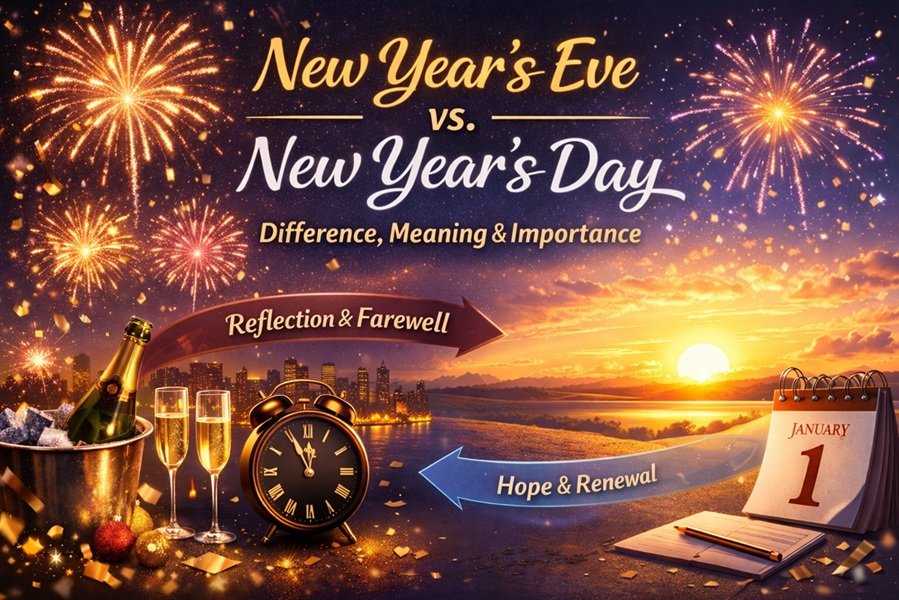
New Year’s Eve vs New Year’s Day: Difference, Meaning and Importance
As the calendar turns, two closely linked yet very different days mark the transition into a new year—New Year’s Eve and New Year’s Day. While both are globally celebrated, they carry distinct meanings, emotions, traditions, and cultural importance. Understanding the difference between these two days helps us appreciate why each holds a special place in human life and societies worldwide.
This article clearly explains the difference, meaning, and importance of New Year’s Eve and New Year’s Day in a simple, factual, and engaging manner.
What Is New Year’s Eve?
New Year’s Eve is celebrated on December 31, the last day of the Gregorian calendar year. It symbolizes closure, reflection, and farewell to the year that has passed.
Meaning of New Year’s Eve
New Year’s Eve represents:
- The end of a year
- Reflection on achievements and failures
- Gratitude for experiences gained
- Emotional closure before a fresh beginning
It is a moment when people pause to look back at their journey—personal, professional, and emotional.
Why Is New Year’s Eve Important?
New Year’s Eve holds importance because:
- It marks the final hours of the year
- People mentally prepare for change
- It encourages reflection and accountability
- It strengthens social bonds through celebrations
Globally, New Year’s Eve is associated with countdowns, fireworks, parties, music, prayers, and family gatherings.
Read This: New Year’s Eve Captions for Instagram & WhatsApp Status
What Is New Year’s Day?
New Year’s Day is celebrated on January 1, the first day of the new calendar year. It represents new beginnings, hope, and renewal.
Meaning of New Year’s Day
New Year’s Day symbolizes:
- A fresh start
- New goals and resolutions
- Hope, optimism, and positivity
- Renewal of personal purpose
It is the day when people officially step into a new phase of life with fresh energy.
Why Is New Year’s Day Important?
New Year’s Day is important because:
- It marks the beginning of a new calendar year
- It is a public holiday in many countries
- People set goals and resolutions
- It promotes optimism and motivation
For many cultures, New Year’s Day is also associated with religious prayers, family meals, charity, and cultural rituals.
New Year’s Eve vs New Year’s Day: Key Differences
| Aspect | New Year’s Eve | New Year’s Day |
|---|---|---|
| Date | December 31 | January 1 |
| Significance | End of the old year | Beginning of the new year |
| Emotional Tone | Reflection, farewell | Hope, renewal |
| Activities | Parties, countdowns, fireworks | Family time, rest, resolutions |
| Focus | Looking back | Looking forward |
| Symbolism | Closure | Fresh start |
Cultural Importance Across the World
New Year’s Eve Traditions
- Fireworks at midnight
- Countdown celebrations
- Music, dance, and gatherings
- Making last wishes of the year
- Symbolic goodbyes
New Year’s Day Traditions
- Making New Year resolutions
- Visiting temples, churches, or mosques
- Spending time with family
- Starting new ventures
- Offering charity and gratitude
Both days together create a bridge between the past and the future, making the transition meaningful rather than sudden.
Psychological and Emotional Importance
From a psychological perspective:
- New Year’s Eve helps people achieve emotional closure
- New Year’s Day boosts motivation and hope
This transition allows the human mind to reset goals, reflect on lessons, and move forward with clarity.
Why Both Days Matter Equally
While New Year’s Eve is about ending, New Year’s Day is about beginning. One cannot exist meaningfully without the other.
- New Year’s Eve teaches us gratitude and learning
- New Year’s Day encourages growth and optimism
Together, they symbolize the cycle of life—endings leading to new beginnings.
Final Thoughts
The difference between New Year’s Eve and New Year’s Day goes far beyond dates on a calendar. One closes a chapter; the other opens a new one. Celebrating both thoughtfully allows us to honor our past while embracing our future.
As one year ends and another begins, these two days remind us that every ending carries the promise of a new beginning.
