
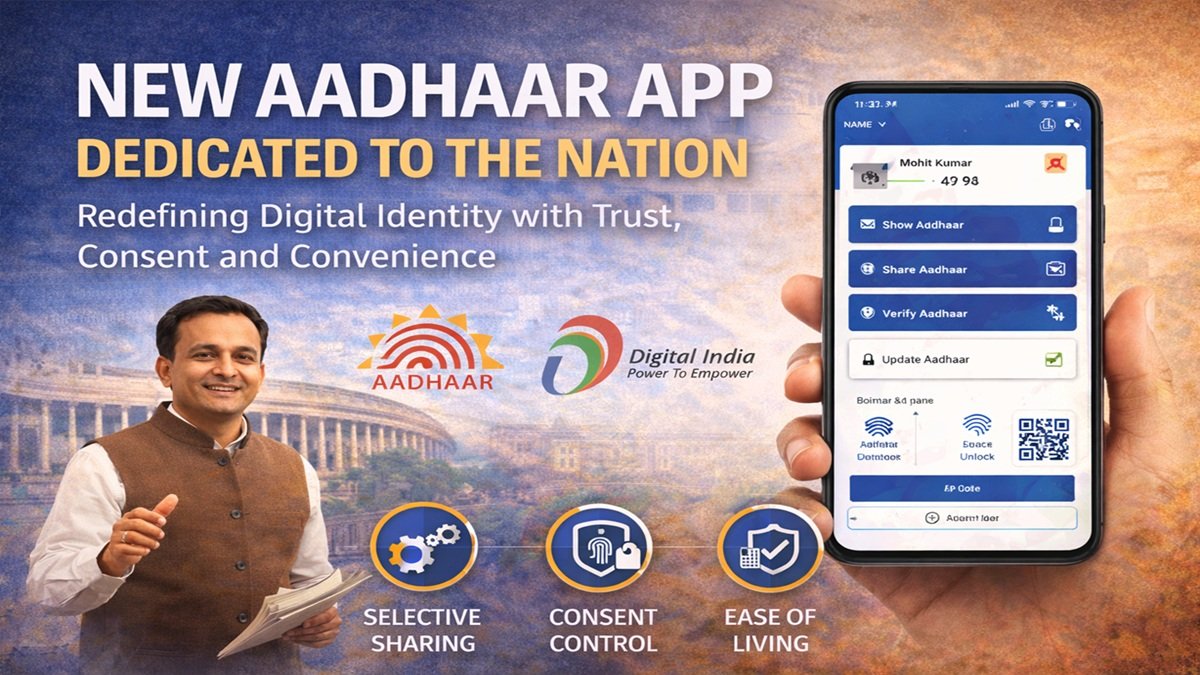
New Aadhaar App Dedicated to the Nation: Redefining Digital Identity with Trust, Consent and Convenience
India has taken another major step in strengthening its digital public infrastructure with the launch of the new Aadhaar App, a next-generation mobile application designed to transform how citizens carry, share, and verify their identity. The app was formally dedicated to the nation by Jitin Prasada, Minister of State for Commerce & Industry and Electronics & Information Technology.
Developed by the Unique Identification Authority of India (UIDAI), the new Aadhaar App places people at the centre of identity verification, with a strong focus on privacy, consent, and ease of living.
A New Vision for Aadhaar-Based Identity Verification
The new Aadhaar App reimagines digital identity as more than a technological tool—it positions it as an instrument of public trust, empowerment, and good governance. At India’s massive scale, UIDAI has recognised that identity systems must be secure, inclusive, and resident-centric.
The app enables Aadhaar Number Holders (ANH) to:
- Carry Aadhaar securely on their mobile device
- Show and share Aadhaar details digitally
- Verify identity without handing over physical documents
- Retain complete control over what data is shared and with whom
Minister’s Remarks: Aadhaar as a Digital Governance Showpiece
After unveiling the application, Jitin Prasada congratulated UIDAI for its innovation and reiterated that Aadhaar continues to be a flagship pillar of India’s digital governance ecosystem.
He noted that UIDAI’s efforts have already made service delivery seamless and hassle-free, and the new Aadhaar App will accelerate this transformation further, making identity verification faster, safer, and more user-friendly.
Privacy-First Design: Control and Consent at Fingertips
Addressing the launch, S. Krishan, Secretary, Ministry of Electronics and Information Technology (MeitY), emphasised that the app is built on the principle of data minimisation.
Key privacy-focused features include:
- Selective sharing of Aadhaar credentials
- Enhanced security mechanisms
- Resident-controlled consent for every transaction
This design ensures that individuals share only what is required, and nothing more.
Wide Range of Real-Life Use Cases
The Aadhaar App is designed for practical, everyday use across sectors. Some prominent use cases include:
- Hotel check-ins using QR code scanning by Offline Verification Seeking Entities (OVSE)
- Optional face verification for proof of presence
- Age verification for cinema ticket bookings
- Hospital admissions for visitors and attendants
- Verification of gig workers and service partners
These use cases significantly reduce paperwork while maintaining trust and security.
Advanced Features for Seamless Identity Management
The new Aadhaar App introduces several advanced functionalities:
- Face verification for digital proof of presence
- Biometric lock/unlock with a single click
- Authentication history view for transparency
- QR-based contact card for easy sharing of contact details
A standout feature is the ability to manage up to five Aadhaar profiles on a single device, promoting the concept of “One Family – One App.”
Simplified Updates and Future Enhancements
In addition to address updates, the app now allows residents to:
- Update their registered mobile number directly through the app
UIDAI has indicated that more Aadhaar update services will be added in future versions, further reducing the need for physical visits to enrolment centres.
UIDAI Leadership on the App’s Vision
Neelkanth Mishra, Chairman, UIDAI, described the app as a significant leap in India’s journey from paper-based to paperless identity systems, reaffirming that UIDAI’s innovation will always remain people-centric.
Bhuvnesh Kumar, CEO, UIDAI, highlighted the app’s most critical feature—selective credential sharing. Through customised QR codes generated by requesting entities, residents can share only specific identity fields required for a particular service.
Importantly:
- Aadhaar numbers are not stored by verifiers
- Only digitally signed, verifiable credentials are shared
- The approach aligns fully with the Digital Personal Data Protection (DPDP) Act
Strengthening India’s Digital Public Infrastructure
With the launch of the new Aadhaar App, India once again reinforces a core principle of its digital strategy: technology must be resident-centric, inclusive, and built on trust.
By combining strong privacy safeguards, intuitive design, and real-world usability, the Aadhaar App sets a new benchmark for digital identity systems globally—demonstrating how large-scale digital governance can empower citizens while protecting their rights.
