
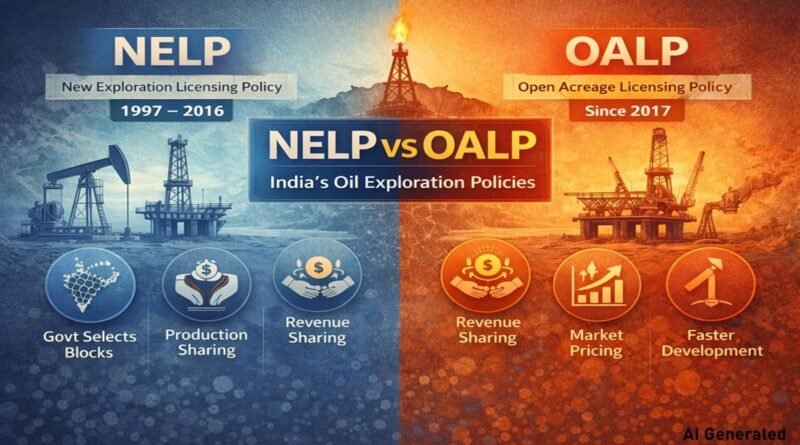
NELP vs OALP: A Detailed Analysis of India’s Oil Exploration Policies
India is the world’s third-largest oil consumer, yet produces only a small portion of its petroleum demand domestically. This heavy import dependence affects energy security, trade deficit, and economic stability. To improve domestic hydrocarbon exploration, the Government of India introduced different policy regimes over time.
Two of the most important upstream exploration frameworks are:
- NELP — New Exploration Licensing Policy (1997–2016)
- OALP — Open Acreage Licensing Policy (2017–Present) under HELP reforms
OALP replaced NELP after nearly two decades because the earlier system failed to significantly boost production or attract sustained investment.
Background: Why India Needed Exploration Reforms
Before 1997, oil exploration in India was dominated by public sector companies like ONGC and Oil India Limited. Private and foreign participation was minimal.
Problems in the pre-reform era:
- Low investment in exploration
- Limited technology access
- Slow discovery of new fields
- Increasing import dependency
To address these issues, India liberalized the sector and introduced NELP.
Read This: Oil Reserves in the World: Distribution, Importance, and Future Outlook
New Exploration Licensing Policy (NELP)
Introduced in 1997, NELP aimed to open India’s upstream hydrocarbon sector to competition and private investment.
Core Idea
Government identified blocks → companies bid → winner got exploration rights.
So companies had to wait for government auctions.
Main Features of NELP
| Feature | Description |
|---|---|
| Contract Type | Production Sharing Contract (PSC) |
| Bidding | Periodic bid rounds (NELP I to IX) |
| Cost Recovery | Companies recover costs before profit sharing |
| Pricing Control | Government influence over gas price |
| Approval Process | Multiple government clearances required |
| Exploration Freedom | Limited |
What is Production Sharing Contract (PSC)?
Under PSC:
- Company invests money to explore oil
- If oil found → company first recovers costs
- Remaining profit shared with government
This created disputes because companies could inflate costs (called gold-plating problem).
Achievements of NELP
Positive outcomes:
- Opened sector to private players
- Brought foreign investment initially
- Expanded exploration acreage
- Some major discoveries (KG Basin)
But long-term results were disappointing.
Major Problems in NELP
1. Cost Recovery Disputes
Government and companies frequently disagreed on:
- What counts as exploration cost
- Whether expenses were justified
This led to arbitration cases and investor uncertainty.
2. Bureaucratic Delays
Companies required approvals for:
- Work plans
- Budgets
- Development plans
Exploration slowed significantly.
3. Waiting for Bidding Rounds
Companies could not explore areas of interest unless government auctioned them.
So investment decisions depended on bureaucracy.
4. Pricing Restrictions
Gas price controls reduced profitability → discouraged investment.
5. Declining Interest
Later bidding rounds saw fewer participants.
Hydrocarbon Exploration and Licensing Policy (HELP) Reform
To solve NELP’s structural problems, India launched HELP in 2016, introducing:
- Revenue Sharing Model
- Marketing and pricing freedom
- Single license for hydrocarbons
- Open Acreage Licensing Policy (OALP)
The biggest shift: government no longer chooses blocks — companies do.
Open Acreage Licensing Policy (OALP)
OALP started in 2017 and transformed exploration from a government-controlled process to an investor-driven system.
Core Idea
Companies select exploration areas anytime using geological data.
This is similar to global best practices used in the US and other mature markets.
How OALP Works
- Government releases National Data Repository (NDR)
- Companies study seismic & geological data
- Companies identify blocks of interest
- Government opens bidding window
- Competitive auction happens
This is called Expression of Interest (EoI) system.
Key Features of OALP
| Feature | Description |
|---|---|
| Contract Type | Revenue Sharing Contract (RSC) |
| Block Selection | By companies |
| Pricing | Market freedom |
| Approval Process | Minimal government interference |
| Coverage | Oil + Gas + CBM + Shale under one license |
| Data Access | National Data Repository |
Revenue Sharing vs Production Sharing
Under NELP (PSC)
Profit shared after cost recovery
→ disputes over costs
Under OALP (RSC)
Revenue shared from beginning
→ no cost auditing
This removed most litigation issues.
Key Differences Between NELP and OALP
| Parameter | NELP | OALP |
|---|---|---|
| Introduced | 1997 | 2017 |
| Block Allocation | Government chooses | Company chooses |
| Contract Type | Production Sharing | Revenue Sharing |
| Cost Recovery | Allowed | Not applicable |
| Pricing | Controlled | Market-linked |
| Bureaucracy | High | Low |
| Investment Attractiveness | Declining | Improved |
| Exploration Speed | Slow | Faster |
| Disputes | Frequent | Minimal |
| Data Access | Limited | Open database |
Why OALP is Considered Better
1. Investor-Driven Exploration
Companies explore areas where they expect hydrocarbons.
2. Reduced Litigation
No cost recovery → no accounting disputes.
3. Faster Development
Less approval → quicker drilling.
4. Market Pricing
Better returns encourage investment.
5. Continuous Bidding
No need to wait for government rounds.
Challenges Still Remaining
Even OALP faces practical hurdles:
- Geological complexity of Indian basins
- Pricing uncertainties in global markets
- Infrastructure limitations
- Environmental clearances
- High import parity pricing issues
So policy reform alone cannot guarantee production growth.
Impact on India’s Energy Security
Under NELP
Production stagnated despite multiple rounds.
Under OALP
Exploration activity increased, especially in:
- Frontier basins
- Deepwater regions
- Small discovered fields
Long-term output impact will depend on discoveries.
Conceptual Understanding (UPSC Perspective)
NELP = Government-controlled exploration regime
OALP = Market-oriented exploration regime
The shift reflects broader economic reform:
From administrative allocation → competitive market framework
Conclusion
NELP was India’s first step toward liberalizing the oil exploration sector, but excessive control, cost recovery disputes, and slow approvals limited its success. OALP, introduced under HELP reforms, replaced it with a transparent, investor-friendly system based on revenue sharing and open acreage access.
The transition marks a significant policy evolution:
- NELP focused on opening the sector
- OALP focuses on efficiency and scalability
Whether India achieves energy independence depends not only on policy design but also on geological discoveries, technology adoption, and global energy economics.
In simple terms:
NELP invited investors
OALP empowers investors
