
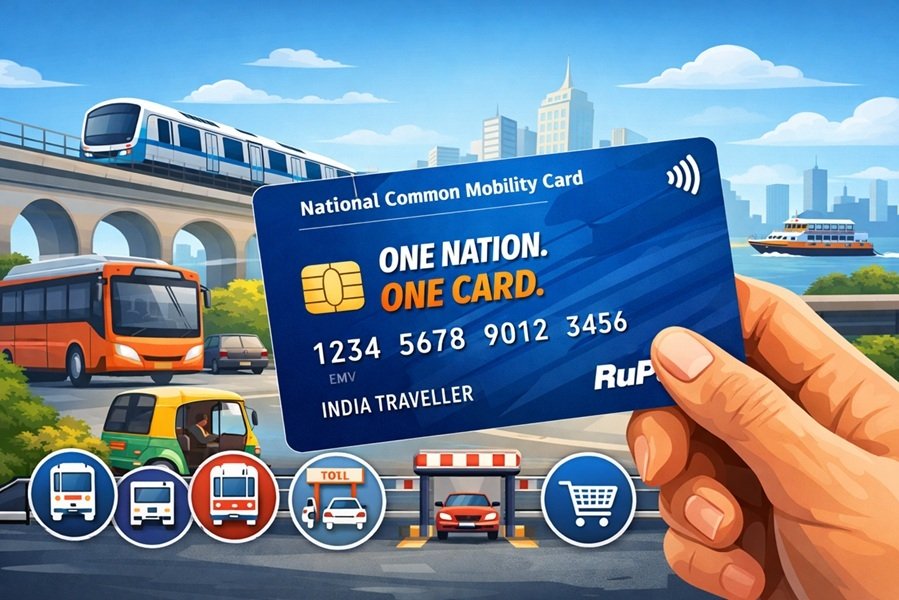
NCMC (National Common Mobility Card): Meaning, Features, Benefits, and Role in India’s Smart Mobility Vision
Introduction
India’s urban mobility landscape is undergoing a major transformation. With rapid urbanisation, rising vehicle ownership, and increasing pressure on public transport systems, the need for seamless, cashless, and integrated travel solutions has become more critical than ever. Addressing this challenge, the Government of India introduced the National Common Mobility Card (NCMC)—a single card designed to enable smooth travel across multiple transport modes and cities.
The NCMC, also popularly known as “One Nation, One Card”, aims to simplify daily commuting, reduce transaction friction, and support India’s broader goals of digital payments, smart cities, and financial inclusion.
What is NCMC (National Common Mobility Card)?
The National Common Mobility Card (NCMC) is an interoperable, contactless payment card that allows users to pay for various transport services using a single card, regardless of the city or mode of transport.
It can be used for:
- Metro rail services
- City buses
- Suburban rail (where enabled)
- Taxis and ferries (future integration)
- Parking facilities
- Toll payments
- Retail purchases (like a regular debit card)
The card is based on RuPay, India’s domestic card payment network, and follows EMV open-loop standards, making it usable beyond transport systems.
Background and Evolution of NCMC
Before NCMC, most Indian cities had closed-loop transit cards, meaning:
- A metro card issued in one city could not be used in another
- Separate cards were needed for buses, metro, parking, and tolls
- Recharging and refund processes were fragmented
To solve these inefficiencies, the idea of a nationwide interoperable mobility card was conceptualised under the guidance of:
- Ministry of Housing and Urban Affairs (MoHUA)
- Ministry of Finance
- Reserve Bank of India (RBI)
- National Payments Corporation of India (NPCI)
The result was the NCMC framework, officially launched to enable uniform fare payment infrastructure across India.
Key Features of the National Common Mobility Card
1. One Card for Multiple Transport Modes
NCMC eliminates the need to carry multiple cards or tokens. A single card can be used across:
- Metro systems
- Public buses
- Parking terminals
- Toll plazas
This interoperability is its biggest strength.
2. Contactless and Fast Transactions
The card uses Near Field Communication (NFC) technology, enabling:
- Tap-and-go payments
- Faster entry and exit at stations
- Reduced queues and congestion
Transactions typically take less than a second, improving commuter experience.
3. Open-Loop Payment System
Unlike closed metro cards, NCMC works as an open-loop card, meaning:
- It can be used at any compatible terminal
- It supports retail purchases, not just transport
- Users can spend the balance like a debit card
4. Issued by Banks (Debit Card Format)
NCMC is issued by participating banks as:
- Debit cards
- Prepaid cards
Users can link it to their bank account, enabling:
- Easy top-ups
- ATM withdrawals (if supported)
- Online and offline spending
5. Offline Transaction Capability
A unique feature of NCMC is offline payment support, which is crucial for:
- Metro gates
- Bus validators
- Areas with poor internet connectivity
This ensures uninterrupted service even during network outages.
How Does NCMC Work?
The NCMC ecosystem includes:
- Issuing banks (provide the card)
- Transit operators (metro, bus corporations)
- NPCI (clearing and settlement)
- Fare collection devices (validators, gates)
Basic Working Flow:
- User taps the NCMC card on a validator
- Fare is deducted instantly (offline/online)
- Transaction is later synced with bank servers
- Settlement happens through NPCI
This design ensures speed, security, and scalability.
Benefits of National Common Mobility Card
Benefits for Commuters
- Single card for daily travel and shopping
- No need to buy separate tickets or cards
- Faster boarding and exits
- Reduced dependency on cash
- Works across multiple cities
Benefits for Transport Authorities
- Lower cash handling costs
- Faster passenger throughput
- Better data analytics for planning
- Reduced card issuance overhead
- Improved transparency in revenue collection
Benefits for the Economy
- Boosts digital payments ecosystem
- Encourages formal financial inclusion
- Supports “One Nation, One Card” vision
- Strengthens India’s indigenous payment infrastructure (RuPay)
Where Is NCMC Currently Used?
NCMC has been implemented or is being rolled out in:
- Metro rail networks (select cities)
- City bus services under smart city projects
- Parking and toll systems (pilot stages)
Adoption is gradual, as transport operators upgrade their Automatic Fare Collection (AFC) systems to be NCMC-compliant.
Challenges in NCMC Implementation
Despite its strong vision, NCMC faces some challenges:
1. Infrastructure Upgrade Costs
Legacy transport systems require significant upgrades to support open-loop payments.
2. Inter-agency Coordination
Multiple stakeholders—banks, state governments, transit agencies—must work in sync.
3. Public Awareness
Many commuters still confuse NCMC with city-specific metro cards.
4. Partial Interoperability
True nationwide interoperability will take time as all cities come onboard.
NCMC and the Smart Cities Mission
The National Common Mobility Card is a core pillar of India’s Smart Cities Mission, supporting:
- Integrated urban transport
- Digital governance
- Data-driven mobility planning
It aligns closely with:
- Digital India
- Make in India
- Atmanirbhar Bharat
By reducing friction in daily travel, NCMC contributes to efficient, sustainable urban living.
Future Scope of NCMC in India
In the coming years, NCMC is expected to:
- Cover all major metro and bus networks
- Integrate suburban rail and regional transport
- Support mobile-based virtual NCMC cards
- Enable multimodal journey planning and payments
- Become the default mobility card for urban India
With wider acceptance, NCMC could evolve into a universal urban services card, extending beyond transport.
Conclusion
The National Common Mobility Card (NCMC) represents a major leap toward seamless, cashless, and integrated mobility in India. By combining transport payments, retail usage, and banking features into a single interoperable card, NCMC simplifies everyday travel while strengthening India’s digital payment ecosystem.
Although challenges remain in terms of infrastructure and adoption, the long-term impact of NCMC is clear—it lays the foundation for a smarter, more connected, and commuter-friendly India.
Below are 15 well-structured FAQs you can directly add at the end of your NCMC (National Common Mobility Card) article.
They are written in simple, exam-friendly and SEO-friendly language, suitable for general readers, competitive exams, and FAQs schema.
Frequently Asked Questions (FAQs) on NCMC (National Common Mobility Card)
1. What is the National Common Mobility Card (NCMC)?
The National Common Mobility Card (NCMC) is an interoperable, contactless payment card that allows users to pay for multiple transport services and retail purchases using a single card across different cities in India.
2. Why is NCMC also called “One Nation, One Card”?
NCMC is called “One Nation, One Card” because it can be used across various transport systems and cities in India, eliminating the need for separate cards for different metros or buses.
3. Which payment network is used for NCMC?
NCMC operates on the RuPay payment network and follows EMV open-loop standards, allowing it to function like a regular debit or prepaid card.
4. Can NCMC be used only for metro travel?
No. While metro travel is a major use case, NCMC can also be used for city buses, parking, toll payments, and retail purchases at enabled locations.
5. Is NCMC a prepaid card or a debit card?
NCMC can be issued as a debit card linked to a bank account or as a prepaid card, depending on the issuing bank.
6. Does NCMC work without internet connectivity?
Yes. NCMC supports offline transactions, which makes it suitable for metro gates and buses where real-time internet connectivity may not be available.
7. Who issues the National Common Mobility Card?
NCMC is issued by participating banks in collaboration with NPCI. Users can obtain it directly from banks offering NCMC-enabled cards.
8. Is NCMC usable across all Indian cities?
Not yet. NCMC is being implemented in phases. It currently works in select metro and bus networks, with nationwide adoption planned gradually.
9. How is NCMC different from traditional metro cards?
Traditional metro cards are city-specific and closed-loop, whereas NCMC is interoperable, open-loop, and usable across cities and services, including retail payments.
10. Can NCMC be used for shopping and non-transport payments?
Yes. Since NCMC is an open-loop RuPay card, it can be used for shopping, dining, and other retail payments at compatible POS terminals.
11. Is NCMC safe and secure to use?
Yes. NCMC uses EMV chip and contactless technology, making transactions secure and reducing the risk of fraud compared to magnetic stripe cards.
12. Can NCMC be recharged or topped up easily?
Yes. NCMC can be recharged through bank accounts, mobile banking apps, ATMs, or other bank-supported channels, depending on the card type.
13. Does NCMC support concessions or discounted fares?
Fare concessions and discounts depend on the policies of individual transport authorities. NCMC provides the payment platform, while fare rules are set by operators.
14. Is NCMC mandatory for public transport users?
No. NCMC is not mandatory. Commuters can continue using existing tickets or city-specific cards where available.
15. What is the future of NCMC in India?
In the future, NCMC is expected to cover all major transport systems, integrate with mobile wallets, and become a unified card for urban mobility and public services.
