
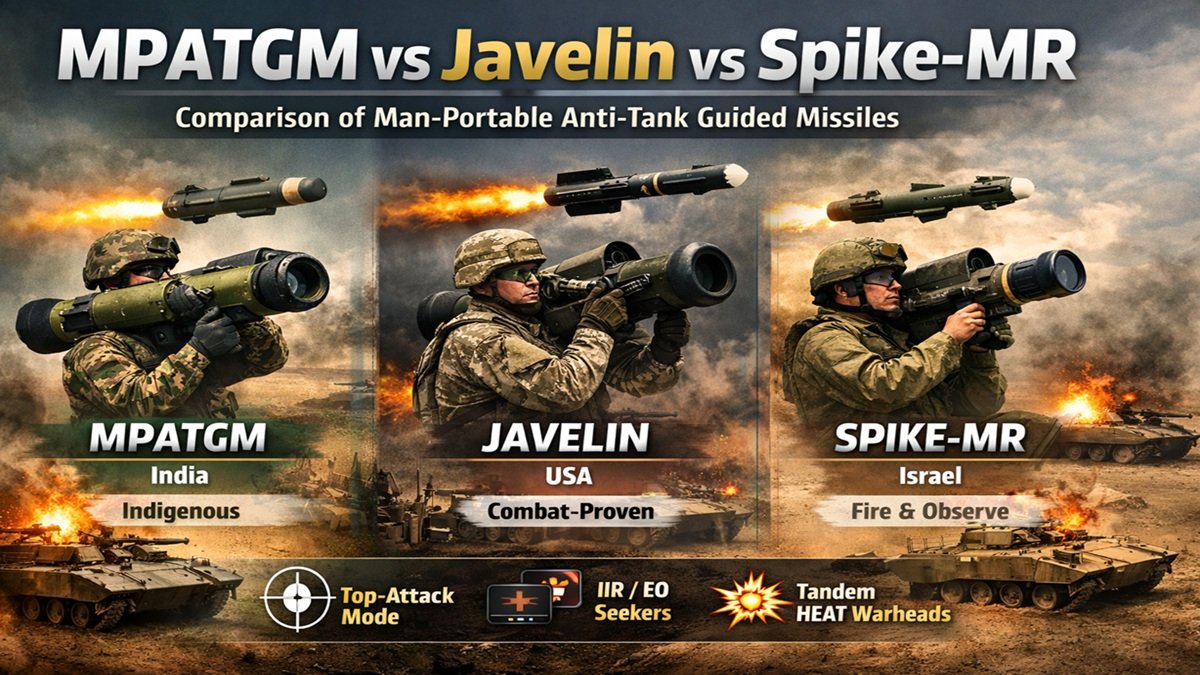
MPATGM vs Javelin vs Spike-MR: A Detailed Comparison of Modern Anti-Tank Guided Missiles
Modern battlefields are witnessing a renewed dominance of armoured warfare, making Man-Portable Anti-Tank Guided Missiles (ATGMs) a decisive factor in infantry combat.
Among the most discussed ATGM systems today are:
- 🇮🇳 MPATGM (India)
- 🇺🇸 FGM-148 Javelin (United States)
- 🇮🇱 Spike MR (Israel)
This article provides an in-depth technical, operational, and strategic comparison of these three advanced anti-tank missile systems.
1. MPATGM (India)
Overview
The Man-Portable Anti-Tank Guided Missile (MPATGM) is India’s indigenous third-generation fire-and-forget ATGM, developed by DRDO to meet the Indian Army’s infantry requirements.
Key Features
- Third-generation Fire-and-Forget capability
- Top-Attack mode for defeating heavy armour
- Imaging Infrared (IIR) seeker
- Tandem HEAT warhead
- All-weather, day & night operation
- Effective range: 200 m to ~4 km
Strengths
- Fully indigenous design and production
- Easier maintenance and future upgrades
- Optimised for high-altitude, desert, and plains
- Enables mass deployment at lower cost
Limitations
- Limited real combat exposure so far
- Still undergoing phased induction
2. FGM-148 Javelin (United States)
Overview
The Javelin is one of the most battle-proven ATGMs in the world, widely used by NATO and allied forces.
Key Features
- True Fire-and-Forget system
- Top-Attack and Direct-Attack modes
- Advanced Imaging Infrared homing seeker
- Very high first-hit probability
- Effective range: 2.5–4 km
Strengths
- Extensive combat experience
- Highly effective in urban and open terrain
- Excellent crew survivability
Limitations
- Extremely high cost per missile
- No meaningful technology transfer
- Strategic dependence on supplier country
3. Spike-MR (Israel)
Overview
The Spike-MR (Medium Range) is a third-generation ATGM featuring man-in-the-loop guidance, offering the operator greater control during flight.
Key Features
- Electro-Optical / IIR seeker
- Fire-and-Observe capability
- Mid-course target correction
- Top-Attack mode
- Effective range: up to ~2.5 km
Strengths
- Ability to change or abort target mid-flight
- Effective in complex and cluttered battlefields
Limitations
- Operator remains exposed longer
- Slower reaction compared to fire-and-forget systems
- Communication dependency during flight
4. Technical Comparison Table
| Feature | MPATGM | Javelin | Spike-MR |
|---|---|---|---|
| Generation | 3rd | 3rd | 3rd |
| Guidance | IIR | IIR | EO / IIR |
| Fire-and-Forget | Yes | Yes | No (Observe) |
| Top-Attack | Yes | Yes | Yes |
| Max Range | ~4 km | ~4 km | ~2.5 km |
| Warhead | Tandem HEAT | Tandem HEAT | Tandem HEAT |
| Cost | Low–Medium | Very High | High |
| Indigenous Control | Full | None | Partial |
5. Battlefield Role Comparison
Mountain Warfare
- MPATGM: Designed for high-altitude operations
- Javelin: Effective but logistically heavy
- Spike-MR: Operator exposure is a concern
Urban Combat
- Javelin: Most effective
- Spike-MR: Good flexibility for target correction
- MPATGM: Increasing capability with newer trials
Large-Scale Conflict
- MPATGM: Economical for mass deployment
- Javelin: Limited by cost
- Spike-MR: Moderate scalability
6. Strategic Significance for India
For India, MPATGM represents more than just a missile system:
- Reduced import dependence
- Long-term cost efficiency
- Strengthening of indigenous defence ecosystem
- Greater strategic autonomy
While Javelin and Spike-MR are technologically mature, MPATGM aligns best with India’s long-term defence and self-reliance goals.
Conclusion
- Javelin → Most combat-proven ATGM
- Spike-MR → Flexible, operator-controlled system
- MPATGM → Indigenous, scalable, future-ready solution
👉 For sustained, large-scale deployment and strategic independence, MPATGM emerges as the most balanced choice for India.
