
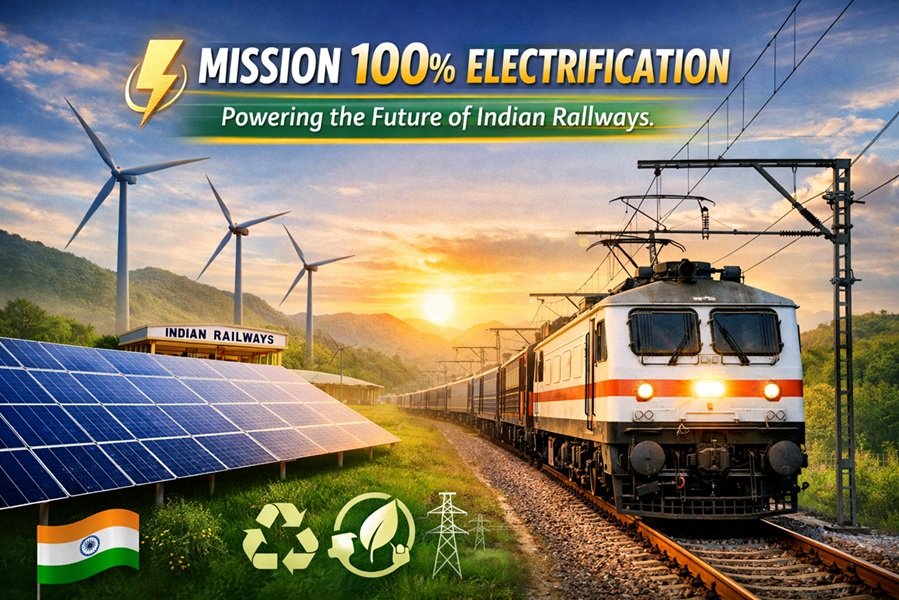
Mission 100% Electrification: Powering the Future of Indian Railways
Introduction
The Indian Railways, one of the largest and most complex railway networks in the world, is undergoing a transformative journey—from predominantly diesel-powered locomotion to a nearly fully electrified system. This transformation is the cornerstone of Mission 100% Electrification, a strategic vision to modernize rail infrastructure, promote sustainability, enhance operational efficiency, and reduce environmental impact. This initiative reflects India’s aspirations to power its transportation backbone with clean energy and efficient systems for the future. (Press Information Bureau)
The Significance of Electrification
Railway electrification involves replacing diesel traction with electric traction along railway routes. Electricity, especially when sourced from renewable energy, offers several advantages over conventional diesel engines, including:
1. Enhanced Environmental Sustainability
Electric traction significantly reduces greenhouse gas emissions compared to diesel locomotives. By minimizing air and noise pollution, electrified railways contribute to cleaner air, especially in urban and industrial regions. Furthermore, electric trains offer smoother rides and reduced carbon footprints for long-distance travel. (Press Information Bureau)
2. Boosting Operational Efficiency
Electric locomotives deliver higher acceleration, greater hauling capacity, and better overall performance than diesel engines. They require less maintenance and fuel logistics are simplified. Electrification enables more reliable and punctual services—a critical requirement for passenger comfort and freight efficiency. (Press Information Bureau)
3. Strengthening Energy Security
Electric railways depend less on imported diesel fuel and more on domestically generated electricity. The integration of solar energy and other renewables further enhances energy security, shielding the railways from global fuel price volatility and supply disruptions. (Press Information Bureau)
Historical Journey of Railway Electrification in India
The journey of railway electrification in India has been one of incremental progress, accelerating dramatically over the past decade. The first electric train ran in India in 1925 between Bombay Victoria Terminus and Kurla Harbour using a 1500-volt DC system. Although this was a short suburban route, it marked the beginning of a century-long evolution in rail technology. (Press Information Bureau)
Early Years and Expansion
For many decades after independence, India’s electrification efforts were slow. By 1947, only 388 route kilometers (RKMs) were electrified. Diesel locomotives continued to dominate the network due to infrastructure limitations and the extensive size of the rail grid. However, steady progress continued over the years as priorities shifted toward more efficient operations. (Press Information Bureau)
Acceleration in Recent Years
A significant acceleration of electrification began in the 21st century. Between 2004 and 2014, the rate of electrification grew to an average of approximately 1.42 kilometers per day. However, between 2019 and 2025, this pace surged dramatically to an average of over 15 kilometers per day, reflecting a decisive strategic shift toward electrified railways. This trend has played a pivotal role in expanding electrified routes across the country. (Press Information Bureau)
Current Status (as of November 2025)
As of November 2025, Indian Railways has electrified approximately 69,427 route kilometers, accounting for about 99.2% of its Broad Gauge network. This makes India’s railway network one of the most extensively electrified in the world—a remarkable achievement in infrastructure modernization. (Press Information Bureau)
State-Wise Electrification Progress
A closer look at electrification on a state-wise basis shows that most states and Union Territories have already achieved full electrification of their Broad Gauge rail lines. Out of 70,001 total Broad Gauge RKMs, 25 states/UTs are 100% electrified, leaving only a small fraction of routes in states like Rajasthan, Tamil Nadu, Karnataka, Assam, and Goa yet to be fully electrified. (Press Information Bureau)
| State | Total BG RKM | Electrified BG RKM | % Electrified | Remaining (RKM) |
|---|---|---|---|---|
| Rajasthan | 6,514 | 6,421 | 99% | 93 |
| Tamil Nadu | 3,920 | 3,803 | 97% | 117 |
| Karnataka | 3,742 | 3,591 | 96% | 151 |
| Assam | 2,578 | 2,381 | 92% | 197 |
| Goa | 187 | 171 | 91% | 16 |
The near-completion of electrification across the railway map highlights India’s focus on creating an interconnected, green transport grid. (Press Information Bureau)
Global Benchmarking and India’s Position
When compared to major countries, India’s railway electrification levels are competitive and impressive:
| Country | % Railway Electrified |
|---|---|
| Switzerland | 100% |
| China | 82% |
| Spain | 67% |
| Japan | 64% |
| France | 60% |
| Russia | 52% |
| United Kingdom | 39% |
This global comparison, based on the International Union of Railways (UIC) report as of June 2025, underscores India’s leadership in railway electrification among large and diverse networks. (Press Information Bureau)
Integration of Renewable Energy: Solar Power on Railways
Indian Railways’ electrification strategy goes hand-in-hand with renewable energy expansion, particularly solar power. As of November 2025, the railways have installed 898 megawatts (MW) of solar capacity across various facilities—an increase from just 3.68 MW in 2014. This leap represents nearly a 244-fold boost in solar implementation. (Press Information Bureau)
Solar Deployment Across Stations
Solar installations now cover 2,626 railway stations, making clean energy a visible part of railway infrastructure throughout the country. This solar power capacity plays a dual role:
- Traction Power: Approximately 629 MW solar capacity directly supports electric traction, contributing to powering trains sustainably.
- Non-Traction Uses: The remaining 269 MW powers station buildings, workshops, lighting systems, and other facilities, reducing dependence on traditional grid electricity. (Press Information Bureau)
By integrating solar energy into its operations, Indian Railways not only reduces operational costs but also meets its energy needs in an environmentally responsible manner. (Press Information Bureau)
Engineering Modernization and Mechanization
Mission 100% Electrification is not just about laying wires—it’s about adopting advanced engineering techniques to ensure speed, safety, and quality.
Mechanised Foundations
Mechanical augering and cylindrical foundation techniques have replaced older manual methods, expediting overhead wire installation and providing greater consistency in construction quality. This mechanization reduces labor intensity and enhances project reliability. (Press Information Bureau)
Automatic Wiring Trains
State-of-the-art Automatic Wiring Trains enable simultaneous installation of catenary and contact wires, maintaining precise tension control and accelerating electrification progress. These innovations reflect Indian Railways’ commitment to adopting modern technology at scale. (Press Information Bureau)
Key Takeaways: Mission 100% Electrification of Indian Railways
- Near-Complete Electrification Achieved
Indian Railways has electrified around 99.2% of its Broad Gauge network (about 69,427 route kilometers) as of November 2025, placing India among the world’s most extensively electrified railway systems. - Major Shift from Diesel to Electric Traction
The transition from diesel locomotives to electric traction significantly reduces fuel imports, operating costs, and dependence on fossil fuels, while improving overall efficiency and reliability. - Strong Environmental Impact
Electrification leads to a substantial reduction in greenhouse gas emissions, air pollution, and noise levels, directly supporting India’s climate commitments and sustainable development goals. - Rapid Acceleration in Recent Years
The pace of electrification increased dramatically after 2019, reaching over 15 km per day, compared to just 1.4 km per day during 2004–2014, reflecting focused policy execution and investment. - Most States Already 100% Electrified
25 States and Union Territories have achieved complete electrification of Broad Gauge routes. Only small residual sections remain in a few states like Rajasthan, Tamil Nadu, Karnataka, Assam, and Goa. - Global Leadership Position
Compared to other major countries, India now ranks ahead of nations such as the UK, France, Japan, and Russia in percentage of railway electrification, and is second only to countries like Switzerland with full electrification. - Integration of Renewable Energy
Indian Railways has installed nearly 898 MW of solar power capacity, a massive rise from just 3.68 MW in 2014, reinforcing the shift toward clean and self-reliant energy usage. - Solar-Powered Railway Infrastructure
Over 2,600 railway stations are equipped with solar panels, supporting both traction (train movement) and non-traction needs like lighting, offices, and workshops. - Adoption of Advanced Engineering Practices
Use of mechanized foundations, automatic wiring trains, and modern construction techniques has improved speed, safety, and quality of electrification works. - Improved Operational Performance
Electric locomotives offer higher hauling capacity, better acceleration, lower maintenance requirements, and improved punctuality for both passenger and freight services. - Enhanced Energy Security
Greater reliance on domestically generated electricity—especially renewables—reduces vulnerability to global fuel price fluctuations and supply disruptions. - Long-Term Economic Benefits
Electrification lowers operating costs, boosts freight efficiency, supports industrial growth along rail corridors, and strengthens India’s overall transport infrastructure. - Strategic Step Toward a Green Future
Mission 100% Electrification is not just an infrastructure upgrade but a foundational reform that aligns Indian Railways with India’s broader goals of sustainability, energy self-reliance, and modern governance.
Looking Ahead: What This Means for India
Mission 100% Electrification represents more than a technological upgrade—it signifies a strategic vision for the future of transportation in India. The shift toward electrified railways:
- Reduces emissions and environmental impact.
- Enhances energy security and operational efficiencies.
- Supports inclusive growth by enabling faster, cleaner travel and freight movement.
- Encourages economic development along railway corridors.
- Aligns with India’s broader goals of sustainability and climate action. (Press Information Bureau)
As Indian Railways nears the finish line of a fully electrified network, the initiative stands as a testament to the country’s resolve to modernize infrastructure while balancing environmental commitments and economic priorities. (Press Information Bureau)
Reference
- Source: Mission 100% Electrification: Powering the Future of Indian Railways, Press Information Bureau, Government of India. Available at: https://www.pib.gov.in/PressNoteDetails.aspx?NoteId=156834&ModuleId=3®=3&lang=1 (Press Information Bureau)
