
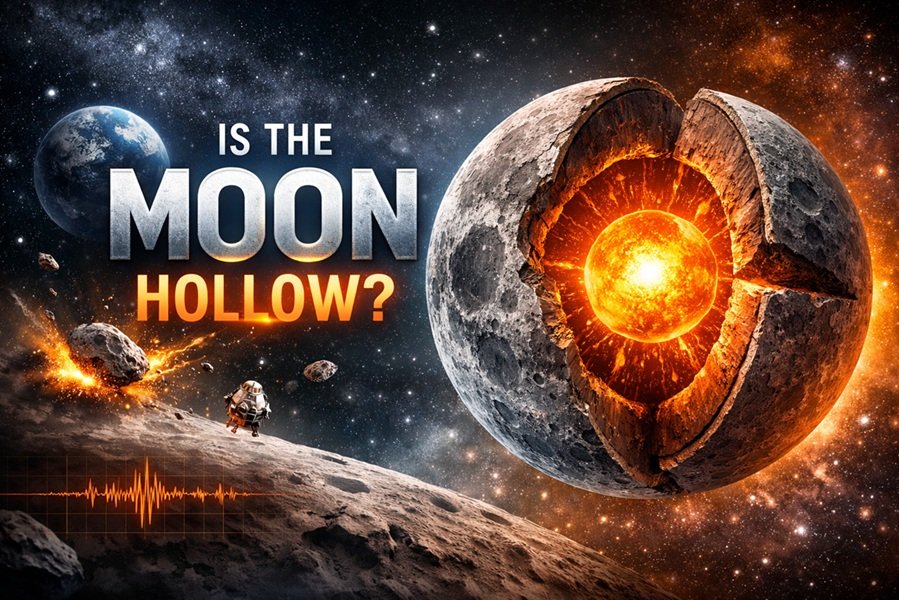
Is the Moon Hollow? A Scientific Examination of Lunar Structure, Myths, and Evidence
Introduction
For decades, the idea that the Moon might be hollow has fascinated the public. From science-fiction novels to internet conspiracy theories, claims about a hollow Moon have circulated widely—often without scientific context. These ideas gained momentum due to misunderstood Apollo mission data, unusual seismic behavior, and the Moon’s comparatively low density.
However, modern planetary science provides clear, measurable, and verifiable evidence about the Moon’s internal structure. Using seismology, gravity mapping, laser ranging, and satellite observations, scientists now understand the Moon far better than ever before.
This article offers a comprehensive, evidence-based analysis of whether the Moon is hollow, explains why the myth exists, and presents scientific consensus supported by open-access references.
Understanding the Moon’s Basic Physical Properties
Before addressing hollow Moon claims, it is important to understand the Moon’s fundamental characteristics.
Key Physical Data of the Moon
| Property | Value |
|---|---|
| Mean radius | ~1,737 km |
| Mass | 7.35 × 10²² kg |
| Mean density | ~3.34 g/cm³ |
| Surface gravity | ~1.62 m/s² |
| Orbital period | 27.3 days |
The Moon’s density is lower than Earth’s, but it is still far too high to allow a hollow interior. A hollow body of the Moon’s size would have a dramatically lower mass and gravitational pull, which is not observed.
Internal Structure of the Moon (Based on Scientific Evidence)
1. Lunar Crust
- Thickness: 30–50 km
- Composition: basaltic and anorthositic rock
- Formed from early magma ocean solidification
The crust is solid and well-mapped using lunar orbiters and gravity data.
2. Lunar Mantle
- Extends to ~1,300 km below the surface
- Composed of silicate minerals
- Makes up the majority of the Moon’s volume
Seismic wave behavior confirms the mantle is solid but partially plastic at depth, similar to Earth’s upper mantle.
3. Lunar Core
- Radius: ~350 km
- Composition: iron-rich with sulfur
- Partially molten outer core, solid inner core
In 2011, NASA confirmed the Moon has a differentiated core, using data from lunar laser ranging and seismic reanalysis.
➡️ A hollow Moon would not allow the formation of a stable metallic core.
How Do Scientists Know What’s Inside the Moon?
Apollo Seismic Experiments
Between 1969 and 1972, Apollo missions placed seismometers on the Moon.
These instruments recorded:
- Moonquakes
- Meteoroid impacts
- Artificial impacts (rocket stages)
Seismic waves behaved exactly as expected for a layered rocky body, not a hollow shell.
Lunar Laser Ranging (Still Active Today)
Retroreflectors placed by Apollo astronauts are still used today to:
- Measure Earth–Moon distance with millimeter accuracy
- Determine mass distribution
- Confirm internal density variations
If the Moon were hollow, its moment of inertia would be dramatically different. Observations match a solid interior.
Gravity Mapping Missions
NASA missions such as:
- GRAIL (Gravity Recovery and Interior Laboratory)
Mapped the Moon’s gravitational field in extreme detail.
Results show:
- Dense mantle regions
- Mass concentrations (mascons)
- No large internal cavities
Why Did the “Hollow Moon” Myth Begin?
“The Moon Rang Like a Bell”
During Apollo 12 and 14, spent rocket stages were deliberately crashed into the Moon.
Result:
- Vibrations lasted longer than on Earth
Misinterpretation:
- Some claimed this meant the Moon was hollow
Scientific explanation:
- The Moon is extremely dry
- No water to absorb vibrations
- Solid rock transmits seismic waves efficiently
This phenomenon is normal for dry planetary bodies.
Misunderstanding Lunar Density
The Moon’s lower density is often cited as evidence for hollowness.
Reality:
- The Moon has:
- A small iron core
- Fewer heavy elements than Earth
- Explained by the Giant Impact Hypothesis
The Giant Impact Hypothesis (Accepted Scientific Model)
According to this model:
- A Mars-sized body (Theia) collided with early Earth
- Debris formed the Moon
- Heavy iron sank into Earth
- Moon formed mostly from lighter mantle material
This explains:
- Lower density
- Small core
- Similar isotopic composition to Earth
No hollow structure is required or supported.
What Would Happen If the Moon Were Hollow?
If the Moon were hollow:
- Its orbit would be unstable
- Earth–Moon tides would behave differently
- Moonquakes would show echo patterns
- Gravity measurements would show anomalies
None of these are observed.
Artificial Moon Theories: Scientific Evaluation
Some claims suggest the Moon is an artificial structure.
Problems with this idea:
- Energy required exceeds any known civilization
- No structural materials detected
- No internal voids
- No technological signatures
These claims belong to speculative fiction, not science.
Scientific Consensus
Every major scientific institution agrees:
The Moon is a natural, solid celestial body with a layered internal structure. It is not hollow.
This conclusion is supported by:
- Seismology
- Gravity mapping
- Orbital dynamics
- Laboratory rock analysis
- Active ongoing experiments
Common Myths vs Scientific Facts
| Claim | Reality |
|---|---|
| Moon is hollow | ❌ False |
| Moon rings because it’s empty | ❌ False |
| Moon has no core | ❌ False |
| Moon is artificial | ❌ No evidence |
| Moon is geologically dead | ❌ Still active |
Conclusion
The idea of a hollow Moon persists because it is intriguing—not because it is true. When examined through the lens of physics, geology, and astronomy, every measurable property of the Moon confirms it is solid.
Modern science leaves no room for a hollow Moon hypothesis. Instead, the Moon stands as one of the best-studied celestial bodies in the solar system and a cornerstone of planetary science.
Open & Free References (Publicly Accessible)
- NASA – Moon Interior Overview
https://moon.nasa.gov - NASA GRAIL Mission Data
https://www.nasa.gov/mission/grail/ - Nature Geoscience – Lunar Core Evidence (2011)
https://www.nature.com/articles/ngeo1020 - USGS – The Moon’s Geology
https://www.usgs.gov/centers/astrogeology-science-center - Apollo Seismic Experiment Data (NASA PDS)
https://pds.nasa.gov - Lunar Laser Ranging Experiment (University of Maryland)
https://www.astro.umd.edu/~llr/ - European Space Agency – Moon Science
https://www.esa.int/Science_Exploration/Human_and_Robotic_Exploration/Exploration/Moon
