
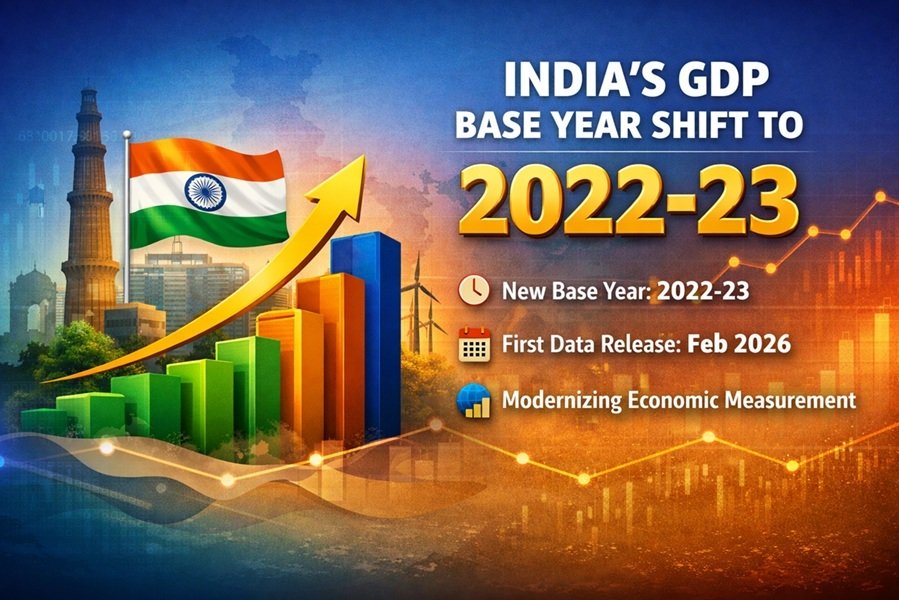
India’s GDP Base Year Shift to 2022-23: What It Means, Why It Matters, and What Changes Ahead
India is preparing for one of the most important statistical reforms in its economic measurement system — the revision of the GDP base year from 2011-12 to 2022-23. This move, led by the Ministry of Statistics and Programme Implementation (MoSPI), is not just a technical update but a structural reset of how India’s economy is measured, interpreted, and compared globally.
This article explains what the GDP base year shift means, why it became necessary, how it will impact growth numbers, and what changes Indians can expect in the coming years.
What Is a GDP Base Year?
A GDP base year is a reference year used to calculate economic growth by keeping prices constant. It helps economists measure real growth by removing the impact of inflation.
For over a decade, India has been calculating GDP using 2011-12 prices and economic structure. However, the Indian economy of 2025 looks dramatically different from that of 2011 — in terms of technology, services, digital payments, energy mix, consumption patterns, and formalisation.
Why Is India Shifting the GDP Base Year to 2022-23?
1. Outdated Economic Structure
The 2011-12 base year does not fully capture:
- Digital economy growth (UPI, fintech, e-commerce)
- Platform-based services
- Renewable energy expansion
- Formalisation after GST
- Rise of startups and MSMEs
An outdated base year can misrepresent sectoral contributions and distort growth estimates.
2. International Standards & IMF Observations
Global institutions such as the IMF assess how current a country’s national accounts system is. India’s older base year raised concerns about data adequacy, even though GDP growth figures themselves were not questioned.
Updating the base year improves:
- Global comparability
- Investor confidence
- Statistical credibility
3. Structural Changes After COVID-19
The post-pandemic economy saw:
- Shift in consumption patterns
- Acceleration of digital services
- Supply chain restructuring
- New employment trends
Using 2022-23 as a base year captures a post-COVID normalized economy, making data more realistic.
When Will the New GDP Series Be Implemented?
- Base Year: 2022-23
- Likely First Release: February 2026
- Initial Coverage: Quarterly GDP data
- Back-Series Revision: Previous years’ data may be recalculated for consistency
This means past growth numbers could be revised, though not necessarily reduced.
Will India’s GDP Growth Rate Change After the Revision?
Yes — but not in a misleading way.
Possible Outcomes:
- Some sectors may show higher contribution
- Others may appear smaller due to better classification
- Growth rates may be revised marginally up or down
Importantly, GDP rebasing does not change the real economy — it only improves how accurately it is measured.
Sectors Likely to Gain More Weight
Under the new base year, higher representation is expected for:
- Digital & IT services
- Fintech and online platforms
- Renewable energy
- Logistics & e-commerce
- Formal MSMEs
Meanwhile, older classifications that undercounted services may be corrected.
What About IIP and Other Economic Indicators?
The base year shift is not limited to GDP alone. It may also impact:
- Index of Industrial Production (IIP)
- Employment surveys
- Consumption expenditure data
- Sectoral productivity estimates
This ensures alignment across economic indicators, reducing inconsistencies.
Why This Change Is Important for Policy Making
Accurate GDP data helps the government:
- Design better fiscal policies
- Allocate resources efficiently
- Assess sector-wise performance
- Improve welfare scheme targeting
For investors and businesses, it provides clearer signals about where growth is actually happening.
Does GDP Rebasing Mean Data Manipulation?
No. GDP rebasing is a standard international practice.
Most countries revise base years every 5–10 years. India itself has done this earlier:
- 1993-94
- 1999-2000
- 2004-05
- 2011-12
The 2022-23 update is simply overdue.
How Will It Affect Common Citizens?
Indirectly, the impact includes:
- Better economic planning
- More accurate employment and income data
- Improved targeting of subsidies and schemes
- Stronger global perception of India’s economy
There is no direct effect on taxes, prices, or salaries due to rebasing.
The Bigger Picture: India’s Economic Transition
The GDP base year shift reflects a larger truth — India is no longer the same economy it was in 2011.
It is now:
- More digital
- More services-oriented
- More formal
- More globally integrated
Rebasing GDP to 2022-23 acknowledges this transformation statistically.
Conclusion
India’s decision to shift the GDP base year to 2022-23 is a crucial step toward modern, transparent, and globally aligned economic measurement. While growth numbers may see revisions, the move strengthens confidence in India’s data ecosystem and ensures that policymaking is based on present-day realities rather than outdated assumptions.
In the long run, this reform will make India’s economic story clearer, stronger, and more credible — both at home and on the global stage.
