
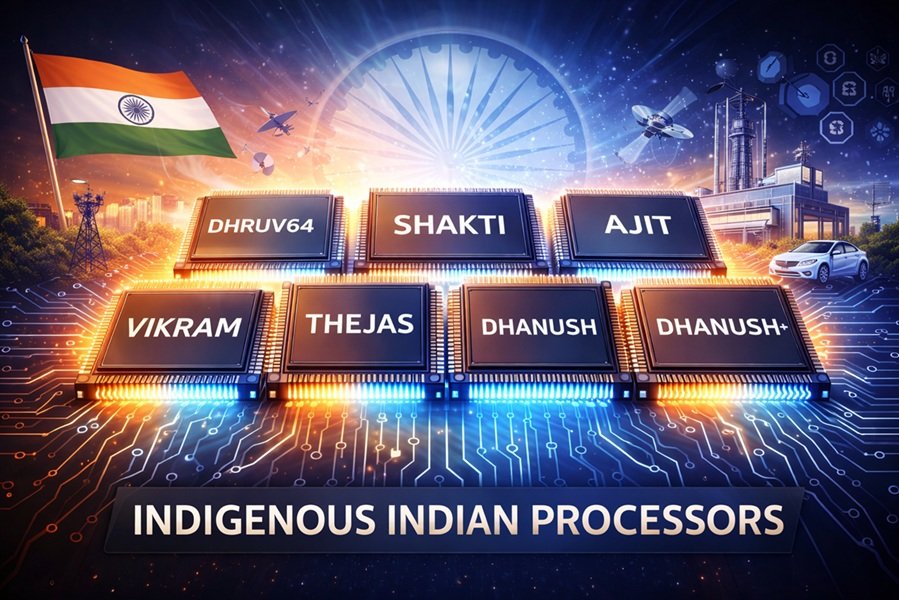
Indian Indigenous Processors: India’s Journey Toward Semiconductor Self-Reliance
Introduction
In the digital age, microprocessors are the backbone of every modern technology — from smartphones and laptops to satellites, missiles, automobiles, power grids, and communication networks. Countries that design and control their own processors enjoy strategic autonomy, economic resilience, and national security advantages.
For decades, India remained largely dependent on foreign processor architectures and imported chips, despite having one of the world’s largest pools of semiconductor design engineers. However, this reality has begun to change. Over the last two decades, India has steadily developed a growing portfolio of indigenous processors — designed within the country for strategic, scientific, industrial, and commercial applications.
Today, Indian indigenous processors represent a strategic transformation: from being a consumer of global chip technology to becoming a creator of sovereign computing platforms.
What Are Indigenous Processors?
Indigenous processors are microprocessors that are:
- Designed and architected in India
- Developed by Indian institutions or companies
- Controlled at the IP (intellectual property) level
- Customisable for national, strategic, or industrial needs
They may be fabricated in domestic or foreign fabs, but the design ownership and architectural control remain Indian, which is the most critical aspect of semiconductor sovereignty.
Why Indigenous Processors Matter for India
1. Strategic & National Security Importance
Modern defense systems, satellites, encrypted communications, and command-and-control infrastructure rely on processors. Using foreign chips creates:
- Supply chain risks
- Security vulnerabilities
- Dependence during geopolitical tensions
Indigenous processors ensure trusted hardware for critical missions.
2. Economic & Technological Sovereignty
Processor IP is among the highest-value intellectual property in the world. Owning it:
- Retains value within the country
- Reduces royalty payments to foreign firms
- Builds a domestic innovation economy
3. Customisation & Long-Term Availability
Foreign commercial chips are designed for mass markets. Indigenous processors can be:
- Custom-built for Indian conditions
- Supported for decades (important for defense & space)
- Modified without vendor restrictions
Evolution of Indian Indigenous Processor Development
India’s processor journey did not happen overnight. It evolved through academic research, government programmes, and strategic missions.
Early Foundations
- Semiconductor research in IITs
- VLSI design capabilities developed in the 1990s
- C-DAC’s experience in supercomputing (PARAM series)
This foundation enabled India to gradually move into CPU and SoC design.
Major Indian Indigenous Processors
1. SHAKTI Processor (IIT Madras)
SHAKTI is one of India’s most well-known indigenous processor initiatives.
Key Highlights
- Based on RISC-V open architecture
- Developed by IIT Madras
- Multiple variants: E-class, C-class, I-class, M-class
- Designed for embedded, industrial, and strategic systems
Significance
- First large-scale academic-to-industrial processor initiative in India
- Demonstrated that India can design scalable CPU architectures
- Forms the backbone of several indigenous computing projects
2. AJIT Processor (IIT Bombay)
AJIT is another indigenous processor developed by IIT Bombay.
Key Characteristics
- Based on SPARC architecture
- Designed for real-time and embedded applications
- Used in robotics, control systems, and research platforms
Strategic Value
- Focus on deterministic performance
- Useful in aerospace and industrial automation
- Strong academic-industry collaboration model
3. VIKRAM Processor (ISRO & SCL)
VIKRAM processors are developed specifically for space applications.
Features
- Radiation-hardened design
- High reliability in extreme environments
- Long mission life support
Importance
- Used in Indian satellites and space missions
- Eliminates reliance on imported space-grade chips
- Ensures mission continuity even under sanctions or export restrictions
4. THEJAS Processor Series (C-DAC)
The THEJAS family represents C-DAC’s indigenous processor development efforts.
Variants
- THEJAS32
- THEJAS64
Applications
- Industrial automation
- Embedded systems
- Research and prototyping
THEJAS processors laid the groundwork for more advanced designs like DHRUV64.
5. DHRUV64 Processor (C-DAC)
DHRUV64 marks a major milestone in India’s indigenous processor journey.
Key Specifications
- 64-bit architecture
- Dual-core
- 1.0 GHz clock speed
- Based on RISC-V
- Designed under the Digital India RISC-V (DIR-V) Programme
Why DHRUV64 Matters
- First commercially viable general-purpose indigenous CPU
- Suitable for:
- 5G infrastructure
- Industrial IoT
- Automotive electronics
- Secure computing systems
- Demonstrates India’s readiness to move beyond experimental chips
Read More: https://bharatarticles.com/dhruv64-indias-strategic-leap-toward-semiconductor-self-reliance/
6. Dhanush & Dhanush+ (Upcoming)
Following DHRUV64, India is developing next-generation processors:
- Dhanush
- Dhanush+
These aim to deliver:
- Higher performance
- Improved multicore scalability
- Enhanced security and reliability features
Role of RISC-V in India’s Indigenous Processor Strategy
A defining feature of India’s modern processor initiatives is the adoption of RISC-V.
Why RISC-V?
- Open-source and royalty-free
- No geopolitical licensing risks
- Full architectural control
- Strong global ecosystem support
Strategic Advantage for India
RISC-V allows India to:
- Build sovereign processors without foreign IP lock-in
- Encourage startups and academia to innovate
- Create custom extensions for security, AI, and networking
Government Programmes Supporting Indigenous Processors
India’s processor ecosystem is backed by coordinated national initiatives:
1. Digital India RISC-V (DIR-V)
- Develops a full range of RISC-V processors
- Encourages ecosystem participation
2. Chips to Startup (C2S)
- Builds semiconductor talent
- Supports academic and startup innovation
3. Design Linked Incentive (DLI)
- Financial support for chip design companies
- Encourages private sector participation
4. India Semiconductor Mission (ISM)
- Focuses on fabs, packaging, and supply chain
- Complements processor design efforts
Applications of Indian Indigenous Processors
Indian processors are increasingly relevant across sectors:
Defense & Strategic Systems
- Secure communications
- Radar and missile systems
- Command & control platforms
Space & Aerospace
- Satellites
- Launch vehicles
- Deep-space missions
Telecom & 5G
- Network infrastructure
- Edge computing
- Secure base stations
Industrial & IoT
- Smart factories
- Power systems
- Critical infrastructure control
Education & Research
- Indigenous computing platforms
- Processor design training
- Academic experimentation
Challenges Ahead
Despite progress, challenges remain:
- Limited domestic fabrication capacity
- Need for stronger commercial adoption
- Software ecosystem maturity
- Global competition in high-performance CPUs
However, India’s strategy focuses on sovereign, secure, and application-specific computing, not direct competition with consumer PC processors.
Conclusion
Indian indigenous processors represent a strategic shift in India’s technological identity. From SHAKTI and AJIT to VIKRAM and DHRUV64, India has built a credible foundation in processor design — driven by open architectures, academic excellence, and government support.
As semiconductor geopolitics reshape the world, India’s commitment to indigenous processors ensures:
- National security
- Economic resilience
- Long-term technological independence
The journey is ongoing, but the direction is clear: India is no longer just designing chips for others — it is designing chips for itself and the future.
