
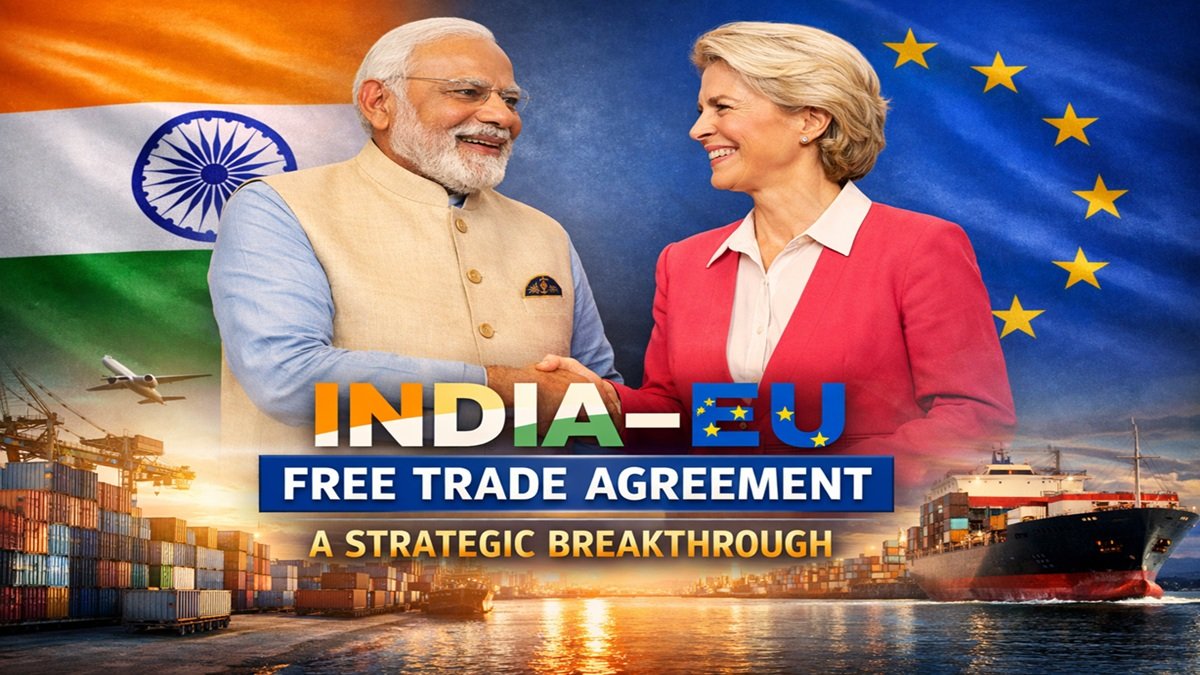
India–European Union Free Trade Agreement: The “Mother of All Deals” Powering India@2047
India and the European Union have reached a historic milestone with the successful conclusion of negotiations for a comprehensive Free Trade Agreement (FTA)—widely described as the “Mother of All Deals”. This landmark agreement marks a decisive shift in India–EU relations, transforming them from a traditional trade partnership into a modern, rules-based, and future-ready economic alliance aligned with India’s long-term vision of India@2047.
Designed to respond to contemporary global challenges—ranging from supply chain disruptions to digital trade and sustainability—the India–EU FTA unlocks unprecedented opportunities for businesses, professionals, farmers, MSMEs, and consumers across both regions.
A Partnership Between Two Global Economic Powerhouses
India, the world’s 4th largest economy, and the European Union, the 2nd largest economy, together represent a combined market of over 2 billion people and an estimated economic size of INR 2091.6 lakh crore (USD 24 trillion). Despite already strong trade ties, both sides recognised that a vast untapped potential remained due to market barriers, tariffs, and regulatory complexities.
The FTA addresses these gaps by enabling deeper market integration, predictable trade rules, and enhanced cooperation—laying the foundation for India and the EU to emerge as each other’s major and most trusted economic partners.
Trade Momentum and the Promise of the FTA
Bilateral trade between India and the EU has shown consistent growth over the years. In 2024–25, merchandise trade stood at approximately INR 11.5 lakh crore (USD 136.54 billion), with Indian exports valued at INR 6.4 lakh crore (USD 75.85 billion). Trade in services reached INR 7.2 lakh crore (USD 83.10 billion) in 2024.
While these numbers reflect healthy engagement, they represent only a fraction of the potential given the scale of both economies. The India–EU FTA provides a clear pathway to bridge this gap, creating a stable and predictable environment that encourages long-term investments, export expansion, and integration into European and global value chains.
Unprecedented Market Access for Indian Exports
One of the most transformative outcomes of the FTA is the preferential access India secures across 97% of EU tariff lines, covering 99.5% of India’s export value. This level of access is among the most ambitious ever achieved by India in a trade agreement.
Key highlights include:
- Immediate zero-duty access for 70.4% of tariff lines, covering 90.7% of India’s exports, particularly benefitting labour-intensive sectors such as textiles, leather, footwear, tea, coffee, spices, toys, sports goods, gems and jewellery, and select marine products.
- Phased zero-duty access over 3 to 5 years for 20.3% of tariff lines, including certain marine products, processed foods, and other selected items.
- Preferential tariff reductions or tariff rate quotas (TRQs) for 6.1% of tariff lines, covering products such as poultry items, bakery goods, preserved vegetables, automobiles, steel, and select shrimp and prawn products.
These measures are expected to significantly enhance the competitiveness of Indian exports currently facing EU import duties ranging from 4% to 26%.
A Major Boost for Jobs, MSMEs, and Labour-Intensive Sectors
Labour-intensive industries—comprising exports worth over INR 2.87 lakh crore (USD 33 billion)—stand out as the biggest beneficiaries of the agreement. Sectors such as textiles, apparel, leather, footwear, marine products, toys, sports goods, plastics, rubber, chemicals, and gems and jewellery will gain zero-duty access from the date the FTA enters into force.
This tariff liberalisation is expected to:
- Strengthen India’s position in EU markets
- Generate large-scale employment
- Empower MSMEs and artisan clusters
- Deepen India’s integration into European value chains
By lowering compliance costs and ensuring long-term policy certainty, the FTA allows Indian businesses—especially MSMEs—to plan expansion and innovation with confidence.
India’s Balanced Offer to the European Union
India, in turn, has offered meaningful and calibrated access to the EU. Under the agreement:
- 92.1% of India’s tariff lines will be opened, covering 97.5% of EU exports
- 49.6% of tariff lines will see immediate duty elimination
- 39.5% will undergo phased elimination over 5, 7, or 10 years
- A small share of sensitive products will be covered under tariff reductions or TRQs, including select fruits such as apples, pears, peaches, and kiwi
Imports of EU high-technology goods are expected to reduce input costs for Indian industries, benefit consumers, and help Indian manufacturers integrate into global supply chains.
Driving Agricultural Growth with Strong Safeguards
The FTA offers significant opportunities for India’s agricultural and processed food exports, including tea, coffee, spices, grapes, gherkins, cucumbers, dried onions, fruits, vegetables, and processed food products. Preferential access to the EU market will enhance competitiveness, boost farmers’ incomes, and strengthen rural livelihoods.
At the same time, India has carefully safeguarded sensitive sectors such as dairy, cereals, poultry, soymeal, and select fruits and vegetables—ensuring that export growth does not come at the cost of domestic priorities or food security.
Rules of Origin and Ease of Doing Business
To ensure genuine value addition, the FTA includes balanced Product Specific Rules (PSRs) aligned with existing global supply chains. These rules ensure that goods receive preferential access only after adequate processing or manufacturing.
Key facilitation measures include:
- Self-certification through Statements of Origin, reducing compliance costs
- Special provisions for MSMEs, including quotas for shrimp, prawns, and downstream aluminium products
- Transition periods for machinery and aerospace sectors, reinforcing the Make in India initiative
Services: The Growth Engine of Future Trade
Services form the fastest-growing component of India–EU trade, and the FTA delivers ambitious outcomes in this area. The EU has committed market access across 144 services subsectors, including:
- IT and IT-enabled services
- Professional and business services
- Education and R&D
India’s competitive, high-tech service providers gain a stable, non-discriminatory, and predictable regime in the EU market. India has also offered access in 102 services subsectors, enabling EU firms to invest, innovate, and provide world-class services in India—creating a mutually beneficial ecosystem.
Mobility, Talent, and Knowledge Exchange
A comprehensive mobility framework under the FTA ensures assured temporary entry and stay for:
- Business Visitors
- Intra-Corporate Transferees
- Contractual Service Suppliers
- Independent Professionals
The framework facilitates movement of professionals and their dependents, supports student mobility and post-study work opportunities, and establishes a roadmap for Social Security Agreements with EU member states over five years. This positions India as a global hub for skilled talent and knowledge-based trade.
Expanding Opportunities for Indian Traditional Medicine
A unique and forward-looking feature of the FTA is its support for Indian traditional medicine. In EU member states where regulations do not exist, AYUSH practitioners will be able to offer services based on their Indian qualifications. The agreement also provides certainty for establishing AYUSH wellness centres and clinics in Europe, promoting global recognition of India’s traditional healthcare systems.
Strengthening Standards, Innovation, and IPR
The agreement reinforces TRIPS-compliant intellectual property protections, affirms the Doha Declaration, and recognises the importance of initiatives like India’s Traditional Knowledge Digital Library (TKDL). Enhanced cooperation on Sanitary and Phytosanitary (SPS) and Technical Barriers to Trade (TBT) will improve regulatory predictability, facilitate equivalence, and enable faster market access through digitisation and international standards.
Sector-Wise Gains Across the Indian Economy
The FTA delivers targeted benefits across multiple sectors:
- Engineering goods gain access to the EU’s massive import market, boosting MSME-led industrial hubs
- Leather and footwear exports receive zero-duty access, strengthening India’s global craftsmanship brand
- Marine products, including shrimp and seafood, gain duty-free access, empowering coastal economies
- Medical devices and instruments benefit from near-total tariff elimination
- Textiles and apparel secure zero-duty access across all tariff lines, opening the EU’s USD 263.5 billion import market
- Plastics, rubber, chemicals, minerals, furniture, and home décor see enhanced competitiveness and export potential
A Transformational Deal for India@2047
The India–EU Free Trade Agreement is not just a trade pact—it is a strategic blueprint for inclusive growth, innovation, and long-term resilience. By combining market access with safeguards, services liberalisation with mobility, and traditional strengths with future technologies, the FTA positions India as a trusted, high-value global partner.
Aligned with the vision of India@2047, this “Mother of All Deals” lays the foundation for sustained economic growth, employment generation, global integration, and shared prosperity for both India and Europe in the decades to come.
Source: https://www.pib.gov.in/PressReleasePage.aspx?PRID=2219146®=3&lang=1
