
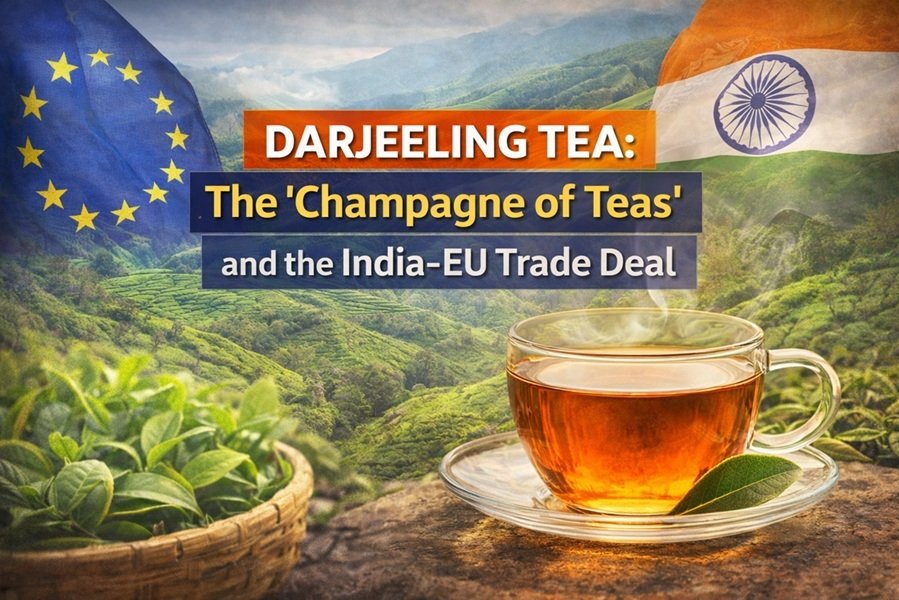
India–EU Trade Deal: Why Darjeeling Tea Is Called the “Champagne of Teas” — and What Makes It Truly Special
When India and the European Union concluded their long-awaited Free Trade Agreement on 27 January 2026, most attention went to big-ticket sectors—automobiles, machinery, pharmaceuticals, and tariff reductions worth billions. Yet, nestled quietly within the agreement is a product that doesn’t rely on massive volumes or container-ship economics to make an impact. Instead, it carries something far rarer in global trade: prestige. That product is Darjeeling tea.
The India–EU trade deal is not only about scale and speed; it is also about identity, origin, and value. Few Indian exports embody these ideas better than Darjeeling tea—a product whose worth flows from where it is grown and how it is crafted, rather than how much of it is produced.
What the India–EU Trade Deal Is Really About
The India–EU Free Trade Agreement ranks among the most significant trade pacts either side has signed. Together, India and the EU represent nearly a quarter of global GDP and serve close to two billion consumers. The agreement aims to reduce or eliminate tariffs on most traded goods, improve access in services, and strengthen cooperation in investment and technology.
For Indian exporters, the EU is a demanding but highly rewarding market. Its strict rules on quality, traceability, sustainability, and consumer protection mean that access to Europe brings more than higher volumes—it brings credibility. Sectors such as textiles, gems and jewellery, marine products, and niche agricultural goods stand to gain from smoother entry and better price realisation.
This is precisely where Geographical Indication (GI) products like Darjeeling tea find their advantage. In a market that values authenticity over abundance, origin becomes a commercial asset.
Why Darjeeling Tea Matters in This Agreement
Darjeeling tea does not compete with everyday supermarket blends. It occupies a different space altogether—closer to fine wine than a daily beverage. The EU already recognises this distinction through its Protected Geographical Indication (PGI) system, which legally restricts the use of the name “Darjeeling” to tea grown in its designated region in West Bengal.
The India–EU trade deal strengthens this protection by improving enforcement against misuse, simplifying access to premium European markets, and reinforcing the link between authentic origin and price. For Indian producers, this means greater assurance that their product’s reputation—and earnings—are not undercut by imitation.
In essence, the agreement gives Darjeeling tea what no marketing campaign can easily buy: trust in a high-value global market.
Why Darjeeling Tea Is Called the “Champagne of Teas”
The comparison with champagne is not poetic exaggeration—it is precise. Just as champagne can only come from the Champagne region of France, genuine Darjeeling tea can only be produced in a small cluster of about 87 tea gardens spread across the Darjeeling hills.
Several natural factors combine to make this possible:
- High altitude
- Cool temperatures
- Mist-laden slopes
- Uneven rainfall
Together, these conditions create a flavour profile that cannot be replicated elsewhere. The most celebrated feature is the muscatel note—a naturally occurring, grape-like aroma that gives Darjeeling tea a light, layered, almost wine-like character. It is aromatic rather than bitter, refined rather than strong. This elegance is why tea connoisseurs in Europe, Japan, and the United States regard Darjeeling as a luxury product.
Terroir and the Importance of Seasonal Flushes
Darjeeling tea is deeply shaped by its environment—what wine experts call terroir. Soil composition, slope, sunlight, altitude, and climate all influence how the tea leaves grow and develop flavour.
Adding to this complexity are the tea’s seasonal flushes, each with a distinct personality:
- First Flush (Spring): Light, floral, and fresh
- Second Flush (Early Summer): Fuller, muscatel-rich, and highly prized
- Monsoon Flush: Stronger teas, often used in blends
- Autumn Flush: Smooth, rounded, and aromatic
Because each harvest tastes different, Darjeeling teas are often sold by estate and season, much like vintage wines. This rarity is almost unheard of in the global tea industry and is central to its premium status.
Scarcity, Skill, and the Value of Being Limited
Darjeeling tea is mostly hand-plucked, grown on steep terrain where mechanisation is impractical. Quality control remains labour-intensive, and production volumes are naturally limited.
This scarcity is not a weakness—it is the very reason the tea commands respect and premium pricing. In European markets, where consumers increasingly value craftsmanship, sustainability, and transparent sourcing, Darjeeling’s small-scale production becomes a powerful strength rather than a constraint.
How the Trade Deal Changes the Conversation
With the India–EU trade agreement in place, Darjeeling tea is not merely protected—it is strategically positioned. Stronger GI enforcement, reduced market friction, and alignment with European standards ensure that when a European consumer buys “Darjeeling,” they receive the genuine product.
Crucially, this is not about turning Darjeeling tea into a mass export. It is about preserving its exclusivity while ensuring that Indian growers receive fair value for their skill, labour, and heritage.
More Than Trade Numbers
The success of the India–EU trade deal will often be measured in tariffs reduced and trade volumes increased. But its deeper value lies in how it treats products like Darjeeling tea—by respecting origin, protecting identity, and rewarding quality.
Darjeeling has always been special. The agreement simply provides the global framework needed to ensure it remains special, not by chasing scale, but by safeguarding authenticity in one of the world’s most discerning markets.
