
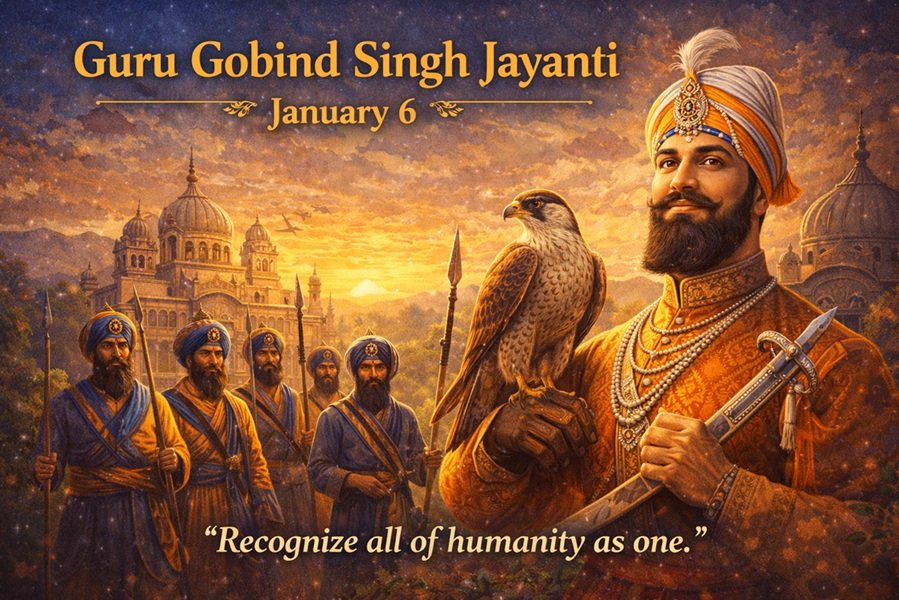
Guru Gobind Singh Jayanti (January 5): History, Significance, Life, and Teachings
Guru Gobind Singh Jayanti, observed on January 5, commemorates the birth anniversary of Guru Gobind Singh Ji, the tenth Sikh Guru and one of the most influential spiritual leaders in Indian history. This sacred occasion is celebrated with deep devotion by Sikhs across India and around the world, honoring a Guru who was not only a saint and philosopher but also a fearless warrior, poet, and reformer.
Guru Gobind Singh Ji played a decisive role in shaping Sikh identity, strengthening the moral foundation of the community, and standing firmly against injustice and oppression.
Date and Observance of Guru Gobind Singh Jayanti
Guru Gobind Singh Jayanti is celebrated according to the Sikh and traditional lunar calendars, which means the date varies each year. In many years, the Jayanti falls in late December or early January.
In this observance, January 5 marks the day when devotees remember and honor the Guru’s birth and legacy.
On this day, Gurdwaras are beautifully decorated, and special religious programs are organized to reflect upon the teachings and sacrifices of Guru Gobind Singh Ji.
Birth and Early Life of Guru Gobind Singh Ji
Guru Gobind Singh Ji was born in 1666 at Patna Sahib (in present-day Bihar). His birth name was Gobind Rai. He was the son of Guru Tegh Bahadur Ji, the ninth Sikh Guru, and Mata Gujri Ji.
From an early age, Guru Gobind Singh Ji showed extraordinary brilliance. He received education in:
- Sikh scriptures and spiritual philosophy
- Sanskrit, Persian, and poetry
- Martial arts, archery, and warfare
This rare combination of spirituality and strength later defined his leadership and vision.
Becoming the Tenth Sikh Guru
After the martyrdom of his father, Guru Tegh Bahadur Ji, who sacrificed his life to protect religious freedom, Guru Gobind Singh Ji became the tenth Sikh Guru at a young age.
His Guruship began during a time of immense political pressure and religious persecution. Despite this, he led the Sikh community with unwavering courage, moral clarity, and spiritual depth.
Creation of the Khalsa Panth
One of the most transformative events in Sikh history was the creation of the Khalsa Panth in 1699 by Guru Gobind Singh Ji at Anandpur Sahib.
Meaning and Importance of the Khalsa
The Khalsa represents a disciplined, fearless, and spiritually committed community devoted to:
- Truth and righteousness
- Equality and social justice
- Courage and selfless service
Guru Gobind Singh Ji introduced the Five Ks (Panj Kakkar)—Kesh, Kara, Kanga, Kachera, and Kirpan—as visible symbols of Sikh faith and identity.
He also abolished caste distinctions by giving all men the surname Singh (lion) and women the surname Kaur (princess), establishing complete equality.
Guru Gobind Singh Ji as a Saint-Soldier
Guru Gobind Singh Ji is remembered as the ideal saint-soldier—a person who balances spiritual devotion with the responsibility to resist injustice.
He led several battles, not for personal ambition or territory, but to defend:
- Religious freedom
- Human dignity
- Moral values and truth
His life taught that peace and strength must coexist and that standing up against injustice is a sacred duty.
Literary and Spiritual Contributions
Guru Gobind Singh Ji was also a distinguished poet and scholar. His compositions reflect deep devotion to the divine, heroic spirit, and philosophical wisdom.
Key Contributions
- Powerful spiritual and poetic writings
- Philosophical teachings emphasizing courage and faith
- Inspiration for ethical living and disciplined conduct
His writings continue to inspire Sikhs to live lives rooted in spirituality, bravery, and service.
Guru Granth Sahib as the Eternal Guru
Before leaving his physical form in 1708, Guru Gobind Singh Ji made a historic declaration that transformed Sikh tradition forever.
He proclaimed the Guru Granth Sahib as the eternal Guru of the Sikhs, ending the line of human Gurus. This decision ensured unity, continuity, and spiritual guidance for future generations.
How Guru Gobind Singh Jayanti Is Celebrated
On January 6, devotees observe Guru Gobind Singh Jayanti with great reverence.
Common Celebrations Include
- Akhand Path (continuous recitation of Guru Granth Sahib)
- Kirtans and discourses in Gurdwaras
- Nagar Kirtans (religious processions)
- Langar (community meals symbolizing equality)
- Remembering the Guru’s life, sacrifices, and teachings
These practices reflect the Sikh principles of devotion, unity, and selfless service.
Teachings and Values of Guru Gobind Singh Ji
Guru Gobind Singh Ji’s teachings remain timeless and relevant even today.
Core Values
- Fearlessness in the face of injustice
- Equality of all human beings
- Devotion to God and truth
- Discipline and moral living
- Service to humanity
He taught that true spirituality requires both inner purity and righteous action.
Relevance of Guru Gobind Singh Jayanti Today
In the modern world, Guru Gobind Singh Jayanti is a reminder that:
- Faith must be accompanied by courage
- Social justice is a moral responsibility
- Equality is the foundation of a strong society
- Spiritual strength empowers ethical action
His life continues to inspire people across religions and cultures.
Conclusion
Guru Gobind Singh Jayanti on January 6 is a sacred occasion that honors a visionary leader who transformed Sikhism into a force of spiritual strength, courage, and equality. Guru Gobind Singh Ji’s life stands as a powerful example of how devotion, discipline, and bravery can guide humanity toward justice and righteousness.
As we commemorate this day, may his teachings inspire us to live with integrity, fearlessness, and compassion for all.
