
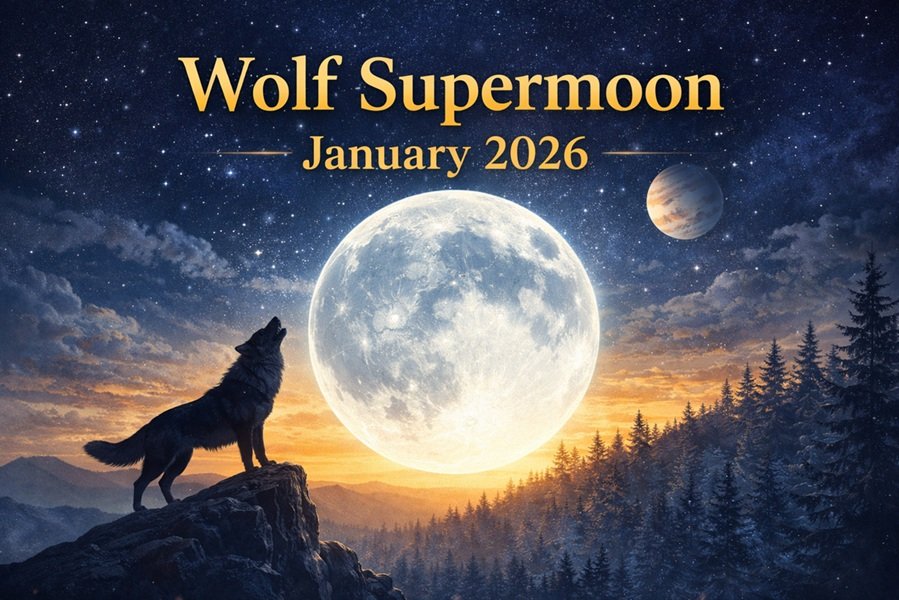
Full Moon January 2026: All About the ‘Wolf Supermoon’
The first full moon of the year always carries a special charm, and January 2026 is set to begin with a spectacular celestial event — the Wolf Supermoon. This striking full moon will light up the winter sky in early January, appearing larger, brighter, and more dramatic than a regular full moon.
Astronomy lovers, skywatchers, and even casual observers will have a chance to witness this rare and visually stunning lunar event.
What Is the ‘Wolf Supermoon’?
The Wolf Moon is the traditional name given to the January full moon. The name comes from ancient folklore, particularly from colder regions of the Northern Hemisphere, where wolves were often heard howling during harsh winter nights. Over time, this name became part of the seasonal moon-naming tradition.
In January 2026, the Wolf Moon earns an extra title — Supermoon — because it occurs when the Moon is unusually close to Earth in its orbit. This proximity makes the Moon look slightly bigger and noticeably brighter than an average full moon.
When Will the Wolf Supermoon Appear in January 2026?
- Date: January 3, 2026
- Peak Full Moon Time: Around 10:03 GMT
- Best Viewing Window: Evening of January 2 and January 3, soon after sunset
Even though the exact peak happens at a specific time, the Moon will appear full to the naked eye for nearly two nights, making it easy to enjoy without special equipment.
Why Is It Called a ‘Supermoon’?
A Supermoon happens when the full Moon aligns closely with the Moon’s perigee, the point in its elliptical orbit where it is nearest to Earth.
Because of this:
- The Moon appears up to 14% larger
- It can look around 30% brighter
- Moonrise and moonset feel more dramatic
Although “supermoon” is not a formal scientific term, it is widely used because it helps describe the Moon’s striking visual impact.
A Rare Cosmic Coincidence in January 2026
What makes the January 2026 Wolf Supermoon even more fascinating is that it occurs very close to Earth’s perihelion — the time of year when Earth is nearest to the Sun.
This alignment is unusual:
- Earth is closest to the Sun
- The Moon is close to Earth
- Both events happen around the same time
Despite this, winter still dominates the Northern Hemisphere, reminding us that seasons are controlled by Earth’s tilt, not distance from the Sun.
Jupiter Adds to the Sky Show
Around the time of the Wolf Supermoon, Jupiter will also be a highlight in the night sky. The giant planet will soon reach a position where it:
- Rises around sunset
- Sets near sunrise
- Appears at its brightest for the year
This makes early January 2026 an excellent period for stargazing, with both the Moon and Jupiter visible in impressive clarity.
Is January 2026’s Wolf Moon the Last Supermoon?
Yes, the Wolf Supermoon of January 2026 marks the final supermoon in a sequence that began in late 2025. That series included:
- October’s Harvest Moon
- November’s Beaver Moon
- December’s Cold Moon
With the Wolf Supermoon, this run of closely spaced supermoons comes to an end.
What’s the Next Full Moon After the Wolf Supermoon?
After January’s Wolf Supermoon, the next full moon will be the Snow Moon, expected on February 1, 2026. The Snow Moon is traditionally associated with heavy winter snowfall and is considered the second full moon of winter in the Northern Hemisphere.
How to Best View the Wolf Supermoon
To enjoy the Wolf Supermoon at its best:
- Choose an open area with a clear horizon
- Avoid bright city lights if possible
- Watch the Moon shortly after it rises — it looks larger near the horizon
- No telescope required; naked-eye viewing is perfect
Binoculars can enhance surface details, but the Moon’s brightness alone will be enough to create a memorable sight.
Why the Wolf Supermoon Matters
Beyond its beauty, the Wolf Supermoon:
- Connects modern astronomy with ancient traditions
- Marks the beginning of the lunar year
- Reminds us of the dynamic relationship between Earth, Moon, and Sun
It’s a perfect example of how science and folklore blend together in the night sky.
Final Thoughts
The Wolf Supermoon of January 2026 is more than just the first full moon of the year — it’s a rare combination of brightness, proximity, and timing. With its historical name, supermoon status, and alignment with other celestial events, it promises a stunning start to 2026 for skywatchers worldwide.
If you enjoy watching the heavens, this is one lunar event you won’t want to miss.
