
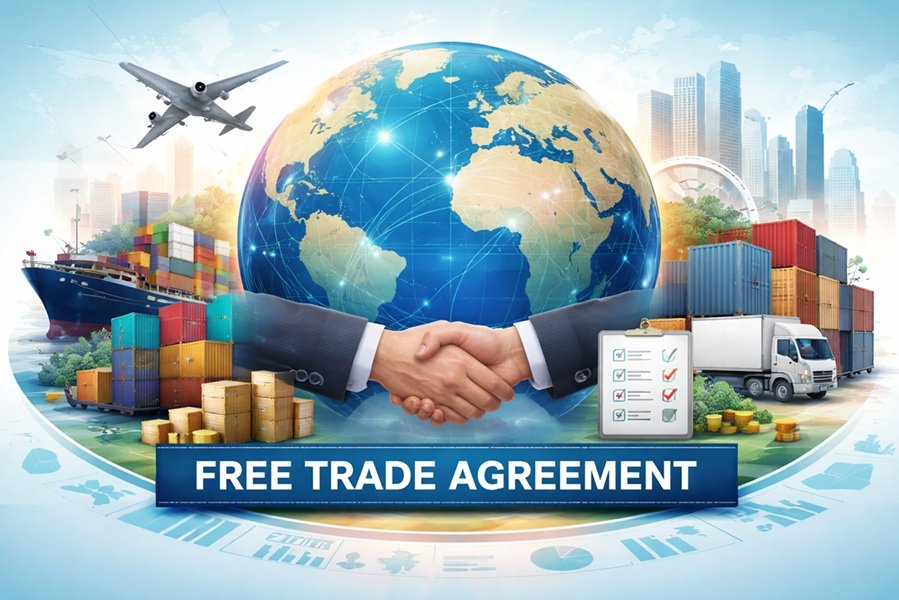
Free Trade Agreement (FTA): Meaning, Types, Benefits, Challenges, and Global Importance
Introduction
In an increasingly interconnected world, international trade plays a crucial role in economic growth, job creation, and global cooperation. One of the most important instruments shaping modern global trade is the Free Trade Agreement (FTA). These agreements aim to reduce or eliminate trade barriers between participating countries, enabling smoother exchange of goods, services, investments, and technology.
From regional economic blocs to bilateral partnerships, Free Trade Agreements have transformed how countries interact economically. This article provides a comprehensive explanation of Free Trade Agreements, their types, key features, advantages, disadvantages, and their importance in today’s global economy.
What Is a Free Trade Agreement (FTA)?
A Free Trade Agreement (FTA) is a formal treaty between two or more countries designed to reduce or eliminate barriers to trade such as tariffs, import quotas, and export restrictions. Unlike complete economic unions, FTAs allow member countries to maintain independent trade policies with non-member nations.
The primary objective of an FTA is to promote trade efficiency, economic cooperation, and mutual growth by creating a more predictable and transparent trading environment.
Key Features of Free Trade Agreements
Free Trade Agreements generally include the following core elements:
1. Reduction or Elimination of Tariffs
FTAs significantly lower or completely remove customs duties on goods traded between member countries.
2. Market Access for Services
Many modern FTAs go beyond goods and include sectors like finance, telecom, education, healthcare, and IT services.
3. Investment Protection
FTAs often provide safeguards for foreign investments, ensuring fair treatment and dispute resolution mechanisms.
4. Rules of Origin
These rules determine whether a product qualifies for preferential tariff treatment under the FTA.
5. Intellectual Property Rights (IPR)
Protection of patents, trademarks, copyrights, and geographical indications is commonly included.
6. Dispute Settlement Mechanisms
Formal procedures are defined to resolve trade-related disagreements between member states.
Types of Free Trade Agreements
Free Trade Agreements can be classified into different categories based on scope, participation, and depth of integration.
1. Bilateral Free Trade Agreement
Definition:
A bilateral FTA is an agreement between two countries to promote trade by reducing tariffs and regulatory barriers.
Characteristics:
- Easier to negotiate compared to multilateral FTAs
- Focused on country-specific trade priorities
- Faster implementation
Examples:
- India–UAE Comprehensive Economic Partnership Agreement
- US–South Korea Free Trade Agreement
2. Multilateral Free Trade Agreement
Definition:
A multilateral FTA involves more than two countries, often across regions.
Characteristics:
- Broader market access
- Complex negotiation process
- Greater economic impact
Examples:
- ASEAN Free Trade Area (AFTA)
- Regional Comprehensive Economic Partnership (RCEP)
3. Regional Trade Agreement (RTA)
Definition:
A regional trade agreement covers countries within a specific geographical area.
Characteristics:
- Promotes regional economic integration
- Enhances supply chain connectivity
- Encourages political cooperation
Examples:
- European Free Trade Association (EFTA)
- African Continental Free Trade Area (AfCFTA)
4. Comprehensive Economic Partnership Agreement (CEPA)
Definition:
A CEPA is an advanced form of FTA that covers not only goods and services but also investment, digital trade, competition policy, and labor mobility.
Characteristics:
- Deeper economic integration
- Focus on long-term strategic partnership
- Covers emerging trade areas
Examples:
- India–UAE CEPA
- Japan–Singapore CEPA
5. Comprehensive Economic Cooperation Agreement (CECA)
Definition:
A CECA focuses on trade facilitation and economic cooperation with relatively flexible commitments.
Characteristics:
- Transitional agreement
- Focus on trade promotion
- Often a step toward CEPA
Examples:
- India–Singapore CECA
- India–Malaysia CECA
6. Preferential Trade Agreement (PTA)
Definition:
A Preferential Trade Agreement offers reduced tariffs on selected products rather than full trade liberalization.
Characteristics:
- Limited product coverage
- Lower level of integration
- Often used by developing countries
Examples:
- India–Mercosur PTA
- South Asian Preferential Trade Agreement (SAPTA)
Difference Between FTA and Other Trade Agreements
| Agreement Type | Tariff Elimination | Common External Tariff | Free Movement of Factors |
|---|---|---|---|
| PTA | Partial | No | No |
| FTA | Largely eliminated | No | Limited |
| Customs Union | Fully eliminated | Yes | Limited |
| Common Market | Fully eliminated | Yes | Yes |
| Economic Union | Fully eliminated | Yes | Yes + common policies |
Advantages of Free Trade Agreements
1. Increased Trade Volumes
FTAs make exports cheaper and more competitive, leading to higher trade flows.
2. Economic Growth
By expanding markets and attracting investment, FTAs contribute to GDP growth.
3. Consumer Benefits
Consumers enjoy:
- Lower prices
- Greater product variety
- Improved quality
4. Boost to Exports and MSMEs
Export-oriented industries and small businesses gain better access to foreign markets.
5. Technology and Skill Transfer
Foreign investment brings advanced technologies, managerial expertise, and skill development.
6. Strengthening Diplomatic Relations
FTAs often deepen political and strategic ties between countries.
Challenges and Criticisms of Free Trade Agreements
1. Domestic Industry Pressure
Local industries may struggle to compete with cheaper imports.
2. Trade Deficits
If imports grow faster than exports, countries may face widening trade deficits.
3. Job Displacement
Some sectors may experience job losses due to increased competition.
4. Complex Compliance Requirements
Rules of origin and regulatory standards can be difficult for smaller exporters.
5. Loss of Policy Flexibility
Commitments under FTAs can limit a country’s ability to protect sensitive sectors.
Role of FTAs in Developing Economies
For developing countries, FTAs serve as tools for:
- Export diversification
- Integration into global value chains
- Attracting foreign direct investment (FDI)
- Enhancing manufacturing competitiveness
However, successful outcomes depend on domestic reforms, infrastructure development, and skill enhancement.
FTAs in the Digital and Green Economy
Modern FTAs increasingly address:
- Digital trade and e-commerce
- Cross-border data flows
- Environmental protection
- Sustainable development standards
- Clean energy cooperation
These provisions reflect the changing nature of global trade beyond physical goods.
Future of Free Trade Agreements
The future of FTAs will likely involve:
- Mega-regional trade blocs
- Supply chain resilience
- Climate-linked trade policies
- Inclusive trade focusing on MSMEs and women entrepreneurs
- Balanced agreements protecting national interests
Countries are now negotiating smarter FTAs that prioritize quality over quantity.
Conclusion
Free Trade Agreements have become central pillars of the modern global trading system. While they offer significant economic benefits such as market expansion, investment growth, and consumer welfare, they also pose challenges that require careful policy management.
A well-negotiated FTA, supported by strong domestic institutions and competitiveness, can act as a powerful catalyst for sustainable and inclusive economic development. As global trade evolves, FTAs will continue to shape the economic destinies of nations worldwide.
