
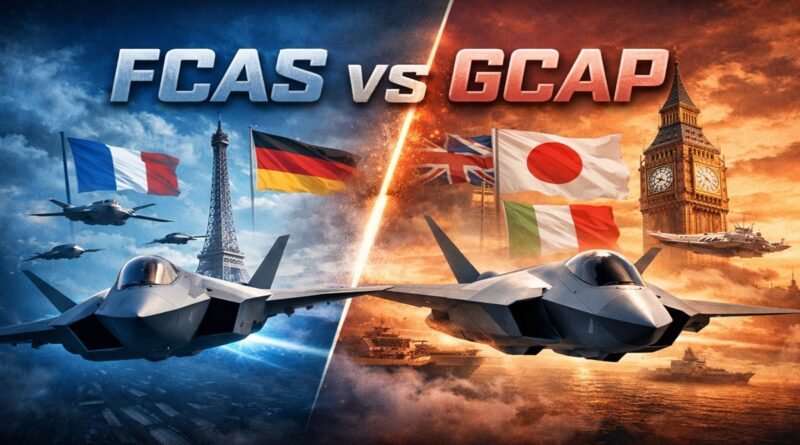
FCAS vs GCAP: Europe’s Next-Generation Fighter Programs Explained
The future of European air dominance is being shaped by two ambitious sixth-generation fighter programs: FCAS and GCAP. Both projects aim to replace existing fighter jets like the Dassault Rafale and Eurofighter Typhoon, but they differ in structure, partnerships, and strategic vision.
This article provides a detailed comparison of FCAS vs GCAP, including participating countries, technology focus, timelines, and geopolitical implications.
What is FCAS?
Future Combat Air System (FCAS) is a joint defense initiative led by France, Germany, and Spain. It is designed to develop a Next Generation Fighter (NGF) along with a connected system of drones, satellites, and combat cloud infrastructure.
Key Features of FCAS
- Next Generation Fighter (NGF) as the core aircraft
- “Remote Carriers” (loyal wingman drones)
- Advanced AI-driven combat cloud
- Stealth and sensor fusion technology
- Nuclear deterrence compatibility (important for France)
Major Companies Involved
- Dassault Aviation
- Airbus
- Indra Sistemas
Expected Timeline
- Prototype flight: Early 2030s
- Operational deployment: Around 2040
What is GCAP?
Global Combat Air Programme (GCAP) is a trilateral collaboration between the United Kingdom, Japan, and Italy. It merges the UK’s Tempest program with Japan’s F-X initiative.
Key Features of GCAP
- Sixth-generation stealth fighter
- Advanced electronic warfare systems
- Hypersonic weapon compatibility
- AI-assisted pilot systems
- Open architecture design for future upgrades
Major Companies Involved
- BAE Systems
- Mitsubishi Heavy Industries
- Leonardo S.p.A.
Expected Timeline
- First flight: Mid-2030s
- Service entry: Around 2035
FCAS vs GCAP: Direct Comparison
| Feature | FCAS | GCAP |
|---|---|---|
| Lead Nations | France, Germany, Spain | UK, Japan, Italy |
| Core Fighter | NGF | Tempest-based platform |
| Target Entry | ~2040 | ~2035 |
| Nuclear Role | Yes (France) | No (primarily conventional) |
| Political Complexity | High (EU internal disputes) | Relatively streamlined |
| Strategic Focus | European strategic autonomy | NATO + Indo-Pacific alignment |
Strategic Differences
1. Political Vision
FCAS emphasizes European defense autonomy, reducing reliance on the United States. Meanwhile, GCAP reflects strong NATO alignment and Indo-Pacific security cooperation, especially due to Japan’s involvement.
2. Industrial Competition
France insists on technological sovereignty, particularly through Dassault Aviation, while Germany prefers shared leadership via Airbus. These tensions have slowed FCAS negotiations.
GCAP appears more commercially streamlined, with clearer industrial division among BAE Systems and partners.
3. Technology Architecture
- FCAS strongly emphasizes a combat cloud network.
- GCAP focuses on open-system modular architecture, making upgrades easier over time.
Which Program Is More Likely to Succeed?
Currently, GCAP is perceived as moving faster due to clearer governance and earlier service entry goals. However, FCAS may deliver deeper European integration if political challenges are resolved.
Both programs aim to compete with:
- F-35 Lightning II
- Chengdu J-20
- Sukhoi Su-57
Conclusion
The FCAS vs GCAP debate is not just about aircraft—it is about the future of global air power and geopolitical alignment.
- FCAS represents European sovereignty and strategic autonomy.
- GCAP represents trans-regional defense collaboration between Europe and Asia.
By 2040, one or both of these platforms could redefine modern aerial warfare.
