
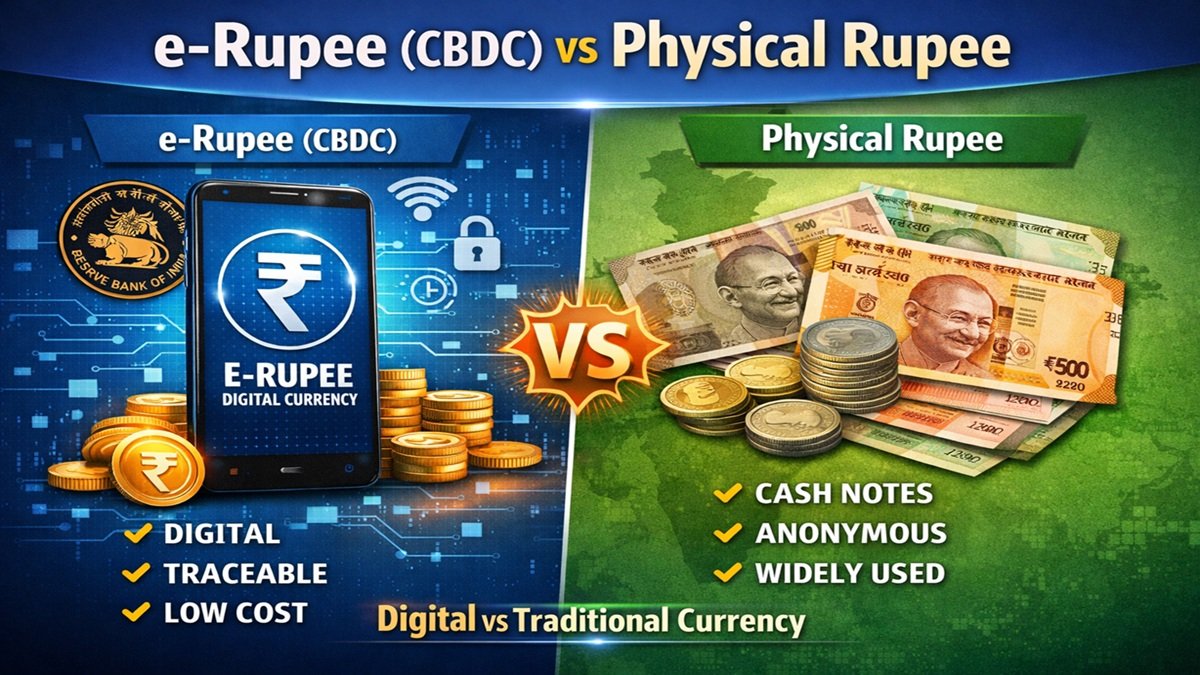
e-Rupee (CBDC) vs Indian Physical Rupee: Key Differences Explained
India’s monetary system is undergoing a historic transition with the introduction of the e-Rupee, also known as the Central Bank Digital Currency (CBDC). Issued by the Reserve Bank of India (RBI), the e-Rupee exists alongside traditional paper currency and coins, commonly referred to as the physical rupee.
This article explains the difference between e-Rupee and Indian physical rupee, their features, advantages, limitations, and how both will coexist in India’s digital economy.
What Is the Indian Physical Rupee?
The physical rupee is the traditional form of money in India, including paper notes and metallic coins issued by the RBI.
Key Characteristics of Physical Rupee
- Tangible and universally accepted
- Does not require internet or electricity
- Enables anonymous transactions
- Prone to wear, counterfeiting, and handling costs
- Difficult to track or trace
Physical cash has been the backbone of India’s economy for decades, especially in rural and informal sectors.
What Is the e-Rupee (CBDC)?
The e-Rupee is a digital version of the Indian rupee issued directly by the RBI. Unlike UPI or wallets, it is legal tender, just like cash.
Key Characteristics of e-Rupee
- Fully digital and sovereign-backed
- Same value as physical rupee (₹1 = ₹1)
- Stored in digital wallets
- Works for peer-to-peer (P2P) and merchant payments
- Can be programmed for specific use cases
The e-Rupee aims to combine the trust of cash with the efficiency of digital payments.
e-Rupee vs Indian Physical Rupee: Detailed Comparison
| Feature | e-Rupee (CBDC) | Physical Rupee |
|---|---|---|
| Issuer | RBI | RBI |
| Form | Digital | Paper & coins |
| Legal Tender | Yes | Yes |
| Internet Dependency | Partial (offline mode planned) | No |
| Anonymity | Limited | High |
| Traceability | High | Low |
| Risk of Theft | Low (recoverable) | High |
| Counterfeit Risk | Nil | Present |
| Storage Cost | Minimal | High (printing & logistics) |
Advantages of e-Rupee Over Physical Cash
1. Reduced Cost of Currency Management
Printing, transporting, and storing cash is expensive. The e-Rupee significantly reduces these costs for the government.
2. Improved Transparency
Digital traceability helps curb black money, counterfeit currency, and illegal transactions.
3. Faster Transactions
Instant settlement without intermediaries improves efficiency in retail and wholesale payments.
4. Financial Inclusion
People without bank accounts can potentially use e-Rupee wallets, expanding access to formal finance.
5. Programmable Money
Government subsidies or welfare payments can be programmed to ensure targeted usage.
Advantages of Physical Rupee Over e-Rupee
1. Complete Privacy
Cash transactions offer higher anonymity compared to digital currencies.
2. Works Without Technology
No smartphone, internet, or electricity is required.
3. Universal Acceptance
Cash is accepted everywhere, including remote areas.
4. Familiarity and Trust
People are comfortable using physical money, especially older generations.
Is e-Rupee the Same as UPI or Digital Payments?
No. This is a common misconception.
- UPI / Wallets: Use bank deposits as money
- e-Rupee: Is actual RBI-issued currency in digital form
Even if banks fail, the e-Rupee remains valid because it is a direct liability of the RBI, just like physical cash.
Will e-Rupee Replace Physical Cash in India?
No. The RBI has clearly stated that the e-Rupee is meant to complement, not replace, physical cash.
India’s diverse population, varying digital literacy, and infrastructure gaps mean that both forms will coexist for the foreseeable future.
Use Cases of e-Rupee in India
- Retail payments
- Interbank settlements
- Government welfare distribution
- Cross-border transactions (future scope)
- Offline digital payments
Challenges of e-Rupee Adoption
- Privacy concerns
- Cybersecurity risks
- Digital literacy gaps
- Smartphone and internet access limitations
Addressing these challenges is critical for mass adoption.
Conclusion
The e-Rupee vs Indian physical rupee debate is not about replacement but evolution. While physical cash continues to play a vital role, the e-Rupee represents India’s step toward a secure, efficient, and future-ready monetary system.
Both forms of money will coexist, giving citizens the choice of convenience or anonymity, depending on their needs.
