
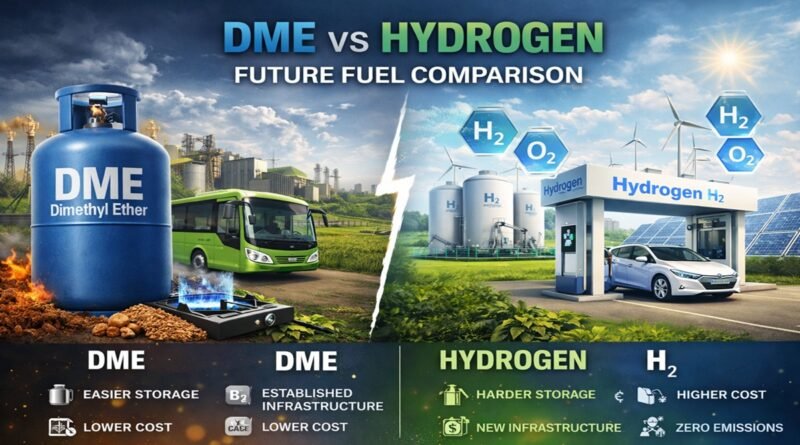
DME vs Hydrogen: Future Fuel Comparison
Introduction
As the world moves toward cleaner and more sustainable energy systems, the search for alternatives to fossil fuels has intensified. Among the most promising contenders are Dimethyl Ether (DME) and Hydrogen fuel. Both are being explored as next-generation energy sources capable of reducing emissions and improving energy security.
However, these two fuels differ significantly in terms of production, storage, infrastructure, cost, and real-world usability. This article provides a detailed comparison to understand which fuel holds more practical potential—especially for countries like India.
What is DME (Dimethyl Ether)?
Dimethyl Ether (DME) is a clean-burning fuel with the chemical formula CH₃OCH₃. It behaves similarly to LPG and can be stored as a liquid under moderate pressure.
Key Features:
- Can be used in LPG cylinders
- Burns with almost zero soot
- Can be produced from biomass, coal, natural gas
- Suitable for cooking, transport, and industrial use
Read this: DME as a Strategic Alternative Fuel During the LPG Crisis Triggered by the US–Israel–Iran Conflict
What is Hydrogen Fuel?
Hydrogen is the lightest and most abundant element in the universe. As a fuel, it is used in fuel cells to produce electricity, with water as the only byproduct.
Key Features:
- Zero carbon emissions at usage
- Used in fuel cell vehicles (FCVs)
- Can be produced via electrolysis (green hydrogen)
- High energy per unit mass
Core Comparison: DME vs Hydrogen
1. Energy Efficiency
- Hydrogen: Very high energy content per kg
- DME: Lower than hydrogen but comparable to LPG
👉 Hydrogen wins in theoretical efficiency, but practical losses in storage and transport reduce its advantage.
2. Storage & Transportation
- DME:
- Easy to store like LPG
- Uses existing cylinders and infrastructure
- Hydrogen:
- Requires high-pressure tanks (350–700 bar)
- Needs cryogenic storage for liquid hydrogen
👉 DME is far easier and cheaper to handle.
3. Infrastructure Readiness
- DME:
- Can leverage LPG infrastructure
- Minimal changes required
- Hydrogen:
- Requires entirely new ecosystem
- Refueling stations are limited
👉 DME is more practical for immediate adoption.
4. Production Methods
- DME:
- From biomass, coal, natural gas
- Can use agricultural waste
- Hydrogen:
- Grey hydrogen (from fossil fuels)
- Green hydrogen (from electrolysis using renewables)
👉 Green hydrogen is clean but expensive; DME is more flexible.
5. Environmental Impact
- Hydrogen:
- Zero emissions at point of use
- Truly clean if produced via renewable energy
- DME:
- Very low emissions
- Near-zero particulate matter
- Carbon-neutral if biomass-based
👉 Hydrogen is cleaner, but DME is still very environmentally friendly.
6. Cost Factor
- DME:
- Lower production cost
- Affordable for developing countries
- Hydrogen:
- High production and storage cost
- Expensive infrastructure
👉 DME is currently more economical.
7. Use Cases
| Application | DME | Hydrogen |
|---|---|---|
| Cooking fuel | ✔️ Yes | ❌ Not practical |
| Transport | ✔️ Diesel alternative | ✔️ Fuel cell vehicles |
| Power generation | ✔️ Yes | ✔️ Yes |
| Industrial use | ✔️ Yes | ✔️ Yes |
India Perspective: Which is Better?
For India, the choice depends on practicality and scalability.
Why DME Fits India Better (Short-Term)
- Can replace LPG quickly
- Uses existing cylinder network
- Can be produced from agricultural waste
- Lower cost and faster deployment
Why Hydrogen is a Long-Term Goal
- Ideal for future green economy
- Suitable for heavy transport and industry
- Requires major infrastructure investment
Challenges Comparison
DME Challenges:
- Slightly lower energy density
- Needs minor material modifications
Hydrogen Challenges:
- Storage is difficult and risky
- High cost of production (green hydrogen)
- Infrastructure almost non-existent in many regions
Future Outlook
The future of energy will likely not depend on a single fuel but a mix of solutions.
- Short to Medium Term: DME can act as a practical replacement for LPG and diesel
- Long Term: Hydrogen may dominate as infrastructure and technology mature
Countries may adopt a hybrid approach:
- DME for immediate energy security
- Hydrogen for long-term sustainability
Read This: DME vs CNG vs LPG: Complete Comparison
Conclusion
Both DME and Hydrogen are promising alternatives to fossil fuels, but they serve different roles:
- DME is practical, affordable, and ready to deploy today
- Hydrogen is clean, powerful, but still developing
For countries facing immediate energy challenges, DME offers a realistic and scalable solution. Meanwhile, hydrogen represents the ultimate vision of a zero-carbon future.
