
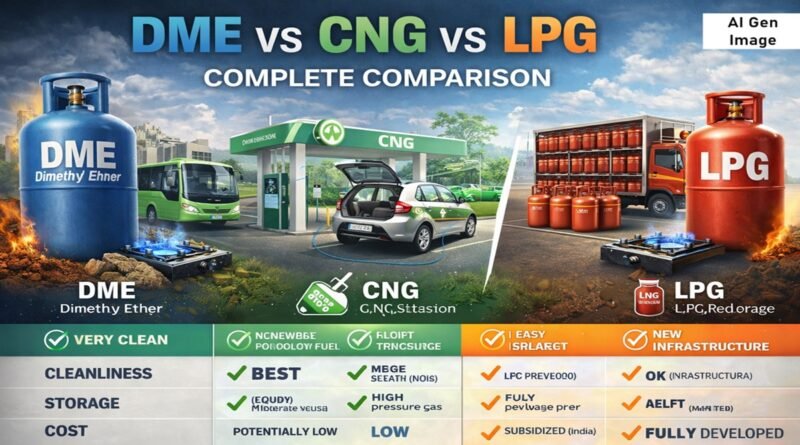
DME vs CNG vs LPG: Complete Comparison
Introduction
With rising fuel prices, environmental concerns, and global supply uncertainties, the search for cleaner and more reliable fuels has become essential. Three fuels often discussed in this context are Dimethyl Ether (DME), Compressed Natural Gas (CNG), and Liquefied Petroleum Gas (LPG).
Each of these fuels has unique characteristics, advantages, and limitations. This article provides a comprehensive comparison to help understand which fuel is best suited for different applications—especially in countries like India.
Read This: DME as a Strategic Alternative Fuel During the LPG Crisis Triggered by the US–Israel–Iran Conflict
What is DME (Dimethyl Ether)?
DME is a clean-burning fuel with the chemical formula CH₃OCH₃. It behaves similarly to LPG and can be stored as a liquid under moderate pressure.
Key Highlights:
- Can be used as an LPG substitute
- Very low emissions
- Can be produced from biomass, coal, or natural gas
- Suitable for cooking and transport
What is CNG (Compressed Natural Gas)?
CNG is natural gas (mainly methane) stored under high pressure. It is widely used as a vehicle fuel.
Key Highlights:
- Cleaner than petrol and diesel
- Widely used in cars, buses, and autos
- Requires high-pressure cylinders
- Depends on pipeline infrastructure
What is LPG (Liquefied Petroleum Gas)?
LPG is a mixture of propane and butane gases, commonly used for cooking and heating.
Key Highlights:
- Widely used in households
- Easy storage and transport
- Moderate emissions
- Mostly imported in countries like India
Core Comparison Table
| Feature | DME | CNG | LPG |
|---|---|---|---|
| Chemical Type | Ether | Methane | Propane/Butane |
| Storage | Liquid (low pressure) | Gas (high pressure) | Liquid (moderate pressure) |
| Main Use | Cooking, transport | Transport | Cooking |
| Emissions | Very low | Low | Moderate |
| Infrastructure | Emerging | Developed (limited areas) | Fully developed |
| Source | Biomass, coal, gas | Natural gas | Fossil fuel |
| Renewable Option | Yes | Limited | No |
Detailed Comparison
1. Environmental Impact
- DME:
- Near-zero particulate emissions
- No sulfur
- Can be carbon-neutral (biomass-based)
- CNG:
- Lower emissions than petrol/diesel
- Still produces CO₂
- LPG:
- Cleaner than coal/wood
- Higher emissions than DME
👉 Winner: DME (cleanest overall)
2. Storage & Safety
- DME:
- Stored like LPG
- Slightly more volatile but manageable
- CNG:
- Stored at very high pressure (200–250 bar)
- Requires strong cylinders
- LPG:
- Easy storage in cylinders
- Widely proven safety systems
👉 Winner: LPG (most practical), DME close second
3. Cost & Affordability
- DME:
- Potentially low cost if produced locally
- Currently limited availability
- CNG:
- Cheaper than petrol/diesel
- Requires vehicle conversion
- LPG:
- Subsidized in many countries
- Prices fluctuate with imports
👉 Winner: DME (future), CNG (current for transport)
4. Infrastructure
- DME:
- Can use LPG infrastructure (with minor changes)
- Still developing
- CNG:
- Needs pipeline network and stations
- Limited to urban areas
- LPG:
- Fully established nationwide
👉 Winner: LPG (current), DME (future-ready)
5. Energy Efficiency
- DME:
- Slightly lower energy density than LPG
- CNG:
- Good efficiency but bulky storage
- LPG:
- High energy density
- Efficient for cooking
👉 Winner: LPG
6. Use Case Suitability
| Application | Best Fuel |
|---|---|
| Cooking | LPG / DME |
| Cars & Autos | CNG |
| Trucks & Buses | DME / CNG |
| Rural Energy | DME |
India Perspective
Why LPG is Dominant Today
- Government subsidy schemes
- Strong distribution network
- Easy to use in households
Why CNG is Growing
- Cheaper fuel for vehicles
- Lower pollution in cities
Why DME is the Future
- Can reduce LPG imports
- Can be produced from agricultural waste
- Cleaner than both LPG and CNG
- Suitable for both cooking and transport
Challenges of Each Fuel
DME Challenges:
- Limited production capacity
- Needs policy support
- Material compatibility issues
CNG Challenges:
- Limited availability in rural areas
- High initial setup cost
LPG Challenges:
- Import dependency
- Price volatility
- Moderate pollution
Future Outlook
The future energy system will likely be a combination of fuels:
- Short Term: LPG and CNG will continue dominating
- Medium Term: DME blending with LPG will increase
- Long Term: DME could replace LPG in many areas
Governments may promote:
- Biomass-based DME plants
- Cleaner urban transport (CNG/DME)
- Reduced fossil fuel dependency
Read this: DME vs Hydrogen: Future Fuel Comparison
Conclusion
Each fuel has its strengths:
- LPG: Reliable and widely used
- CNG: Cost-effective for vehicles
- DME: Clean, flexible, and future-ready
👉 Final Verdict:
- Present: LPG + CNG dominate
- Future: DME has the highest potential
