
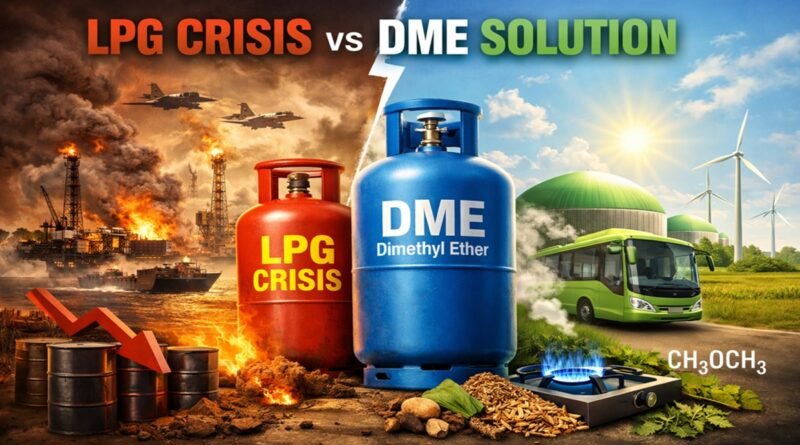
DME as a Strategic Alternative Fuel During the LPG Crisis Triggered by the US–Israel–Iran Conflict
Introduction
The escalating geopolitical tensions involving the United States, Israel, and Iran in 2026 have significantly disrupted global energy supply chains. One of the most critical choke points—the Strait of Hormuz—has faced instability, affecting the transportation of a large share of the world’s oil and gas.
As a result, multiple fuel markets have been impacted, but one of the most sensitive areas has been Liquefied Petroleum Gas (LPG), which is widely used for cooking and household needs.
Countries like India, which depend heavily on LPG imports from the Middle East, are facing serious supply challenges. This has intensified the search for reliable, scalable, and locally producible alternatives. Among the available options, Dimethyl Ether (DME) is gaining attention as a practical and forward-looking solution.
Read this: DME vs Hydrogen: Future Fuel Comparison
LPG Crisis: Understanding the Impact
The ongoing conflict has disrupted:
- Major shipping routes
- Oil and gas production facilities
- Export channels from the Gulf region
These disruptions have led to:
- Rising fuel prices globally
- Supply shortages in LPG-dependent regions
- Operational challenges for households, restaurants, and small businesses
Unlike other fuels, LPG is directly linked to daily life, especially in developing countries. Any disruption in its availability quickly turns into a widespread social issue.
What is Dimethyl Ether (DME)?
Dimethyl Ether (DME) is a clean-burning fuel with the chemical formula CH₃OCH₃. It is a colorless gas that can be liquefied under moderate pressure, making it similar to LPG in terms of storage and transportation.
DME can be produced from multiple feedstocks:
- Natural gas
- Coal
- Biomass (such as agricultural waste)
- Industrial carbon dioxide (through advanced processes)
This flexibility makes it a highly adaptable and future-ready fuel.
Why DME is a Strong Alternative to LPG
1. Compatibility with Existing LPG Systems
One of the biggest advantages of DME is that it can be blended with LPG (typically up to 15–20%) without requiring major changes in infrastructure.
This enables:
- Quick adoption during emergencies
- Minimal investment in new systems
- Smooth transition from LPG to alternative fuels
2. Potential for Domestic Production
Unlike LPG, which depends on imports, DME can be produced within the country using locally available resources such as:
- Agricultural residues
- Coal reserves
- Industrial emissions
This opens the door to energy self-reliance and reduces vulnerability to global conflicts.
3. Environmentally Cleaner Fuel
DME burns much more cleanly compared to LPG and diesel:
- Produces very low particulate matter
- Contains no sulfur
- Can significantly reduce carbon emissions when derived from renewable sources
This aligns with global environmental goals and sustainability targets.
4. Versatile Applications
DME is not limited to household cooking. It can also be used in:
- Transportation (as a diesel alternative)
- Power generation
- Industrial and aerosol applications
This multi-use capability makes it a strategic energy resource.
LPG vs DME: A Comparative Perspective
| Parameter | LPG | DME |
|---|---|---|
| Dependency | High import reliance | Can be domestically produced |
| Emissions | Moderate | Very low |
| Supply Risk | High in geopolitical crises | Lower with local production |
| Infrastructure | Fully developed | Partially compatible |
| Sustainability | Fossil-based | Renewable potential |
Challenges in DME Adoption
While DME offers many benefits, certain challenges must be addressed:
Infrastructure Development
Large-scale production and distribution systems for DME are still under development.
Material Adjustments
DME has different chemical properties and may require modifications in storage components like seals and valves.
Energy Output
DME has slightly lower energy density than LPG, which means consumption may be marginally higher.
Policy Support
Government incentives, regulations, and investments are essential for scaling up DME adoption.
Strategic Importance for India
The current crisis highlights the urgent need for energy diversification.
Adopting DME could help India:
- Reduce dependence on Middle Eastern imports
- Utilize agricultural waste efficiently
- Strengthen domestic energy production
- Improve environmental performance
It also presents an opportunity to build a new energy ecosystem that benefits both urban and rural sectors.
Future Outlook
If geopolitical tensions continue or similar disruptions arise in the future:
- Fossil fuel markets will remain unstable
- Countries will accelerate the adoption of alternative fuels
- DME could transition from a niche solution to a mainstream energy source
The shift may occur gradually:
- Blending DME with LPG
- Introducing dedicated DME distribution systems
- Expanding its use across industries
Read this: DME vs CNG vs LPG: Complete Comparison
Conclusion
The current LPG shortage caused by global conflict is a clear reminder of the risks associated with overdependence on imported fuels.
Dimethyl Ether (DME) stands out as a viable alternative because it:
- Integrates well with existing systems
- Can be produced domestically
- Offers cleaner combustion
In the long term, fuels like DME are not just substitutes—they are essential components of a resilient and sustainable energy future.
