
DHRUV64: India’s Strategic Leap Toward Semiconductor Self-Reliance
Introduction
On 15 December 2025, the Government of India unveiled DHRUV64, the country’s first fully indigenous 1.0 GHz, 64-bit dual-core microprocessor, developed by the Centre for Development of Advanced Computing (C-DAC) under the Microprocessor Development Programme (MDP). This achievement marks a major milestone in India’s semiconductor history and represents a decisive shift toward technological autonomy in the core building blocks of modern digital systems. (Press Information Bureau)
Microprocessors — essentially the brains of electronic devices — are ubiquitous in modern life, powering everything from smartphones and servers to industrial machinery, automobiles, satellites, and defense electronics. Traditionally, India has been heavily dependent on imported microprocessors and chipsets for such applications. DHRUV64’s launch signals a new chapter in reducing this dependence while strengthening India’s domestic semiconductor design and innovation ecosystem. (Press Information Bureau)
What Is DHRUV64?
DHRUV64 is a 64-bit, dual-core microprocessor operating at a clock speed of 1.0 GHz. Its architecture supports modern computing workloads, improved multitasking, and higher reliability compared to older generations of processors. Developed using an open-architecture instruction set (RISC-V), DHRUV64 can be integrated into a diverse range of systems, thanks to its flexible and royalty-free design. (Press Information Bureau)
Key Technical Characteristics
- Clock Speed: 1.0 GHz
- Architecture: 64-bit dual-core
- Instruction Set: RISC-V (open, royalty-free ISA)
- Designed For: Strategic and commercial computing applications
- Primary Use Cases: Consumer electronics, industrial automation, 5G infrastructure, automotive systems, IoT devices, and more (Press Information Bureau)
Although not designed to compete directly with high-end microprocessors from global tech giants in raw performance, DHRUV64’s architecture emphasizes scalability, security, and integration flexibility, making it suitable for a broad set of non-consumer and embedded applications where customization and sovereignty matter more than sheer clock speeds. (businessworld.in)
Strategic Importance of an Indigenous Microprocessor
Reducing Dependence on Imports
India is estimated to consume approximately 20 % of the world’s microprocessors but has historically imported the vast majority of them. This dependence exposes the country to global supply chain disruptions and geo-economic pressures. DHRUV64 mitigates this vulnerability by enabling India to design, test, and prototype processors domestically, gradually reducing reliance on foreign-made chips. (Press Information Bureau)
Economic and Technological Autonomy
Design and ownership of key semiconductor technologies contribute directly to national autonomy in critical sectors, such as defense electronics, aerospace systems, and strategic communications infrastructure. By nurturing homegrown innovation, India can tailor microprocessors to strategic priorities — incorporating security features, compliance requirements, and performance attributes specific to mission-critical tasks. (Press Information Bureau)
Building an Innovation Ecosystem
DHRUV64’s open architecture and indigenously developed design tools enable startups, researchers, and academic institutions to experiment, innovate, and contribute to India’s chip design ecosystem. By sharing a common RISC-V foundation, multiple stakeholders can collaborate, share codebases, and create interoperable hardware platforms — fostering a strong ecosystem of domestic microprocessor designers. (Press Information Bureau)
The Role of RISC-V in India’s Microprocessor Strategy
One of the defining technical choices in DHRUV64’s development is the use of the RISC-V instruction set architecture (ISA) — an open, royalty-free alternative to proprietary ISAs like ARM or x86.
What Is RISC-V?
RISC-V is an open-source ISA that anyone can use without licensing fees, unlike many commercial alternatives that require expensive and restrictive royalties. This strategic choice enables more affordable design, testing, and deployment of custom processors. (Press Information Bureau)
Advantages of RISC-V for India
- Cost Efficiency: Eliminates licensing costs, lowering barriers for startups and research institutions.
- Customization: Enables tailored instruction sets for specific use cases, such as security, networking, or industrial protocols.
- Ecosystem Growth: Encourages open innovation across academia and industry, leading to a diverse portfolio of hardware designs. (Press Information Bureau)
This commitment to RISC-V aligns with India’s broader goal of nurturing a collaborative technology environment where domestic innovators can build competitive hardware solutions without being constrained by proprietary license fees and restrictions. (Press Information Bureau)
The Indian Microprocessor Ecosystem: Historical Context
India’s pursuit of indigenous microprocessor development is not a recent effort but part of a decades-long progression of research and innovation.
Earlier Indigenous Processors
Before DHRUV64, several notable indigenously designed processors had emerged in India:
- SHAKTI (IIT Madras): A family of RISC-V microprocessors designed for strategic and research applications. (Wikipedia)
- AJIT (IIT Bombay): Designed for robotics and industrial purposes. (Press Information Bureau)
- VIKRAM (ISRO–SCL): Developed for space applications where reliability in extreme conditions is crucial. (Press Information Bureau)
- THEJAS64 (C-DAC): A 64-bit SoC supporting industrial automation. (Press Information Bureau)
Each of these processors contributed incrementally to India’s chip innovation capabilities, but DHRUV64 represents the first commercially viable general-purpose microprocessor — a more significant step in mainstream adoption and ecosystem development. (Press Information Bureau)
The Digital India RISC-V (DIR-V) Programme
Central to the development and deployment of DHRUV64 is the Government of India’s Digital India RISC-V (DIR-V) Programme — a flagship initiative aimed at building a complete portfolio of RISC-V-based processors and establishing India as a hub for electronics system design and manufacturing (ESDM). (Press Information Bureau)
Core Objectives of DIR-V
- Develop Indigenous Processors: Design and fabricate microprocessors across performance tiers.
- Encourage Collaboration: Bring together academia, startups, industry, and research organizations.
- Build Talent: Enhance semiconductor design skills through training, workshops, and research projects.
- Reduce Import Dependence: Create a self-sustaining ecosystem that minimizes reliance on foreign technology. (Press Information Bureau)
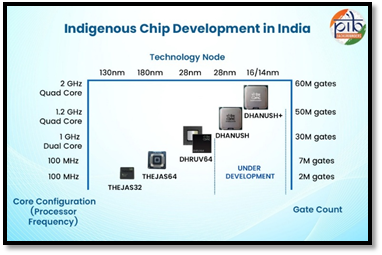
Under DIR-V, DHRUV64 is the third microprocessor fabricated, following:
- THEJAS32: First prototype chip.
- THEJAS64: Second prototype and industrial SoC.
- DHRUV64: First commercially deployable, high-value microprocessor. (Press Information Bureau)
Future Roadmap: Dhanush and Dhanush+
Following DHRUV64, C-DAC and partnering institutions are already developing Dhanush and Dhanush+ — next-generation processors that aim to deliver higher performance, expanded core counts, and enhanced capabilities for strategic computing workloads. (Press Information Bureau)
Institutional Drivers Behind Indigenous Chip Development
The success of DHRUV64 reflects a coordinated effort among several national programmes and institutions led primarily by the Ministry of Electronics and Information Technology (MeitY).
Ministry of Electronics and Information Technology (MeitY)
MeitY provides policy guidance, funding, and strategic oversight to India’s semiconductor initiatives, including DIR-V, the Microprocessor Development Programme, and the India Semiconductor Mission (ISM) — a body that facilitates large semiconductor investments across the country. (Press Information Bureau)
C-DAC: Centre for Development of Advanced Computing
C-DAC has been the principal design organization behind many of India’s indigenous processors, including DHRUV64. It not only develops processor IPs and SoCs but also provides tools, development boards, and support infrastructure that enable broader adoption and experimentation. (Press Information Bureau)
Other Supporting Programmes
- India Semiconductor Mission (ISM): Encourages investments in fabrication, assembly, and packaging facilities in India. (Press Information Bureau)
- Chips to Startup (C2S): Builds manpower and supports semiconductor startups across academia and MSMEs. (Press Information Bureau)
- Design Linked Incentive (DLI): Offers financial support for chip design and related infrastructure development. (Press Information Bureau)
- Indian Nanoelectronics Users Programme (INUP-i2i): Provides hands-on training in fabrication and prototyping. (Press Information Bureau)
Potential Applications and Sectoral Impact
DHRUV64’s flexible design and open architecture enable a wide range of applications:
Telecommunications and 5G Infrastructure
With India ramping up 5G deployments nationwide, having indigenous processors that can handle baseband processing, signal control, and network edge computing will reduce reliance on foreign semiconductor IPs and improve national control over critical infrastructure. (Press Information Bureau)
Industrial Automation and IoT
Factories and industrial systems increasingly rely on embedded computing platforms for automation, robotics, and real-time data processing. DHRUV64 can serve as a reliable processor for such industrial IoT devices and control units. (Press Information Bureau)
Automotive Systems
Modern vehicles — especially electric and autonomous vehicles — require onboard computing for navigation, safety systems, and sensor fusion. Indigenous processors like DHRUV64 can be adapted to automotive-grade specifications, reducing dependency on imported chips. (Press Information Bureau)
Consumer Electronics
Although current global demand favors high-performance CPUs from global manufacturers, DHRUV64 can be vital in mid-range smart devices, educational hardware, and locally manufactured systems that emphasize customizability over raw performance. (Press Information Bureau)
Strategic and Defense Applications
Customized processors with secure hardware features are particularly valuable for defense electronics, secure communications, and defense-specific computing platforms where intellectual property protection and security assurances are paramount. (Press Information Bureau)
Challenges and Opportunities Ahead
While DHRUV64’s launch is a significant breakthrough, the road to global competitiveness in semiconductor design is long and complex.
Performance Competitiveness
At 1.0 GHz, DHRUV64 is relatively modest in performance compared to commercial processors from industry leaders like Intel, AMD, or ARM-based designs in mainstream consumer markets. However, India’s strategy emphasizes specialized, domain-focused solutions rather than direct competition in high-end CPUs. This focus will allow India to build custom processors optimized for targeted use cases rather than raw benchmark performance. (businessworld.in)
Ecosystem Development
For sustainable growth, India needs a larger ecosystem of fabrication facilities (fabs), testing labs, packaging units, and supply chain partners. The India Semiconductor Mission and associated incentives are steps in this direction, but long lead times and capital intensity are inherent challenges. (Press Information Bureau)
Talent and R&D
India already has a strong base of chip design engineers, estimated to account for around 20 % of the global workforce. Programs like C2S and INUP-i2i aim to expand this workforce further, enabling India to compete in complex chip design and semiconductor R&D. (Press Information Bureau)
Conclusion: A Milestone in India’s Technology Narrative
The launch of DHRUV64 represents more than just another hardware announcement — it is a symbolic and functional milestone in India’s ongoing quest for technological self-reliance. It marks a turning point where India transitions from being a consumer of global semiconductor technologies to a creator and exporter of cutting-edge digital infrastructure.
Through strategic programmes, open-architecture innovation, and coordinated institutional support, India is actively reshaping its semiconductor future. DHRUV64, along with the growing ecosystem of indigenous processors, positions the nation on a confident path toward innovation, security, and economic autonomy in the digital age. (Press Information Bureau)
