
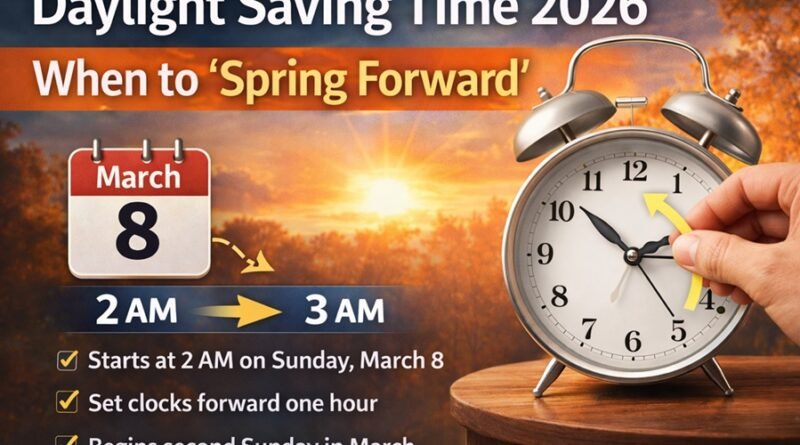
Daylight Saving Time 2026: When to ‘Spring Forward’ and What to Know
The time to “spring forward” is almost here.
As winter transitions into spring, clocks across much of the United States will move ahead by one hour for Daylight Saving Time (DST). This seasonal shift means longer evenings with more daylight — but slightly darker mornings.
Here’s everything you need to know about Daylight Saving Time 2026, including when it starts, when it ends, which states observe it, and how it may affect your health.
When Do We ‘Spring Forward’ in 2026?
Daylight Saving Time in 2026 begins at 2 a.m. on Sunday, March 8.
At that time, clocks must be set forward one hour — from 2 a.m. to 3 a.m.
This means:
- Sunrise and sunset will occur about one hour later than the previous day
- There will be more daylight in the evening
- There will be less daylight in the early morning
Daylight saving time in the U.S. always begins on the second Sunday in March and ends on the first Sunday in November.
In 2026, DST will end on Sunday, November 1, when clocks will “fall back” one hour.
Why Do We Change the Clocks?
According to Time and Date, setting clocks forward was introduced in the U.S. to make better use of natural daylight and conserve energy.
The United States has followed the current DST schedule since 2007.
The idea behind DST:
- Maximize evening daylight
- Reduce the need for artificial lighting
- Encourage outdoor activity
Do All States Observe Daylight Saving Time?
No, not all U.S. states and territories observe DST.
The following do not participate:
- Hawaii
- Most of Arizona
- American Samoa
- Guam
- Northern Mariana Islands
- Puerto Rico
- U.S. Virgin Islands
Arizona does not observe DST due to its desert climate. However, the Navajo Nation, which spans parts of Arizona, Utah, and New Mexico, does observe daylight saving time.
Most other U.S. states participate.
Does Daylight Saving Time Affect Your Health?
Johns Hopkins Bloomberg School of Public Health reports that adjusting clocks can disrupt sleep patterns for millions of people.
Researchers have linked the time change to:
- Sleep disturbances
- Mood changes
- Increased hospital admissions
- Higher risk of car accidents in the days following the shift
For over 300 million Americans, even a one-hour change can temporarily affect the body’s internal clock.
Tips to Adjust to Daylight Saving Time
Here are a few helpful tips (courtesy of Time and Date) to ease the transition:
1. Gradually Adjust Sleep
Go to bed 10–15 minutes earlier each night leading up to March 8.
2. Get Morning Sunlight
Spend time outside early in the day to help reset your body clock naturally.
3. Limit Caffeine
Avoid caffeine late in the afternoon or evening.
4. Maintain a Consistent Routine
Keep your sleep and meal schedule steady — even on weekends.
Final Takeaway
Daylight Saving Time 2026 begins at 2 a.m. on Sunday, March 8, when Americans will move their clocks forward one hour.
While the shift brings brighter evenings, it can temporarily disrupt sleep and daily routines. Preparing in advance can help minimize its effects.
Mark your calendar — and don’t forget to “spring forward.”
