
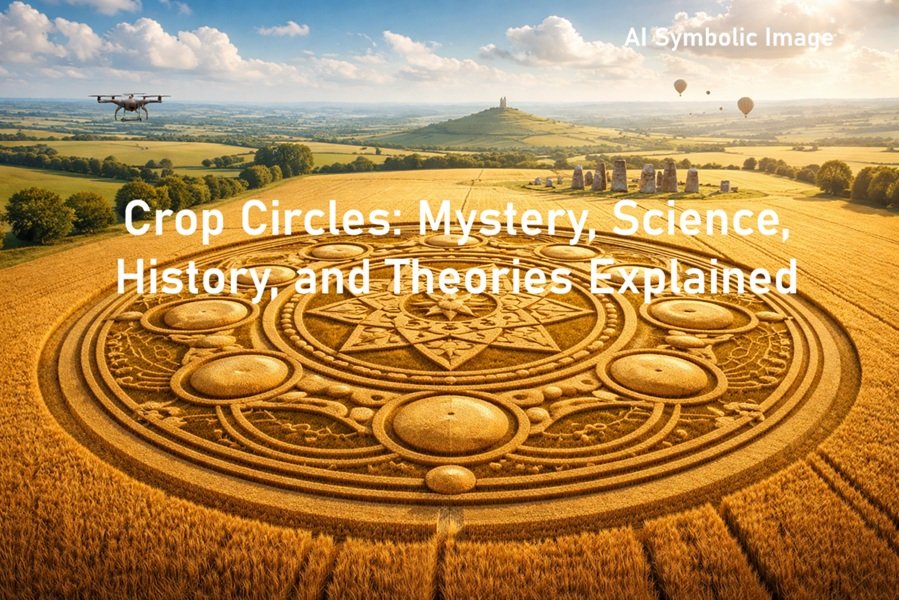
Crop Circles: Mystery, Science, History, and Theories Explained
Crop circles are one of the most intriguing and controversial phenomena of the modern world. Appearing suddenly in agricultural fields, these intricate geometric patterns have sparked global curiosity, scientific investigation, media attention, and countless debates. Are crop circles messages from extraterrestrial intelligence, unknown natural phenomena, or elaborate human-made artworks? This article explores the history, characteristics, scientific explanations, cultural impact, and theories surrounding crop circles in a comprehensive and unbiased manner.
What Are Crop Circles?
Crop circles are patterns formed by flattening crops such as wheat, barley, corn, or rice, typically found in large open fields. The plants are bent close to the ground rather than broken, creating visible designs when viewed from above.
Key Characteristics
- Usually appear overnight
- Found mostly in grain crops
- Designs range from simple circles to highly complex geometric patterns
- Crops are often bent at nodes, not snapped
- Patterns are best visible from aerial views
Historical Background of Crop Circles
Early References
The phenomenon of flattened crop patterns is not entirely new.
- 1678: A woodcut pamphlet from England titled “The Mowing Devil” describes a mysterious circular pattern in a field.
- 19th–20th centuries: Isolated reports of strange crop formations appeared in rural Europe.
However, modern crop circles as we know them gained prominence in the late 20th century.
Rise in Modern Times
- 1970s–1980s: Sudden increase in crop circles, especially in southern England
- Wiltshire and Hampshire became global hotspots
- Media attention turned crop circles into an international mystery
Where Are Crop Circles Found?
Although reported worldwide, certain regions experience higher frequencies.
Major Hotspots
- United Kingdom (Wiltshire, near Stonehenge and Avebury)
- United States
- Canada
- Germany
- Netherlands
- Australia
- Japan
- India (sporadic reports)
England remains the epicenter of crop circle activity.
Types of Crop Circle Designs
1. Simple Circular Patterns
- Single or multiple concentric circles
- Early and most basic form
2. Geometric Designs
- Triangles, squares, hexagons
- Precise symmetry
3. Fractals
- Self-repeating mathematical patterns
- Extremely complex and precise
4. Pictograms
- Representations of symbols, faces, or objects
- Some resemble ancient or astronomical symbols
5. Astronomical Patterns
- Designs aligned with solstices, eclipses, or planetary movements
How Crop Circles Are Made (Physical Observations)
Plant Behavior Inside Crop Circles
Researchers have noted:
- Crops are bent, not broken
- Nodes (joints in the stem) sometimes show elongation
- Seeds from affected crops sometimes show altered germination rates
These observations have fueled debates about whether human tools alone can replicate such effects.
Scientific Explanations for Crop Circles
1. Human-Made Hoaxes (Most Accepted Explanation)
Many crop circles are now widely acknowledged to be man-made.
Evidence Supporting Human Creation
- Confessions by circle-makers
- Tools such as:
- Wooden planks
- Ropes
- GPS devices
- Laser guides
- Time-lapse footage of people creating complex designs overnight
Famous Admission
In 1991, two Englishmen, Doug Bower and Dave Chorley, admitted to creating hundreds of crop circles since the late 1970s.
2. Natural Phenomena Theories
Some scientists have explored natural explanations, though none fully account for all cases.
Plasma Vortex Theory
- Suggests spinning columns of charged plasma flatten crops
- Explains circular motion but lacks strong experimental proof
Wind and Weather Patterns
- Whirlwinds or microbursts can flatten crops
- However, they rarely produce precise geometric patterns
3. Electromagnetic Effects
- Some claim localized electromagnetic radiation alters plant growth
- Soil samples sometimes show slight magnetic anomalies
- Results are inconsistent and not universally reproducible
Extraterrestrial Theories
One of the most popular public beliefs is that crop circles are messages from alien civilizations.
Arguments Used by Proponents
- Extreme geometric precision
- Appearing near ancient monuments
- Mathematical ratios such as:
- Pi (π)
- Golden Ratio (φ)
- No visible entry or exit marks
Scientific Position
- No verified evidence links crop circles to extraterrestrial activity
- No signals, materials, or technology of non-human origin have been confirmed
Mathematical and Symbolic Interpretations
Some crop circles contain:
- Advanced geometry
- Complex fractals
- Astronomical alignments
These have led researchers to speculate about:
- Sacred geometry
- Universal mathematics
- Symbolic communication
However, skilled human designers can also intentionally incorporate these elements.
Crop Circles and Ancient Sites
Many crop circles appear near:
- Stonehenge
- Avebury
- Silbury Hill
This has led to theories connecting crop circles with:
- Ley lines
- Earth energy grids
- Ancient astronomical knowledge
There is no scientific consensus confirming such connections.
Media, Art, and Cultural Impact
Popular Culture
- Documentaries
- Movies
- Books
- Television series
Crop circles have become symbols of mystery and the unknown.
Tourism
- Temporary crop circle tourism boosts local economies
- Guided tours and aerial photography are common
Crop Circle Art Movement
Some modern artists openly create crop circles as:
- Environmental art
- Temporary land installations
- Large-scale geometric expressions
Crop Circles in India
India has reported occasional crop circle sightings, particularly in:
- Madhya Pradesh
- Maharashtra
- Karnataka
Most cases were later attributed to:
- Human activity
- Agricultural practices
- Natural flattening
No verified unexplained cases have been officially confirmed.
Investigations and Research Organizations
Notable Groups
- Centre for Crop Circle Studies (UK)
- Independent researchers and skeptics
- Agricultural scientists
Research Methods
- Soil analysis
- Plant tissue examination
- Drone and satellite imaging
- Statistical pattern analysis
Results generally favor human creation, with a few anomalies still debated.
Why Do Crop Circles Still Fascinate Us?
Crop circles persist in popular imagination because they combine:
- Mystery
- Geometry
- Nature
- Art
- The possibility of the unknown
They challenge the boundary between science and belief, logic and wonder.
Are Crop Circles Still Appearing Today?
Yes, though at a reduced frequency.
- Improved surveillance and technology make hoaxes easier to detect
- Many creators now openly claim authorship
- Social media has shifted public attention elsewhere
Conclusion
Crop circles are a fascinating blend of human creativity, scientific inquiry, cultural symbolism, and mystery. While the overwhelming majority are now understood to be human-made, their impact on popular culture and scientific curiosity remains significant. Crop circles remind us of humanity’s deep fascination with patterns, the universe, and the unknown—and how easily mystery can grow where knowledge is incomplete.
Rather than being proof of extraterrestrial intelligence, crop circles stand as a testament to human imagination, artistic expression, and our enduring desire to search for meaning beyond the ordinary.
