
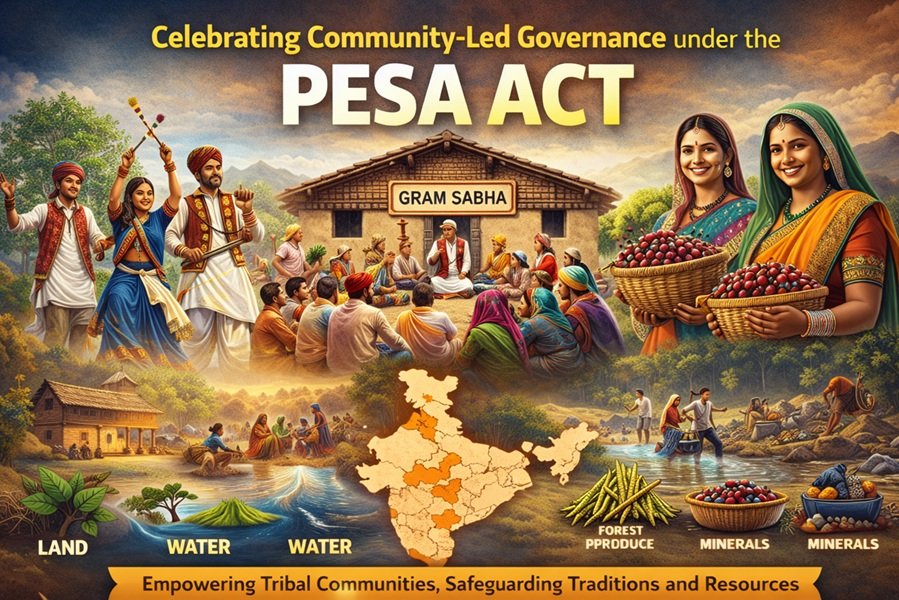
Celebrating Community-Led Governance under the PESA Act – A Comprehensive Overview
The Panchayats (Extension to Scheduled Areas) Act, 1996 (PESA Act) stands as a landmark legislation that extends the provisions of the Panchayati Raj system to tribal and traditional communities living in India’s Scheduled Areas. On 22 December 2025, the Ministry of Panchayati Raj announced the PESA Mahotsav 2025, a special festival celebrating this transformative law and the spirit of community-led governance it fosters. The event is scheduled for 23–24 December 2025 in Visakhapatnam, Andhra Pradesh and aims to draw attention to the unique role of tribal communities in shaping their own development through strengthened governance structures. (Press Information Bureau)
Understanding the Context: Tribal Communities and the PESA Act
India is home to a rich mosaic of tribal traditions and cultures, with Scheduled Tribes representing approximately 8.6% of the population. Recognizing the distinct socio-cultural contexts of tribal communities, the Constitution of India allows the President to designate regions with significant tribal populations as Scheduled Areas under Article 244. These areas require special governance frameworks that respect traditional practices, community rights, and local autonomy. (Press Information Bureau)
While the 73rd Constitutional Amendment Act (1993) established Panchayati Raj Institutions — empowering local governance across the country — it did not automatically extend these provisions to tribal regions. To bridge this gap, the PESA Act was enacted in 1996. Its core objective is to extend decentralised democratic governance to Scheduled Areas in a manner that preserves tribal customs, cultural practices, and control over natural and community resources. (Press Information Bureau)
PESA Act: A Tool for Tribal Self-Governance
At its heart, the PESA Act empowers tribal communities by strengthening the role of Gram Sabhas — the assembly of all adult members of a village. Under PESA:
- Gram Sabhas become the pivotal decision-making body in Scheduled Areas, entrusted with authority to approve development plans, manage village resources, and safeguard customary laws. (Press Information Bureau)
- Traditional governance systems and cultural practices are recognised and integrated into modern governance frameworks. (Press Information Bureau)
- Tribal communities are granted rights over land, water bodies, forests, minor minerals, and other resources — significantly enhancing economic prospects and community well-being. (Press Information Bureau)
The Act explicitly recognises the right of Gram Sabhas to elect their leaders, approve budgets, and oversee development initiatives, ensuring that decentralised governance is not just administrative but truly participatory. (Press Information Bureau)
Scheduled Areas: A Geographic and Demographic Overview
India’s Scheduled Areas span across several states:
- Andhra Pradesh
- Chhattisgarh
- Gujarat
- Himachal Pradesh
- Jharkhand
- Madhya Pradesh
- Maharashtra
- Odisha
- Rajasthan
- Telangana (Press Information Bureau)
These regions collectively represent diverse tribal populations with unique socio-economic challenges and cultural identities. While eight of these states have fully implemented PESA rules, Odisha and Jharkhand have framed draft rules which are in the process of formalisation. (Press Information Bureau)
PESA Mahotsav 2025: Celebrating Tradition and Governance
The PESA Mahotsav 2025 is envisioned as more than a commemorative event — it is a cultural celebration and awareness platform. Scheduled to be held in Visakhapatnam, the festival will highlight tribal heritage through cultural showcases, traditional sports, indigenous cuisine, and handicrafts. (Press Information Bureau)
Cultural and Traditional Highlights
The Mahotsav will include vibrant displays of tribal games and cultural practices such as:
- Chakki Khel
- Uppanna Barelu
- Cholo and Puli Doud
- Mallakhamba
- Pithool
- Gedi Doud
- Sikor
These activities not only celebrate tribal heritage but also emphasise the connection between governance and community identity. (Press Information Bureau)
Government Initiatives for PESA Implementation
The Ministry of Panchayati Raj, in coordination with state governments and civil society partners, has undertaken a series of initiatives to ensure effective implementation of the PESA Act:
Training and Capacity Building
- Master Trainer Programmes were conducted across multiple states to train elected representatives, functionaries, and community leaders on the provisions of the PESA Act. These programs have empowered participants with knowledge of rights, governance procedures, and resource management techniques. (Press Information Bureau)
Digital Enablement and Resource Planning
- The PESA-Gram Panchayat Development Plan Portal facilitates planning and monitoring of development activities, enabling tailored interventions based on community priorities and resource allocation from central and state schemes. (Press Information Bureau)
This digital initiative reinforces transparency and ensures that communities have real-time access to development planning tools. (Press Information Bureau)
Real-Life Impact: PESA Act Success Stories
The PESA Act has not only strengthened governance frameworks but also transformed everyday life for many tribal communities. Several documented success stories illustrate how empowered Gram Sabhas have improved livelihoods and protected traditional rights:
Village Empowerment Through Collective Action
In Khamdhogi village (Chhattisgarh), the Gram Sabha took charge of local development by organising committees and optimising natural resource use. Through training and community engagement, residents diversified their livelihoods by collecting forest produce, running fisheries, and promoting bamboo rafting — significantly increasing local income and socio-economic stability. (Press Information Bureau)
Sustainable Forest Produce Management
In areas of Himachal Pradesh, the Rarang Gram Panchayat utilised PESA rights to manage pine nut harvesting — a traditional occupation. The Gram Sabha ensured equitable access and control over forest produce sales, distributing income among all households and preserving customs. (Press Information Bureau)
Protecting Land and Livelihoods
In Rajasthan’s Udaipur district, the Gram Sabha successfully opposed displacement by asserting rights under the PESA Act. This action prevented involuntary relocation due to wildlife sanctuary expansion, safeguarding traditional livelihoods and tribal cultural continuity. (Press Information Bureau)
These case studies demonstrate how local institutions can become powerful drivers of inclusive growth, social justice, and sustainable resource management when equipped with the right legal tools. (Press Information Bureau)
Conclusion: PESA as a Pathway to Inclusive Governance
Nearly three decades after its enactment, the PESA Act continues to empower tribal communities by strengthening democratic governance tailored to their unique cultural contexts. By decentralising authority and recognising tribal customs and local decision-making, the Act not only improves developmental outcomes but also enhances self-respect, dignity, and agency among tribal peoples. (Press Information Bureau)
The PESA Mahotsav 2025 not only commemorates this enduring legacy but also reaffirms the Government of India’s ongoing commitment to inclusive governance and community-centric development. Celebrating traditional sports, cultural heritage, and participatory governance underscores the vibrancy of tribal societies and the transformative power of local self-government. (Press Information Bureau)
Reference: https://www.pib.gov.in/PressNoteDetails.aspx?NoteId=156625&ModuleId=3®=3&lang=1
