
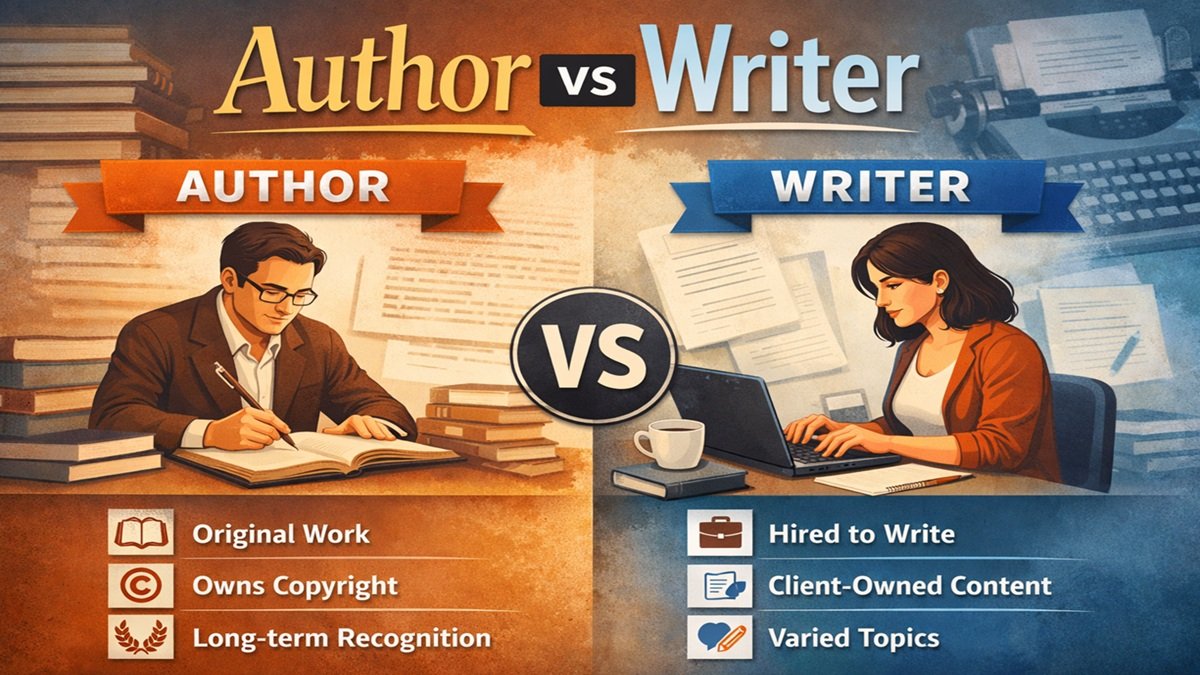
Author vs Writer: What Is the Difference Between an Author and a Writer?
The terms author and writer are often used interchangeably in everyday language. However, in professional, academic, literary, and digital publishing contexts, there are clear conceptual and practical differences between an author and a writer. Understanding these differences is important for students, publishers, content creators, freelancers, and readers alike.
This article provides a deep, structured, and detailed comparison of author vs writer, covering definitions, roles, legal standing, credibility, scope of work, and real-world examples.
What Is a Writer?
A writer is a person who writes content in any form. Writing is the act of putting thoughts, information, or creativity into written words. A writer may produce content for multiple purposes, platforms, or clients.
Key Characteristics of a Writer
- Focuses on writing as a skill or task
- May write for clients, organizations, or employers
- Often works on assigned topics
- Usually does not own intellectual rights to the content
- Can write across multiple formats and niches
Common Types of Writers
- Content writers
- Blog writers
- Copywriters
- Technical writers
- SEO writers
- Ghostwriters
- Scriptwriters
- News writers
A writer’s primary responsibility is to create content that meets specific requirements, such as word count, tone, SEO guidelines, or audience intent.
What Is an Author?
An author is a person who creates original intellectual work and is formally credited as its creator. Authorship implies ownership, originality, authority, and long-term recognition.
Key Characteristics of an Author
- Produces original, independent work
- Has intellectual ownership of the content
- Usually publishes under their own name
- Associated with books, research, or major publications
- Builds authority and credibility over time
Common Types of Authors
- Book authors
- Novelists
- Academic authors
- Research paper authors
- Biographers
- Historians
- Subject-matter experts
An author is often recognized as an expert or thought leader in a particular field.
Author vs Writer: Core Difference Explained
The fundamental difference lies in ownership and intent.
- A writer writes content
- An author creates original intellectual work and owns it
Every author is a writer, but not every writer is an author.
Author vs Writer: Detailed Comparison Table
| Basis of Comparison | Writer | Author |
|---|---|---|
| Definition | A person who writes content | A person who creates original work |
| Focus | Skill of writing | Original creation and authorship |
| Ownership | Usually no ownership | Full intellectual ownership |
| Credibility | Depends on employer or platform | Built through personal work |
| Content Type | Blogs, ads, articles, scripts | Books, research, novels |
| Freedom | Writes as per instructions | Writes independently |
| Legal Rights | Belong to client/publisher | Belong to author |
| Recognition | Limited or anonymous | Public recognition |
| Long-term Impact | Often short-term | Long-lasting legacy |
Legal and Copyright Perspective
From a legal standpoint:
- Writers (especially freelancers or employees) usually sign contracts transferring copyright to the client.
- Authors retain copyright unless they explicitly transfer it to a publisher.
This distinction is crucial in:
- Book publishing
- Academic research
- Intellectual property disputes
- Royalty agreements
Author vs Writer in Digital Media
In the digital age, the line between author and writer has blurred, but the distinction still exists.
Example Scenarios
- A person writing SEO articles for a website → Writer
- A person publishing a book on Amazon under their own name → Author
- A blogger building a personal brand with original insights → Author + Writer
- A ghostwriter writing books for others → Writer (not author)
Who Has More Authority: Author or Writer?
Generally, authors are perceived as having more authority because:
- They create original work
- Their name is permanently associated with the content
- They build expertise over time
However, a skilled writer with years of experience can still command high respect and income, especially in professional domains like SEO, technical writing, or journalism.
Can a Writer Become an Author?
Yes. Many writers eventually become authors by:
- Writing and publishing their own books
- Creating original research or long-form content
- Transitioning from client-based writing to independent publishing
This progression is common in journalism, blogging, and academic fields.
Author vs Writer in Academic Context
In academics:
- Author refers to the person who contributes original research or theory.
- Writer may assist with editing, formatting, or language but is not credited as an author.
Authorship in research carries ethical and professional responsibility.
Which Term Is Better?
There is no superior term—only different roles.
- Choose writer if your primary role is producing content for others.
- Choose author if you create and own original intellectual work.
Both are respectable professions with distinct purposes.
Conclusion
The difference between author and writer goes far beyond semantics. A writer focuses on the act of writing, often for others, while an author represents original creation, ownership, and authority.
Understanding this distinction helps in:
- Career planning
- Academic clarity
- Publishing decisions
- Legal and copyright awareness
In short:
All authors are writers, but not all writers are authors.
