
Amanta Month and Purnimanta Month: Meaning, Difference & Importance in the Hindu Calendar
In the Hindu lunar calendar, months are not counted the same way as in the modern Gregorian calendar. Instead, they are based on the Moon’s phases. This lunar system is followed in two different traditions known as the Amanta system and the Purnimanta system.
Understanding these two systems is essential for knowing festival dates, vrat (fasting) days, and religious observances, as the same festival may fall in different lunar months depending on the system followed.
What Is the Hindu Lunar Month?
A Hindu lunar month is divided into two halves:
- Shukla Paksha – Waxing phase of the Moon (New Moon to Full Moon)
- Krishna Paksha – Waning phase of the Moon (Full Moon to New Moon)
The difference between Amanta and Purnimanta lies in where a month begins and ends.
What Is Amanta Month?
Meaning of Amanta
The word Amanta comes from:
- Amavasya (New Moon)
- Anta (End)
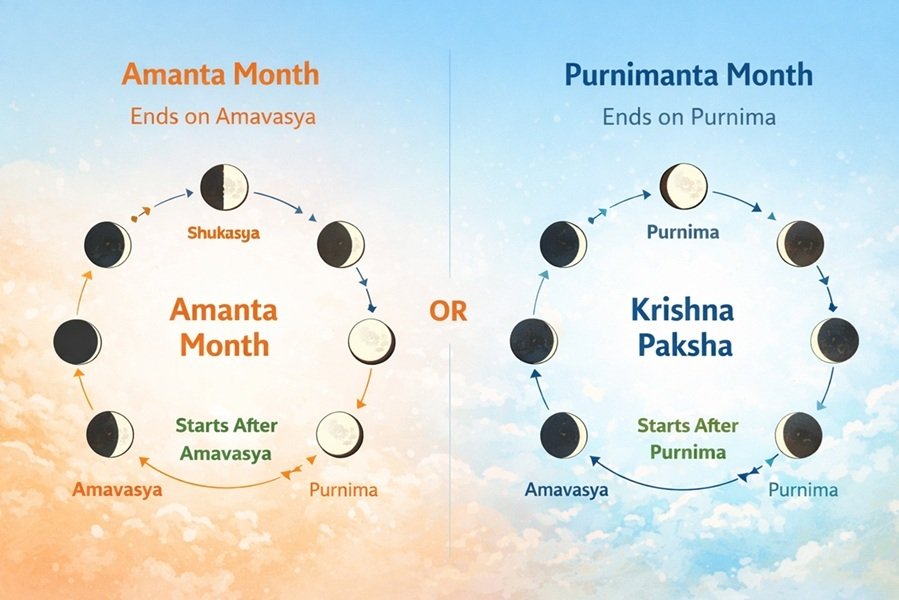
👉 In the Amanta system, the lunar month ends on Amavasya (New Moon) and begins the next day.
Structure of Amanta Month
- Month starts: After Amavasya
- Month ends: On Amavasya
- Order:
- Shukla Paksha → Krishna Paksha → Amavasya (month ends)
Regions Following Amanta System
The Amanta system is followed mainly in:
- Maharashtra
- Gujarat
- Andhra Pradesh
- Telangana
- Karnataka
- Tamil Nadu
- Kerala
Most South and Western Indian Panchangs use the Amanta system.
What Is Purnimanta Month?
Meaning of Purnimanta
The word Purnimanta comes from:
- Purnima (Full Moon)
- Anta (End)
👉 In the Purnimanta system, the lunar month ends on Purnima (Full Moon).
Structure of Purnimanta Month
- Month starts: After Purnima
- Month ends: On Purnima
- Order:
- Krishna Paksha → Shukla Paksha → Purnima (month ends)
Regions Following Purnimanta System
The Purnimanta system is mainly followed in:
- Uttar Pradesh
- Bihar
- Rajasthan
- Madhya Pradesh
- Punjab
- Haryana
- Himachal Pradesh
Most North Indian Panchangs follow this system.
Key Differences Between Amanta and Purnimanta
| Aspect | Amanta Month | Purnimanta Month |
|---|---|---|
| Month ends on | Amavasya (New Moon) | Purnima (Full Moon) |
| Month begins after | Amavasya | Purnima |
| First Paksha of month | Shukla Paksha | Krishna Paksha |
| Followed mainly in | South & West India | North India |
| Naming of months | Based on Amavasya | Based on Purnima |
Why Do Festival Dates Differ?
This is the most common source of confusion.
- The tithi (date) of a festival remains the same
- The month name may differ depending on the system
Example:
- Maha Shivaratri
- Amanta system: Falls in Magha Krishna Chaturdashi
- Purnimanta system: Falls in Phalguna Krishna Chaturdashi
So, the festival is celebrated on the same night, but the month name changes.
Which System Is Older?
Scholars believe:
- Purnimanta system is the older Vedic tradition
- Amanta system became more popular later due to regional and astronomical preferences
Today, both systems are equally valid and accepted in Hindu tradition.
Importance in Panchang and Vrat Calculations
The choice of system affects:
- Month names in Panchang
- Vrat names (Masik Shivaratri, Ekadashi, Amavasya)
- Sankalpa during puja
- Astrological charts and Muhurta calculations
That’s why Panchangs clearly mention whether they follow Amanta or Purnimanta reckoning.
Simple Way to Remember
- Amanta = Amavasya ends the month
- Purnimanta = Purnima ends the month
Conclusion
The Amanta and Purnimanta month systems are two parallel methods of tracking lunar months in Hindu tradition. While they differ in structure and regional usage, both are rooted in ancient astronomy and spiritual practice.
Understanding this difference helps avoid confusion about festival dates, vrat months, and religious rituals, and deepens appreciation for the scientific precision of the Hindu lunar calendar.
In essence,
the Moon is the same—only the method of counting changes.
