
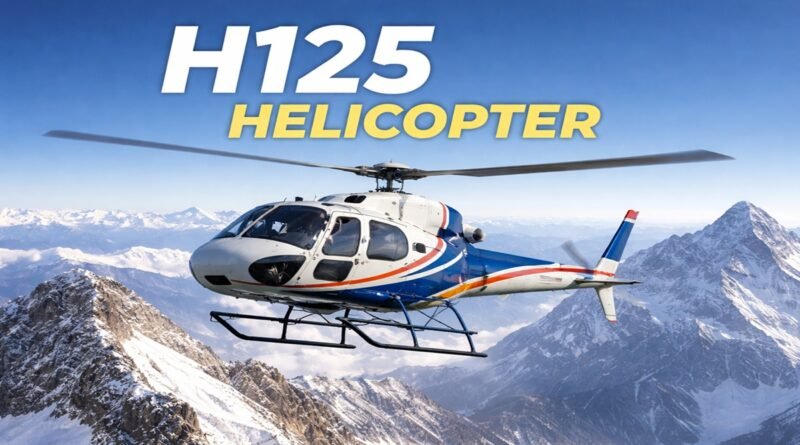
Airbus H125 Helicopter — The World’s Most Capable High-Altitude Light Helicopter
The Airbus H125 is widely regarded as the most powerful and versatile single-engine helicopter ever built for civil operations. Designed to operate in extreme conditions — from deserts to the Himalayas — it has become the global standard for mountain rescue, tourism flights, aerial work and law-enforcement missions.
Earlier known as the AS350 B3e AStar, the aircraft was renamed H125 after Airbus reorganized its helicopter lineup in 2015. Despite the new name, it continues the legacy of a helicopter family trusted for nearly five decades.
Development History
The helicopter traces its origins to a French design project in the early 1970s. Engineers wanted a lightweight aircraft that could:
- carry passengers efficiently
- operate from small landing areas
- work in hot climates
- perform at high altitude
The result was the AS350 Écureuil (“Squirrel”). Over time, upgraded engines and avionics produced the high-performance B3e variant, which later became the modern H125.
Today thousands are flying worldwide — from Alaska glaciers to the peaks of Nepal.
Cabin & Layout
One of the biggest reasons for the helicopter’s success is its flexible cabin design.
Passenger Arrangement
- 1 pilot in the front right seat
- up to 5 passengers behind
The cabin is wide for a light helicopter, with large windows providing excellent visibility — important for sightseeing and surveillance work.
Modular Interior
Operators can reconfigure the interior within hours:
- tourist seating
- medical stretcher setup
- camera mount configuration
- cargo transport
- police observation platform
This multi-role capability allows one helicopter to serve multiple businesses.
Engine and Flight Performance
At the heart of the aircraft is a powerful Safran Arriel turboshaft engine, specially optimized for thin air.
Why It Performs So Well
Helicopters lose lift at high altitude because air density decreases.
The H125 solves this with:
- high-efficiency rotor blades
- excellent engine power-to-weight ratio
- advanced fuel control system
- strong cooling performance
Typical Performance Figures
| Parameter | Approximate Value |
|---|---|
| Cruise speed | about 250 km/h |
| Maximum range | around 600+ km |
| Endurance | roughly 4–5 hours |
| Service ceiling | over 23,000 ft |
| External lifting capacity | over 1.3 tons |
These numbers make it one of the strongest lifting light helicopters in the world.
The Everest Achievement
The helicopter became globally famous when a production model landed on the summit of Mount Everest.
This wasn’t a modified aircraft.
It was a standard helicopter — proving the design could operate where the air pressure is only one-third of sea level.
That single event transformed its reputation and made it the primary aircraft used in Himalayan rescue operations today.
Operational Roles
The H125 is considered a “multi-mission platform.”
Few helicopters are used in as many different roles.
Civil Transport
- mountain tourism
- VIP charter
- corporate travel
- religious pilgrimage flights
Emergency Services
- medical evacuation
- disaster response
- search and rescue
- firefighting support
Government & Security
- police patrol
- border observation
- traffic monitoring
Industrial Work
- power-line inspection
- construction lifting
- oil & gas operations
- forestry and agriculture
Because it can hover at high altitude, it is especially valuable in mountainous countries like India and Nepal.
Cost and Economics
A major advantage of the H125 is efficiency.
Twin-engine helicopters are safer for offshore operations but much more expensive.
The H125 offers a balance: strong performance with lower fuel burn and maintenance cost.
Typical Market Price
- New aircraft: around 3 million USD (varies with equipment)
- Used aircraft: depends on year and flight hours
Operators often choose it because revenue per hour is high while operating expenses remain manageable.
Growing Importance in India
India’s geography — mountains, remote villages and extreme heat — perfectly suits this helicopter.
It is heavily used in:
- Char Dham yatra flights
- Himalayan rescue missions
- state government operations
- tourism charters
Local manufacturing partnerships planned in India are expected to expand its presence significantly in the coming decade.
Strengths and Limitations
Strengths
- unmatched high-altitude performance
- versatile cabin configuration
- reliable single-engine design
- relatively low operating cost
- strong lifting capability
Limitations
- fewer passengers than larger helicopters
- single engine restricts offshore usage
- cabin smaller than twin-engine VIP aircraft
Conclusion
The Airbus H125 is not just another light helicopter — it is a benchmark in aviation engineering. Its ability to operate where most aircraft cannot has made it indispensable for rescue crews, tour operators and government agencies.
From Everest landings to everyday medical evacuation missions, it proves that a well-designed lightweight helicopter can outperform larger aircraft in extreme environments.
For this reason, aviation professionals often call it the most capable single-engine helicopter ever produced.
