
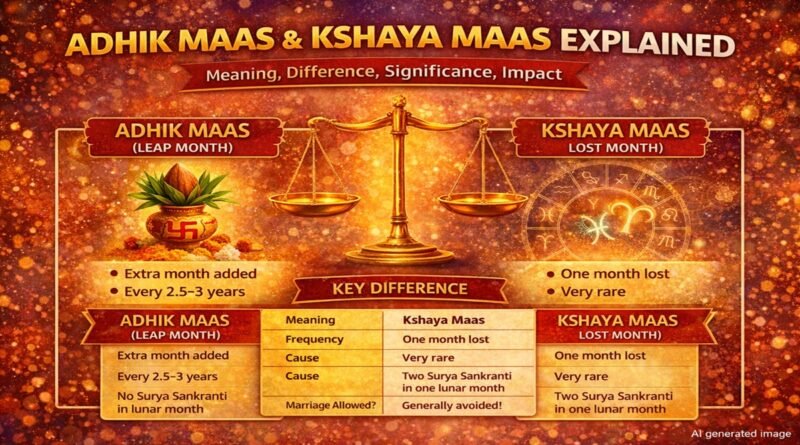
Adhik Maas and Kshaya Maas Explained: Meaning, Difference, Significance, and Impact on Hindu Calendar
The Hindu Panchang (lunar calendar) follows a unique system that synchronizes the movements of the Moon and the Sun. Because the lunar year and solar year are not perfectly aligned, special adjustments are made from time to time. These adjustments are known as Adhik Maas (Leap Month) and Kshaya Maas (Lost Month).
Both phenomena are deeply rooted in astronomical calculations and hold religious importance in Hindu tradition. In this article, we explain what Adhik Maas and Kshaya Maas are, why they occur, how often they happen, and how they affect marriage and other auspicious ceremonies.
Read also: Is the Hindu Panchang Lunisolar? A Complete Explained Guide
What is Adhik Maas?
Adhik Maas, also known as Purushottam Maas or Mal Maas, is an extra lunar month added to the Hindu calendar to balance the difference between the lunar year and the solar year.
Why Does Adhik Maas Occur?
- A lunar year is approximately 354 days
- A solar year is approximately 365 days
- This creates a gap of about 11 days every year
Over time, this difference accumulates. To correct this imbalance, an additional month is inserted roughly every 2.5 to 3 years.
Astronomical Condition
Adhik Maas occurs when:
- A complete lunar month passes
- But no Surya Sankranti (Sun’s transition into a new zodiac sign) takes place during that lunar month
As a result, that month is declared Adhik Maas.
Religious Significance of Adhik Maas
Traditionally, Adhik Maas is considered highly spiritual but not suitable for worldly celebrations.
Activities Encouraged:
- Fasting (Vrat)
- Charity (Daan)
- Reading scriptures
- Meditation and prayer
- Pilgrimage
Activities Generally Avoided:
- Marriage ceremonies
- Griha Pravesh (housewarming)
- Mundan (tonsure ceremony)
- Major property purchases
The month is dedicated to devotion and self-purification rather than celebrations.
What is Kshaya Maas?
Kshaya Maas literally means “lost month.”
It is far rarer than Adhik Maas and occurs under the opposite astronomical condition.
Astronomical Condition
Kshaya Maas occurs when:
- Two Surya Sankranti events happen within a single lunar month
In this case, one lunar month effectively “disappears” from the calendar.
How Rare is Kshaya Maas?
- Extremely rare
- May occur once in several decades
- Sometimes even 100+ years apart
Because of its rarity, many generations may not experience Kshaya Maas during their lifetime.
Religious Significance of Kshaya Maas
Like Adhik Maas, Kshaya Maas is generally considered unsuitable for:
- Marriage
- Major auspicious ceremonies
- Large celebrations
It is viewed as a spiritually sensitive period requiring restraint and religious focus.
Key Differences Between Adhik Maas and Kshaya Maas
| Feature | Adhik Maas | Kshaya Maas |
|---|---|---|
| Meaning | Extra month added | One month lost |
| Frequency | Every 2.5–3 years | Very rare |
| Cause | No Surya Sankranti in lunar month | Two Surya Sankranti in one lunar month |
| Marriage Allowed? | Generally avoided | Generally avoided |
| Spiritual Importance | High | High |
Impact on Marriage and Auspicious Muhurat
Both Adhik Maas and Kshaya Maas impact Vivah Muhurat planning.
During these months:
- Most Panchang calculations do not provide marriage muhurats
- Priests advise postponing wedding dates
- Families focus more on spiritual practices
For example, in 2026, Adhik Maas affects mid-May to mid-June, limiting available wedding dates during that period.
Scientific and Astronomical Perspective
The Hindu calendar is a lunisolar calendar, meaning it tracks both:
- Phases of the Moon
- Position of the Sun
Without adjustments like Adhik Maas, Hindu festivals would gradually shift across seasons. These corrections ensure that major festivals such as:
- Diwali
- Holi
- Navratri
remain seasonally aligned year after year.
In this way, Adhik Maas and Kshaya Maas are not just religious concepts but also astronomical corrections.
Why Understanding These Months Matters
For families planning:
- Weddings
- Property purchases
- Religious ceremonies
- Business openings
understanding Adhik and Kshaya Maas helps avoid scheduling conflicts with traditional guidelines.
However, customs may vary by region and community. Always consult a qualified priest or astrologer for personal decisions.
Conclusion
Adhik Maas and Kshaya Maas demonstrate the sophistication of the Hindu lunisolar calendar. While Adhik Maas appears regularly as a balancing mechanism, Kshaya Maas remains a rare astronomical phenomenon.
Both months emphasize spiritual growth over material celebration, reflecting the deeper philosophical foundation of Hindu timekeeping.
