
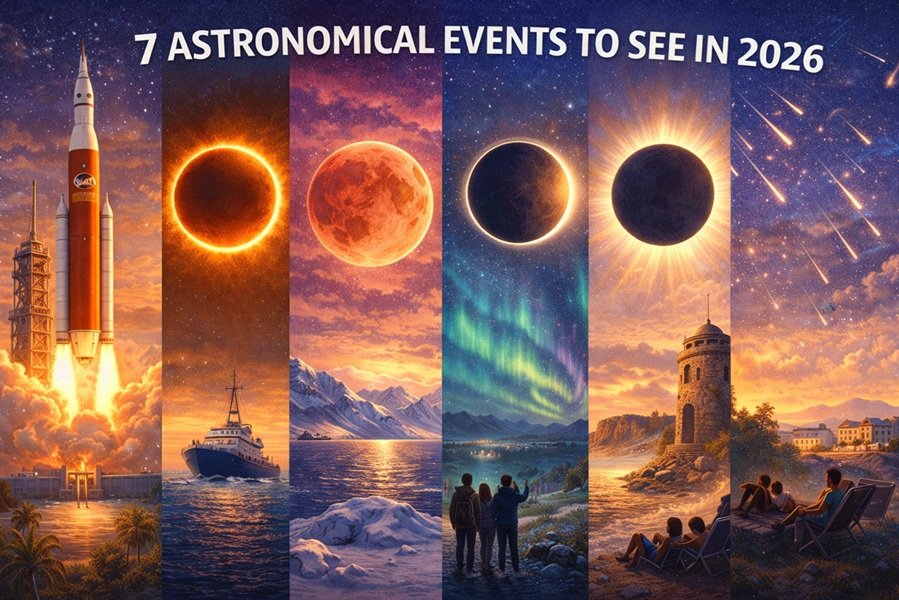
7 Astronomical Events Worth Traveling for in 2026
Introduction
Just as the Moon’s shadow races across Earth during a solar eclipse, astronomy-driven travel is emerging as one of the most meaningful ways to explore the world. In 2026, the skies will offer rare spectacles that transform ordinary trips into once-in-a-lifetime experiences. From historic space missions to eclipses, auroras, and meteor showers, the coming year presents exceptional opportunities to plan journeys guided by the cosmos.
While the August 2026 total solar eclipse will dominate headlines, it is far from the only celestial reason to pack your bags. Here are seven astronomical events in 2026 that are truly worth traveling for—and the best places on Earth to witness them.
1. Artemis II Crewed Moon Mission
Expected: Early February 2026
Although technically a spaceflight milestone rather than a natural sky event, the Artemis II mission represents humanity’s bold return to deep-space exploration. It will be NASA’s first crewed mission of the Artemis program, sending astronauts on a lunar flyby and marking a critical step toward future Moon landings.
Where to travel
Florida’s Space Coast, USA, near the Kennedy Space Center, offers front-row access. Rocket launches here become shared public experiences, watched from beaches, bridges, and waterfront parks.
Travel tip
Launch dates often change due to weather or technical checks. Plan extra days so your trip isn’t dependent on a single moment. Even if delayed, the Space Coast rewards visitors with wildlife refuges, bioluminescent waters, and classic coastal towns.
2. Annular Solar Eclipse
February 17, 2026
An annular solar eclipse occurs when the Moon passes directly in front of the Sun but appears too small to fully block it, leaving a glowing “ring of fire” in the sky. This is one of the most visually striking eclipse types.
Where to travel
The path of annularity crosses Antarctica, making this one of the most remote eclipse events on record. Partial views will be visible in parts of southern Africa.
Travel tip
Most Antarctic cruises reach only areas with partial visibility. To experience full annularity, specialized expedition routes are required—and they come at a premium. This is a once-in-a-lifetime eclipse best suited for seasoned adventure travelers.
3. Total Lunar Eclipse
March 3, 2026
During a total lunar eclipse, Earth’s shadow covers the Moon, turning it a deep copper-red—a phenomenon often called a “Blood Moon.” Unlike solar eclipses, lunar eclipses are safe to view with the naked eye.
Where to travel
Large portions of North America, eastern Asia, and Australia will have excellent visibility. Since travel isn’t required, this is an ideal event to combine with scenic landscapes for astrophotography.
Travel tip
No special equipment is needed, but binoculars or a telescope will reveal fascinating surface details. Choose a location with minimal light pollution for the best experience.
4. Spring Equinox Aurora Displays
Around March 20, 2026
The period around the spring equinox often brings heightened geomagnetic activity, increasing the chances of vivid aurora borealis displays. Even as solar activity gradually declines from its recent peak, strong auroras are still expected.
Where to travel
Top destinations include:
- Iceland
- Northern Norway
- Finnish and Swedish Lapland
- Alaska
- Northern Canada
Travel tip
Aurora viewing demands patience. Plan for multiple nights to improve your chances, and choose destinations with clear skies and minimal artificial light.
5. Total Solar Eclipse
August 12, 2026
This is the defining astronomical event of the year. A total solar eclipse will sweep across parts of Greenland, Iceland, and northern Spain, briefly turning day into night and revealing the Sun’s outer corona.
Where to travel
- Northern Spain offers the most accessible land-based viewing
- Iceland is popular but heavily booked
- Greenland is best experienced via expedition cruises
Travel tip
Book accommodations well in advance. If viewing from land, prepare backup locations and remain flexible—cloud cover can change everything at the last minute.
6. Perseid Meteor Shower
Peak: August 12–13, 2026
The Perseids are among the most beloved meteor showers, known for their fast, bright streaks and high hourly rates. In 2026, the peak coincides with a new moon, creating near-perfect viewing conditions.
Where to travel
Any dark-sky destination across the Northern Hemisphere will work well. Remote beaches, deserts, mountains, and protected dark-sky reserves are ideal.
Travel tip
Forget telescopes—meteor showers are best enjoyed with the naked eye. Bring blankets or reclining chairs and give your eyes time to adapt to the darkness.
7. Geminid Meteor Shower
Peak: December 13–14, 2026
Often considered the strongest meteor shower of the year, the Geminids are known for their slow-moving, colorful meteors. In 2026, moonlight interference will be minimal.
Where to travel
Best viewed in the Northern Hemisphere, though Southern Hemisphere observers will still catch a decent display.
Travel tip
December stargazing can be cold. Dress in layers, bring hot drinks, and choose a sheltered viewing location to stay comfortable during long observation periods.
Conclusion
The year 2026 promises a rare alignment of cosmic events that reward those willing to travel with unforgettable skywatching experiences. Whether it’s standing beneath a total solar eclipse, witnessing humanity’s return toward the Moon, or watching meteors streak across pristine night skies, these moments offer perspective that few other journeys can.
For travelers who seek meaning beyond destinations, the universe itself becomes the itinerary.
