
22° Halo: Meaning, Scientific Explanation, Formation Process, Myths, and Weather Significance
Introduction
Occasionally, observers notice a large, luminous ring encircling the Moon or the Sun in the sky. This striking optical phenomenon is known as a 22° halo. While it often appears mysterious or symbolic to casual viewers, the 22° halo is a well-understood atmospheric effect governed by the laws of physics and optics.
This article presents a comprehensive scientific explanation of the 22° halo, exploring how it forms, why the angle is fixed at 22 degrees, how it differs from similar phenomena, and what it can reveal about upcoming weather conditions. All information is based on established atmospheric science and open-access research.
What Is a 22° Halo?
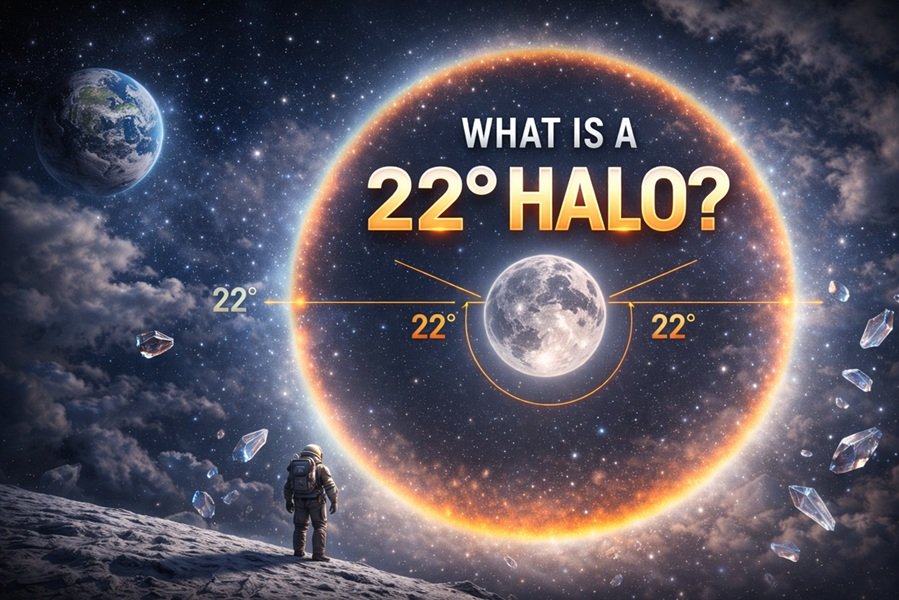
A 22° halo is a circular ring of light that appears around the Sun or the Moon at an angular distance of approximately 22 degrees from the center of the light source. The halo is usually faint, whitish, or slightly tinted with reddish hues on the inner edge and bluish tones on the outer edge.
When the phenomenon occurs around the Moon, it is called a lunar 22° halo. When it occurs around the Sun, it is referred to as a solar 22° halo.
Why Is It Called a “22°” Halo?
The term 22° does not refer to temperature or location. Instead, it refers to the angular radius of the halo as measured from the observer’s viewpoint.
- The halo forms at a constant angle of about 22 degrees
- This angle is determined by the optical properties of ice crystals
- The geometry of light refraction inside these crystals fixes this value
The consistency of this angle is one of the strongest pieces of evidence that the halo is a purely physical phenomenon.
The Science Behind the 22° Halo
Ice Crystals in the Upper Atmosphere
22° halos form when light from the Sun or Moon passes through cirrostratus clouds, which are thin, high-altitude clouds located approximately 6 to 13 kilometers above Earth’s surface.
These clouds are composed of microscopic hexagonal ice crystals, rather than liquid water droplets.
Refraction of Light
When light enters a hexagonal ice crystal:
- It slows down and bends (refraction)
- It travels through the crystal
- It exits at a specific angle
The minimum deviation angle for light passing through a hexagonal prism is approximately 22 degrees. This optical constraint creates the circular halo at a fixed distance from the light source.
Color Formation
The halo often shows subtle coloration:
- A faint red or orange tint on the inner edge
- A pale blue or white outer edge
This occurs because different wavelengths of light refract by slightly different amounts, similar to the physics behind a rainbow, though much less intense.
Lunar Halo vs Solar Halo
| Feature | Lunar 22° Halo | Solar 22° Halo |
|---|---|---|
| Light source | Moon | Sun |
| Visibility | Nighttime | Daytime |
| Brightness | Faint | Very bright |
| Viewing safety | Safe | Requires eye protection |
| Frequency | Common near full Moon | Common in thin clouds |
Weather Significance of a 22° Halo
Does a 22° Halo Indicate Rain or Snow?
In many cases, yes.
Cirrostratus clouds are often associated with approaching warm fronts in weather systems. These fronts can bring:
- Rain
- Snow
- Storms
- Extended cloud cover
Historically, meteorologists have observed that precipitation may follow within 12 to 36 hours after a halo appears, although this is not guaranteed.
The halo should be seen as a weather indicator, not a definitive forecast.
Is the 22° Halo Rare?
No. The 22° halo is relatively common but often overlooked due to:
- Light pollution
- Cloud cover
- Lack of public awareness
Many occurrences go unnoticed even though the phenomenon happens regularly worldwide.
Common Myths About the 22° Halo
Myth 1: A Halo Means the Moon Is Hollow
False.
The halo forms in Earth’s atmosphere, not on or inside the Moon.
Myth 2: Halos Are Supernatural Signs
False.
They are fully explained by atmospheric optics.
Myth 3: Halos Predict Disasters
False.
They may indicate weather changes, not catastrophic events.
Difference Between a Halo and a Corona
| Feature | 22° Halo | Corona |
|---|---|---|
| Cause | Ice crystals | Water droplets |
| Size | Large | Small |
| Distance from Moon | Far (22°) | Very close |
| Shape | Circular | Irregular |
| Cloud type | Cirrostratus | Altostratus |
Importance in Atmospheric Science
22° halos help scientists:
- Study ice crystal geometry
- Understand cloud composition
- Analyze large-scale weather systems
- Validate atmospheric optical models
They are not just visually impressive, but scientifically valuable.
Can 22° Halos Occur Around Other Objects?
Theoretically, halos can form around any sufficiently bright light source, but in nature, only the Sun and Moon are bright enough to produce clearly visible 22° halos.
Conclusion
The 22° halo is a natural, elegant demonstration of physics at work in Earth’s atmosphere. Its formation depends entirely on the interaction between light and ice crystals suspended high above the planet’s surface.
Despite widespread myths and misinterpretations, the phenomenon has:
- No connection to supernatural forces
- No relation to the Moon’s internal structure
- No ominous implications
Instead, it stands as a reminder of how atmospheric science can transform ordinary light into extraordinary celestial displays.
Open-Access References (Free to Read)
- NASA – Atmospheric Optics
https://science.nasa.gov - American Meteorological Society – Halo Phenomena
https://glossary.ametsoc.org/wiki/Halo - National Oceanic and Atmospheric Administration (NOAA)
https://www.weather.gov - University of Wisconsin – Atmospheric Optics
https://aos.wisc.edu - Royal Meteorological Society
https://www.rmets.org
