
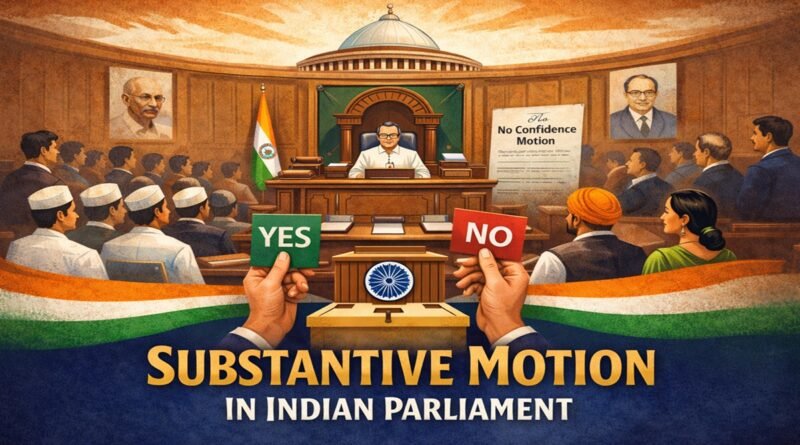
Substantive Motion in the Indian Parliament
The functioning of a democratic legislature depends not only on debates but also on formal proposals through which the House expresses its opinion or decision. In the Parliament of India, these formal proposals are called motions. Among them, the Substantive Motion holds special importance because it allows the House to directly pronounce its judgment on a matter of national significance.
This article explains the meaning, features, procedure, and examples of a Substantive Motion in the Indian Parliament in a clear and exam-oriented manner.
What is a Motion in Parliament?
In parliamentary procedure, a motion is a formal proposal made by a Member of Parliament (MP) requesting the House to take a decision or express an opinion on a particular matter.
Every discussion in Parliament — whether on policy, governance, or accountability — ultimately revolves around a motion.
There are three main categories of motions in Indian parliamentary practice:
- Substantive Motion
- Substitute Motion
- Subsidiary Motion
Among these, the substantive motion is the original and independent motion placed before the House.
Meaning of Substantive Motion
A Substantive Motion is a self-contained, independent proposal submitted to the House for discussion and decision.
It does not depend on any other motion and expresses the definite opinion or will of the House.
When adopted, it becomes the official resolution or judgment of the Parliament.
Key Features of Substantive Motion
- Independent in nature
It stands on its own and is not attached to any other motion. - Seeks a clear decision of the House
The House must accept or reject it after debate. - May express approval, disapproval, or recommendation
- Usually relates to matters of national importance
- Requires formal voting
- Can have serious political consequences
Types of Substantive Motions
Several important parliamentary procedures fall under substantive motions.
1. No-Confidence Motion
A motion expressing that the House has no confidence in the Council of Ministers.
If passed in the Lok Sabha, the government must resign.
2. Confidence Motion (Trust Vote)
Moved by the government to prove it enjoys majority support in the House.
3. Adjournment Motion
Moved to discuss a definite matter of urgent public importance by suspending normal business of the House.
4. Privilege Motion
Moved when a Member believes that a breach of parliamentary privilege has occurred.
5. Impeachment Motion
Used for removal proceedings against high constitutional authorities like the President or judges.
6. Censure Motion
Used to strongly criticize specific policies or actions of the government.
Procedure for Moving a Substantive Motion
The process is governed by the Rules of Procedure of both Houses — Lok Sabha and Rajya Sabha.
Step 1: Notice
The MP submits a written notice to the Speaker (Lok Sabha) or Chairman (Rajya Sabha).
Step 2: Admission
The presiding officer decides whether the motion is admissible.
Step 3: Listing
If admitted, the motion is scheduled for discussion.
Step 4: Debate
Members debate the motion in detail.
Step 5: Voting
The House votes — voice vote or division.
Step 6: Decision
If passed → becomes decision of the House
If rejected → motion lapses
Importance of Substantive Motion
1. Ensures Government Accountability
Parliament can remove or criticize the government.
2. Enables Democratic Control
Legislature exercises real authority over executive actions.
3. Facilitates Serious National Debate
Issues of public importance receive structured discussion.
4. Reflects Will of the House
Once adopted, it becomes Parliament’s official opinion.
Difference Between Types of Motions
| Feature | Substantive Motion | Substitute Motion | Subsidiary Motion |
|---|---|---|---|
| Nature | Independent | Replaces original | Assists another motion |
| Purpose | Final decision | Alternative proposal | Procedural |
| Voting | Mandatory | If admitted | Depends |
| Examples | No-confidence, adjournment | Amendment replacement | Closure motion |
Real Parliamentary Significance
In practice, substantive motions are politically powerful tools:
- Opposition uses them to challenge government
- Government uses them to prove majority
- Parliament uses them to enforce accountability
They often determine the survival of a government in parliamentary democracy.
Conclusion
A Substantive Motion is one of the most important instruments of parliamentary control in India. It represents the direct voice of the legislature and serves as a constitutional mechanism to evaluate, criticize, or remove the executive.
Without substantive motions, Parliament would only be a debating forum — not a decision-making authority. Therefore, they form the backbone of legislative sovereignty and democratic accountability in the Indian parliamentary system.
