
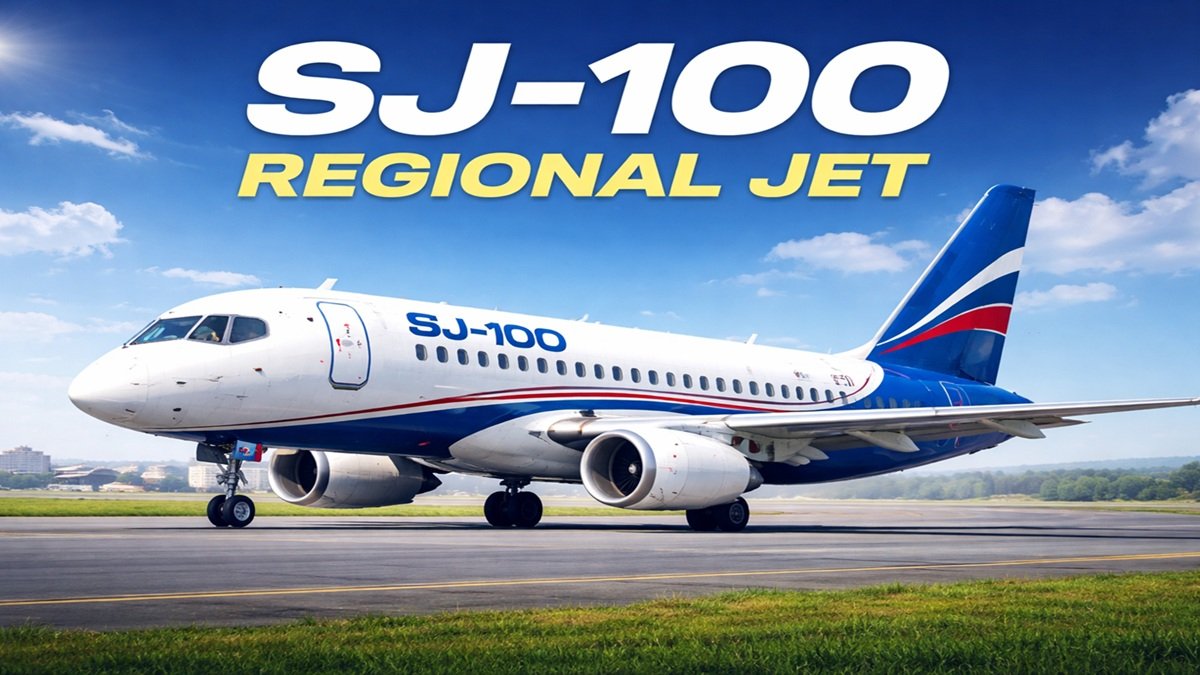
SJ-100 Regional Jet: Sukhoi Superjet 100 / SSJ100
What is the SJ-100?
The SJ-100 (formerly Sukhoi Superjet 100 or SSJ100) is a twin-engine, narrow-body regional passenger jet aircraft developed by Russia’s aerospace industry. It was designed to serve short- to medium-haul commercial flights, seating roughly 87 to 103 passengers, and to compete with other regional jets such as the Embraer E-Jets and Bombardier CRJs. (Wikipedia)
Originally manufactured by Sukhoi Civil Aircraft Company — part of United Aircraft Corporation (UAC) — the aircraft entered service in 2011, marking Russia’s first modern commercial airliner program of the 21st century. (Golden Epaulettes Aviation)
In recent years, due to supply-chain challenges and geopolitical issues, the aircraft has been redesigned into a “Russified” SJ-100 with predominantly Russian engines and systems. (Wikipedia)
Development and History
Origins
The Superjet 100 program began in the early 2000s to revitalize Russia’s civil aviation industry and reduce dependence on aging Soviet-era aircraft. The aircraft was developed collaboratively with several Western partners, including engine manufacturers and avionics suppliers. (Golden Epaulettes Aviation)
- Maiden prototype flight: May 19, 2008. (Wikipedia)
- First commercial operation: April 2011. (Superjet International)
The original aircraft used PowerJet SaM146 turbofan engines, a joint venture between French and Russian companies, and featured a fly-by-wire flight control system — the first in its size class. (Superjet International)
Transition to SJ-100
Following Western sanctions that limited access to foreign components, Russia initiated a redesign to replace most imported parts. This “modernized” version, now branded SJ-100, utilizes Russian-made Aviadvigatel PD-8 engines and domestic avionics. (Wikipedia)
Design and Technology
Airframe and Configuration
The SJ-100 is a narrow-body jet with a five-abreast cabin layout — more space efficient than smaller four-seat-across regional jets but lighter and more economical than larger Airbus or Boeing airliners. (Wikipedia)
Fly-by-Wire System
The aircraft’s fly-by-wire (FBW) controls help reduce pilot workload, enhance flight stability, and improve fuel economy compared to mechanical control systems. (Superjet International)
Engines and Performance
The modern SJ-100 uses two Aviadvigatel PD-8 turbofan engines, which offer good performance for regional routes. (Yakovlev)
Technical Specifications
| Feature | SJ-100 (Typical) |
|---|---|
| Passenger Capacity | ~103 seats (Yakovlev) |
| Length | ~29.94 m (Yakovlev) |
| Wingspan | ~29.7 m (Yakovlev) |
| Height | ~10.28 m (Yakovlev) |
| Range | ~3,530 km (Yakovlev) |
| Cruise Speed | Mach 0.78–0.81 (about 820–870 km/h) (Golden Epaulettes Aviation) |
| Maximum Takeoff Weight | ~49,450 kg (Yakovlev) |
| Required Runway (Takeoff) | ~1,900 m (Yakovlev) |
Variants
The original Superjet family included several proposed versions:
- SSJ100-75 – Smaller variant with seating for ~68–78 passengers. (Wikipedia)
- SSJ100-95B – Baseline version with ~95 passengers. (Wikipedia)
- SSJ100-95LR – Long-range model with extended fuel capacity and higher range. (Wikipedia)
The SJ-100 is the updated “Russified” variant with predominantly domestic systems and a seating capacity of about 103. (Wikipedia)
Operational Use
Airlines and Service
Over 200 SJ-100 aircraft have been produced and operated by carriers across Russia and beyond, including airlines such as Aeroflot subsidiaries and international operators. (EURASIAN TIMES)
The aircraft has seen mixed commercial success. Early international operations faced logistical challenges with maintenance and parts, but the modern SJ-100 aims to simplify support with domestic manufacturing. (Simple Flying)
India Partnership
In 2025, Hindustan Aeronautics Limited (HAL) agreed with UAC to produce SJ-100 aircraft in India — potentially a major milestone in local aircraft manufacturing and regional connectivity expansion under initiatives such as UDAN. (The Economic Times)
Strengths and Challenges
Strengths
- Efficient design for regional short-haul flights. (Golden Epaulettes Aviation)
- Fly-by-wire control system, uncommon for regional jets of its era. (Superjet International)
- Lower operating cost potential compared to some competitors. (Golden Epaulettes Aviation)
Challenges
- Early models faced maintenance and support challenges outside Russia. (Simple Flying)
- Geopolitical factors and sanctions impacted parts supply, prompting redesign efforts. (Wikipedia)
Open Free References
Here are the freely accessible sources used to compile this article:
- https://en.wikipedia.org/wiki/Yakovlev_SJ-100 (Wikipedia)
- https://goldenepaulettes.com/sukhoi-superjet-100-overview (Golden Epaulettes Aviation)
- https://eng.yakovlev.ru/products/sj-100/ (Yakovlev)
- https://vajiramandravi.com/current-affairs/sj-100/ (Vajiram & Ravi)
- https://simpleflying.com/sukhoi-superjet-story/ (Simple Flying)
- https://www.superjetinternational.com/products/sukhoi-superjet100/ (Superjet International)
- https://forumias.com/blog/sj-100/ (UPSC IAS Prep Resources)
- https://aerospaceglobalnews.com/news/hal-build-sukhoi-superjet-100-india/ (AGN)
