
Shukla Paksha and Krishna Paksha in the Hindu Calendar: Meaning, Difference & Religious Importance
The Hindu calendar is a lunar-based system that follows the movement and phases of the Moon. Unlike the modern Gregorian calendar, which is based on the Sun, Hindu timekeeping closely observes the waxing and waning of the Moon. Two very important divisions of every lunar month in this system are Shukla Paksha and Krishna Paksha.
Understanding Shukla Paksha and Krishna Paksha is essential to know festival dates, vrats (fasts), muhurat calculations, and religious observances in Hindu tradition.
What Is Paksha in the Hindu Calendar?
The word Paksha means half or fortnight.
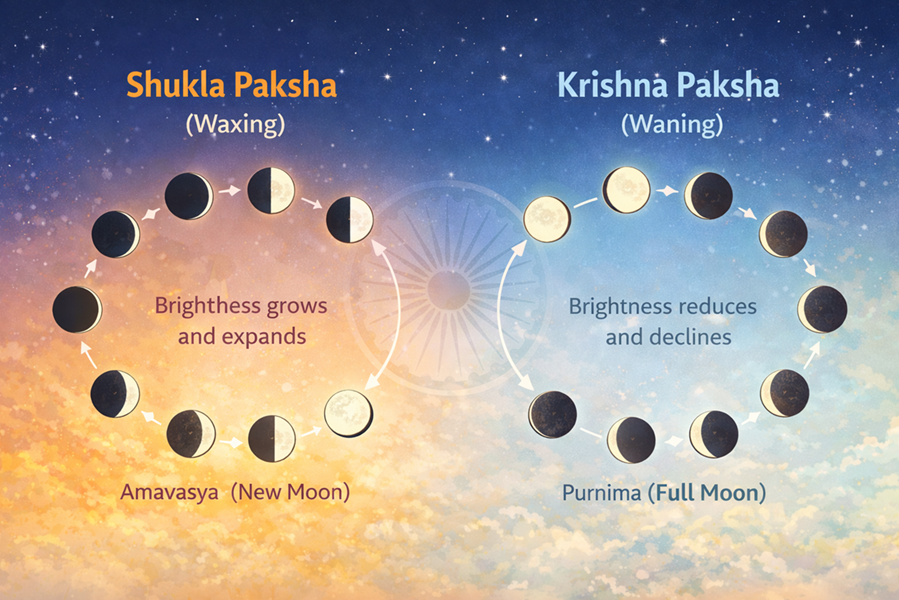
Each lunar month (Chandramas) is divided into two Pakshas, each lasting about 15 tithis (lunar days):
- Shukla Paksha – the bright fortnight
- Krishna Paksha – the dark fortnight
These Pakshas are determined by the Moon’s visibility and illumination.
What Is Shukla Paksha?
Meaning of Shukla Paksha
- Shukla means bright, pure, or white
- Shukla Paksha is the period when the Moon grows from New Moon to Full Moon
Duration
- Begins: Amavasya (New Moon)
- Ends: Purnima (Full Moon)
Each night during Shukla Paksha, the Moon appears brighter and larger.
Religious Importance of Shukla Paksha
Shukla Paksha is considered highly auspicious in Hinduism. It symbolises:
- Growth
- Positivity
- Prosperity
- New beginnings
Most ** शुभ कार्य (auspicious activities)** are performed during Shukla Paksha, such as:
- Marriage ceremonies
- Griha Pravesh (housewarming)
- Namkaran (naming ceremony)
- Business openings
- Temple consecrations
Major Festivals in Shukla Paksha
Some important festivals observed during Shukla Paksha include:
- Ram Navami
- Hanuman Jayanti
- Basant Panchami
- Guru Purnima
- Sharad Purnima
- Raksha Bandhan
- Vasant Navratri (mostly in Shukla Paksha)
What Is Krishna Paksha?
Meaning of Krishna Paksha
- Krishna means dark
- Krishna Paksha is the period when the Moon wanes from Full Moon to New Moon
Duration
- Begins: Purnima (Full Moon)
- Ends: Amavasya (New Moon)
During Krishna Paksha, the Moon gradually decreases in brightness each night.
Religious Importance of Krishna Paksha
Krishna Paksha is associated with:
- Introspection
- Renunciation
- Spiritual discipline
- Detachment
This Paksha is considered ideal for:
- Fasting and penance
- Ancestor rituals (Pitru Karma)
- Meditation and self-reflection
- Austerities and vows
It is not seen as negative, but rather spiritually inward-focused.
Important Observances in Krishna Paksha
Key rituals and vrats during Krishna Paksha include:
- Ekadashi Vrat
- Maha Shivaratri
- Pitru Paksha
- Amavasya rituals
- Somvati Amavasya
- Masik Shivaratri
Many people observe strict fasting during Krishna Paksha.
Difference Between Shukla Paksha and Krishna Paksha
| Aspect | Shukla Paksha | Krishna Paksha |
|---|---|---|
| Moon phase | Waxing Moon | Waning Moon |
| Begins on | Amavasya | Purnima |
| Ends on | Purnima | Amavasya |
| Symbolism | Growth, light, positivity | Introspection, discipline |
| Suitable for | Auspicious works | Fasting & penance |
| Visual Moon | Increasing brightness | Decreasing brightness |
Role of Paksha in Festivals & Panchang
- Every festival date is defined by Paksha + Tithi
Example: Krishna Paksha Chaturdashi or Shukla Paksha Navami - Vrat Sankalpa always mentions Paksha
- Panchang calculations depend on Paksha for muhurat and astrology
Even when Amanta and Purnimanta month systems differ, Paksha and Tithi remain the same.
Spiritual Meaning of Both Pakshas
Hindu philosophy sees life as a balance:
- Shukla Paksha represents expansion and action
- Krishna Paksha represents withdrawal and reflection
Both are equally important for spiritual growth.
Simple Way to Remember
- Moon growing → Shukla Paksha
- Moon reducing → Krishna Paksha
Conclusion
Shukla Paksha and Krishna Paksha are not just time divisions—they reflect the rhythm of nature and human life. One encourages growth and outward activity, while the other promotes discipline and inner awareness.
Together, they form a complete lunar cycle, guiding religious observances, festivals, and spiritual practices in Hindu tradition.
Understanding Paksha helps us align our actions with nature’s cycles and ancient wisdom.
