
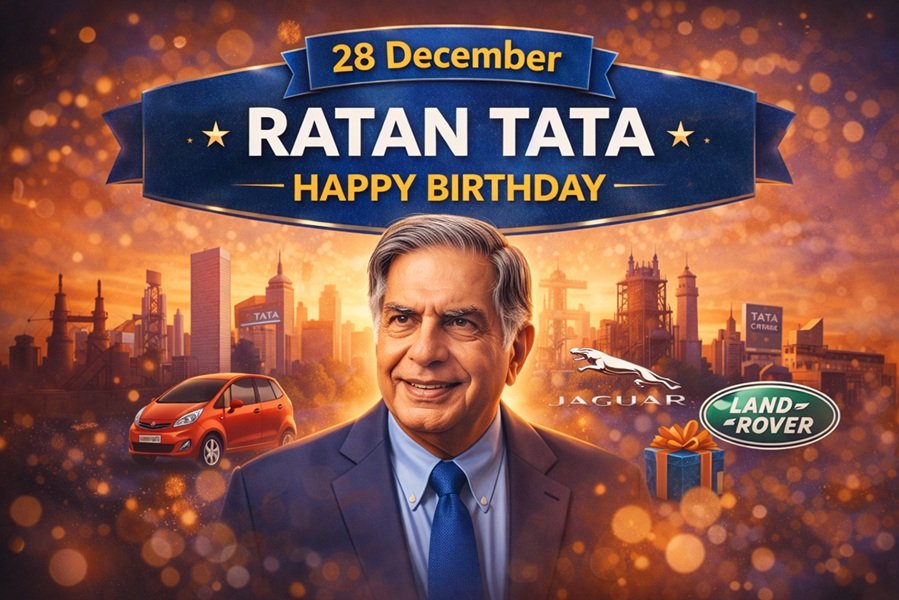
Ratan Tata (1937–2024): Remembering the Life, Legacy, and Values of a Visionary Leader
India remembers Ratan Naval Tata not merely as an industrialist, but as a rare leader who proved that success and ethics can coexist. With his passing on 9 October 2024, the nation lost one of its most respected voices in business, philanthropy, and moral leadership.
Even in absence, Ratan Tata’s influence continues to shape India’s corporate culture, startup ecosystem, and social responsibility framework. His life stands as a reminder that true leadership is not measured by wealth alone, but by impact, integrity, and compassion.
Early Life and Family Background
Ratan Tata was born on 28 December 1937 in Bombay (now Mumbai) into the illustrious Tata family, founded by Jamsetji Tata, one of India’s greatest nation-builders. Despite his privileged lineage, his early life was marked by emotional challenges.
After the separation of his parents, Ratan Tata was raised by his grandmother, Lady Navajbai Tata, who deeply influenced his upbringing. She instilled in him values of humility, discipline, empathy, and independence—traits that defined his personality throughout life.
Unlike many heirs to business empires, Ratan Tata grew up reserved, introspective, and deeply private.
Education and Early Career
Ratan Tata studied architecture and structural engineering at Cornell University in the United States and later completed the Advanced Management Program at Harvard Business School.
He joined the Tata Group in 1962, choosing not to enter the boardroom directly. Instead, he began his career on the shop floor of Tata Steel in Jamshedpur, working alongside workers and learning the realities of Indian industry firsthand. This ground-level exposure gave him a rare understanding of labour, production, and human dignity.
Becoming Chairman of Tata Group
In 1991, Ratan Tata became the Chairman of Tata Sons, succeeding the legendary J.R.D. Tata. His appointment coincided with a turning point in India’s economic history—liberalisation.
Initially, he faced internal resistance. The Tata Group was fragmented, with powerful leaders running individual companies independently. Ratan Tata took the difficult but necessary step of unifying the group under a common vision, branding strategy, and ethical framework.
Transforming Tata into a Global Powerhouse
Under Ratan Tata’s leadership, the Tata Group transformed from a largely India-focused conglomerate into a globally respected enterprise.
Landmark Global Acquisitions
- Tetley Tea (UK)
- Corus Steel (UK–Europe)
- Jaguar Land Rover (UK)
These acquisitions were bold and, at times, criticised. However, history proved them right. Jaguar Land Rover, in particular, became one of Tata Motors’ most successful ventures, showcasing Indian management on a global stage.
Visionary Projects for India
Tata Nano – The People’s Car
The Tata Nano was Ratan Tata’s most emotionally driven project. Conceived as a safe and affordable alternative for families using two-wheelers, the Nano reflected his concern for common people. Though it did not succeed commercially, it remains one of the most ambitious social engineering projects in Indian automotive history.
Strengthening Indian IT and Infrastructure
During his tenure, companies like:
- Tata Consultancy Services (TCS)
- Tata Power
- Tata Communications
- Tata Motors
grew into industry leaders. Today, TCS stands among the world’s most valuable IT companies, employing hundreds of thousands globally.
Commitment to Philanthropy and Social Good
One of Ratan Tata’s most enduring legacies is philanthropy. About two-thirds of Tata Sons is owned by charitable trusts, making the Tata Group unique among global corporations.
Key Areas of Contribution
- Education and scholarships
- Healthcare and cancer treatment
- Rural development
- Scientific research
- Disaster relief
Institutions such as Tata Institute of Social Sciences (TISS) and Tata Memorial Hospital continue to serve millions, reflecting his belief that wealth must benefit society.
Leadership Style and Personal Values
Ratan Tata was known for:
- Quiet leadership
- Ethical decision-making
- Long-term vision
- Empathy for employees
- Personal simplicity
He avoided publicity, lived modestly, and never allowed power to distance him from people. His leadership style stood in sharp contrast to flashy corporate culture, earning him respect across generations.
Awards and Recognition
Ratan Tata received numerous honours, including:
- Padma Bhushan (2000)
- Padma Vibhushan (2008)
- Honorary doctorates from global universities
However, he often stated that public trust and respect mattered more than awards.
Life After Retirement and Support for Startups
After retiring as Chairman in 2012, Ratan Tata remained active as a mentor and investor. He supported Indian startups, young entrepreneurs, and innovation-driven enterprises, believing that India’s future lay in its youth.
Passing and National Mourning
Ratan Tata passed away on 9 October 2024 at the age of 86. His death triggered nationwide mourning. Tributes poured in from business leaders, political figures, entrepreneurs, and ordinary citizens—each acknowledging the void left by his departure.
Why Ratan Tata’s Legacy Matters Today
Ratan Tata’s life teaches that:
- Business can be ethical
- Leadership can be humane
- Success can be selfless
- Power does not require arrogance
In an era of aggressive capitalism, his example stands as a moral benchmark.
Conclusion
Ratan Tata is no longer with us, but his values live on—in institutions, in ethical business practices, and in the hearts of millions. Remembering him is not just about honoring the past; it is about carrying forward the responsibility to lead with integrity.
India did not just lose a businessman.
It lost a conscience.
