
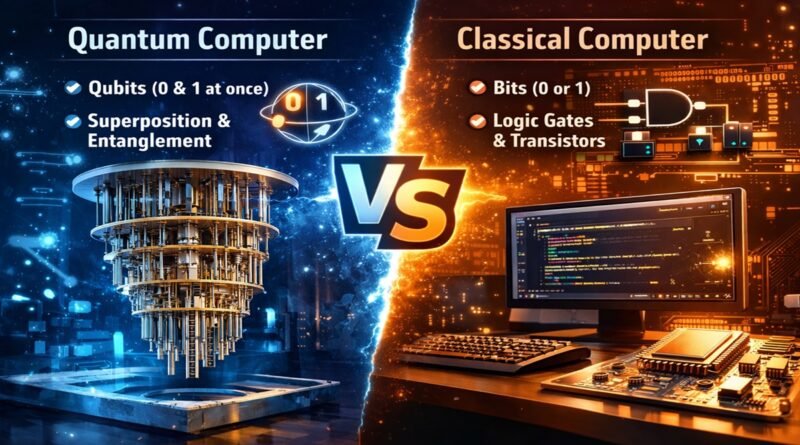
Quantum Computer vs Classical Digital Computer: A Complete Detailed Comparison
Computers today run everything — smartphones, banking, satellites, and even space missions. These machines are called classical (digital) computers.
But scientists are now building a completely different kind of machine — the quantum computer — which does not just calculate faster… it calculates differently.
This article explains in a simple yet deep way:
- How a digital computer actually works
- How a quantum computer works
- Why quantum computing is revolutionary
- Where each one will be used in the future
1. What is a Classical (Digital) Computer?
A digital computer is the machine you are using right now — laptop, mobile, server, ATM, etc.
It works using electricity signals that represent two states:
0 = OFF (No voltage)
1 = ON (Voltage present)
These 0 and 1 are called binary bits.
Every photo, video, WhatsApp message, website and game is ultimately converted into long sequences of:
010101110001010101010101011101
Core Components of Digital Computer
| Component | Function |
|---|---|
| Transistor | Acts as electronic switch (0 or 1) |
| Logic Gates | Perform AND, OR, NOT operations |
| CPU | Processes instructions |
| RAM | Temporary memory |
| Storage | Permanent memory |
Modern processors contain billions of transistors switching billions of times per second.
2. What is a Quantum Computer?
A quantum computer is based on quantum mechanics, the physics that controls atoms and subatomic particles.
Instead of bits, it uses:
Qubits (Quantum Bits)
A qubit does NOT stay only 0 or 1.
It can be:
0
1
0 and 1 at the same time
This property is called Superposition (scientific_concept).
3. Key Quantum Principles Behind Quantum Computing
Superposition
A qubit can hold multiple states simultaneously.
Think of it like a spinning coin — it is neither head nor tail until it stops.
Entanglement
Two qubits become linked. Changing one instantly affects the other — even across distance.
Interference
Quantum states can strengthen correct answers and cancel wrong answers.
These effects allow quantum computers to try millions of possibilities at once — not one by one.
4. Bit vs Qubit — The Fundamental Difference
| Number of Units | Classical Computer | Quantum Computer |
|---|---|---|
| 1 | 0 or 1 | 0 & 1 simultaneously |
| 2 | 4 possibilities checked one-by-one | 4 at same time |
| 10 | 1024 steps | 1024 at same time |
| 50 | Impossible to simulate efficiently | Natural for quantum system |
This is why quantum computing is powerful — not faster clock speed, but parallel reality computation.
5. Architecture Comparison
Digital Computer Architecture
- Deterministic logic
- Sequential operations
- CMOS transistor based
- Reliable & stable
Quantum Computer Architecture
- Cryogenic temperature (-273°C near absolute zero)
- Ion traps / superconducting circuits
- Uses probability mathematics
- Extremely fragile
6. Working Process Comparison
Classical Computer Problem Solving
Step-by-step checking:
Try option A
Wrong
Try option B
Wrong
Try option C
Correct
Quantum Computer Problem Solving
Checks all options simultaneously:
A + B + C + D at same time
Correct answer amplified
Wrong answers cancelled
This is why quantum computing is powerful for complex search problems.
7. Speed Comparison
Important point:
Quantum computers are NOT faster for everything.
They are faster only for specific types of problems.
| Task | Winner |
|---|---|
| Typing document | Classical |
| Watching video | Classical |
| Gaming | Classical |
| Weather prediction | Quantum (future) |
| Drug discovery | Quantum |
| Breaking encryption | Quantum |
| AI optimization | Quantum |
8. Programming Difference
Classical Programming
Languages:
- C
- C++
- Java
- Python
Based on logical conditions.
Quantum Programming
Languages:
- Qiskit
- Cirq
- Q#
- Quantum Python libraries
Based on probability amplitudes & matrices.
9. Memory & Data Storage
| Feature | Classical | Quantum |
|---|---|---|
| Storage | SSD/HDD | Cannot store classical files |
| Stability | Permanent | Collapses on measurement |
| Copy Data | Easy | Impossible (No-cloning theorem) |
| Error | Rare | Extremely high |
Quantum data disappears if observed — this is a major engineering challenge.
10. Real World Applications
Where Classical Computers Will Always Be Used
- Social media
- Operating systems
- Web browsing
- Office work
- Mobile apps
- Databases
Where Quantum Computers Will Be Used
- Cryptography breaking (scientific_concept: Shor’s Algorithm)
- New medicine molecules
- Climate simulation
- Material science
- Logistics optimization
- Financial modelling
- Artificial intelligence acceleration
11. Security Impact
Modern internet security uses encryption like RSA based on factorization difficulty.
A powerful quantum computer can break it quickly using Shor’s Algorithm (scientific_concept).
That’s why governments are developing Post-Quantum Cryptography (academic_field).
12. Limitations of Quantum Computers
They are NOT replacing laptops anytime soon because:
- Require extreme cooling
- Very high error rate
- Very expensive
- Hard to scale qubits
- Need specialized algorithms
So they will work as co-processors in data centers, not personal devices.
13. Future: Hybrid Computing Era
Future computing will be:
Classical Computer + Quantum Computer together
Classical computer:
Controls interface and logic
Quantum computer:
Solves heavy mathematical core
Example:
AI server sends optimization problem → quantum processor → result returned.
14. Final Comparison Summary
| Feature | Classical Computer | Quantum Computer |
|---|---|---|
| Unit | Bit | Qubit |
| State | 0 or 1 | 0 & 1 simultaneously |
| Reliability | Very high | Very fragile |
| Speed | General tasks | Specialized tasks |
| Cost | Cheap | Extremely expensive |
| Availability | Everywhere | Research labs |
| Replacement | No | No (complementary) |
Read this: GaN Chips: A Complete Guide to Gallium Nitride Technology, Uses, Benefits, and the Future
Conclusion
Quantum computers are not the next version of laptops — they are a new category of machine.
- Digital computers = universal everyday workers
- Quantum computers = super-specialized problem solvers
The future is not quantum instead of classical.
The future is quantum + classical working together
Just like calculators didn’t replace humans, and GPUs didn’t replace CPUs — quantum computers will extend computing power into areas previously impossible.
