
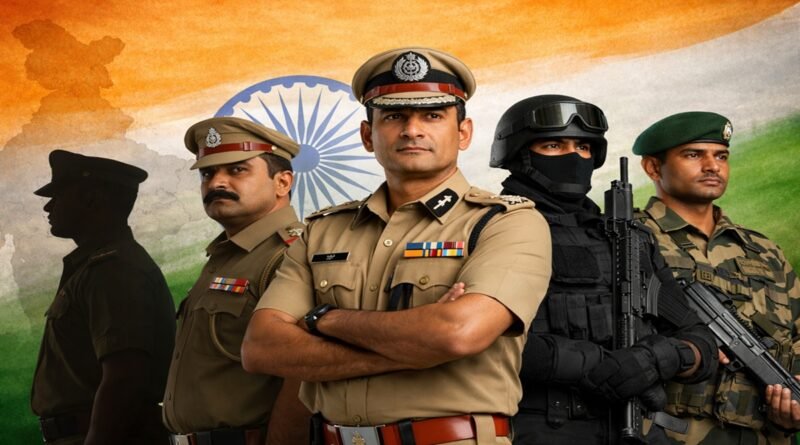
Police System in India: From State Police to Central Forces (Ranks, Structure, and Posts)
India has one of the largest policing systems in the world. The police structure is divided into State Police, Central Police Organizations, and Central Armed Police Forces (CAPFs). These work together to maintain law and order, internal security, border management, crime investigation, and national safety.
This article explains the complete hierarchy from the lowest rank to the highest rank, including state police, IPS officers, and central forces.
Read This: Indian Administrative System: From District Administration to Ministry Level Secretariat
Structure of the Police System in India
India’s policing is divided into three major levels:
1. State Police
- Controlled by respective State Governments
- Responsible for law and order, crime control, investigation
- Headed by the Director General of Police (DGP) (Wikipedia)
2. Central Police Organizations
- Work under the Ministry of Home Affairs (MHA)
- Examples: Intelligence Bureau, CBI, NCRB
3. Central Armed Police Forces (CAPFs)
- Provide internal security and border protection
- Examples:
- CRPF
- BSF
- CISF
- ITBP
- SSB (Central Armed Police Forces)
Indian Police Service (IPS)
The IPS is one of the All India Services, recruited by UPSC. Officers are appointed by the Central Government but serve both state and central organizations. (Shiksha)
- IPS officers hold most leadership posts in police departments. (Shiksha)
- They can serve as:
- SP
- DIG
- IG
- ADG
- DGP
State Police Rank Hierarchy (Lowest to Highest)
Below is the common rank structure followed by most state police forces.
Non-Gazetted Officers
These are ground-level operational officers.
- Constable
- Head Constable
- Assistant Sub-Inspector (ASI)
- Sub-Inspector (SI)
- Inspector
These ranks handle:
- FIR registration
- Patrolling
- Investigation
- Station-level operations
Many of these posts are filled through state police recruitment boards. (Shiksha)
Gazetted Officers (State Police & IPS Entry Level)
Gazetted officers start from DSP/ASP level. (Directorate of Higher Education Shimla)
- Deputy Superintendent of Police (DySP) / Assistant Commissioner of Police (ACP)
Reminder:
- DSP is State Police Service
- ASP is IPS entry rank
- Additional Superintendent of Police (Addl. SP)
- Superintendent of Police (SP)
- Senior Superintendent of Police (SSP)
SP/SSP usually control a district’s law and order.
Senior IPS Ranks in State Police
- Deputy Inspector General of Police (DIG)
- Inspector General of Police (IGP)
- Additional Director General of Police (ADGP)
- Director General of Police (DGP)
- ADGP is second-highest rank below DGP. (Wikipedia)
- DGP is the highest police officer in a state or UT. (Wikipedia)
Commissionerate System (Urban Police Administration)
In addition to the traditional district policing model led by the Superintendent of Police (SP), many large and high-population cities in India follow the Commissionerate System. This system is designed to provide faster decision-making and better law-and-order management in complex urban environments.
Under the commissionerate model, certain executive magistrate powers—which are normally exercised by the District Magistrate in the traditional system—are granted to senior police leadership. This allows the police to take immediate action during emergencies, public gatherings, riots, traffic control situations, and major law-and-order challenges.
The commissionerate system is implemented in several major cities across different states such as Maharashtra, Gujarat, Karnataka, Telangana, Tamil Nadu, Delhi, and Uttar Pradesh. The exact structure and seniority of posts may vary depending on the size, population, and administrative importance of the city.
General Rank Structure in Commissionerates
Although designations are broadly similar across India, the actual rank level assigned to each post differs from state to state.
Commissioner of Police (CP)
- Head of the city police
- Usually an IPS officer
- May hold rank equivalent to Inspector General (IG), Additional Director General (ADG), or in some very large metropolitan cities even higher, depending on state policy
Special Commissioner / Joint Commissioner of Police
- Present mainly in very large metropolitan areas
- Typically senior IPS officers
- Supervise major wings such as Law & Order, Crime, Traffic, or Administration
Additional Commissioner of Police
- Often equivalent to DIG level
- Assists in zone-level supervision and specialized units
Deputy Commissioner of Police (DCP)
- Equivalent to SP / SSP rank
- Responsible for city zones, districts, or major operational divisions
Assistant Commissioner of Police (ACP)
- Equivalent to DSP / ASP
- Supervises a group of police stations
- Replaces the traditional Circle Officer (CO) role within commissionerate areas
Police Station Level (Same as State Police)
Below ACP level, the structure generally remains unchanged:
- Inspector (Station House Officer)
- Sub-Inspector (SI)
- Assistant Sub-Inspector (ASI)
- Head Constable
- Constable
Important Note:
Unlike a fixed national template, the commissionerate system in India is flexible. Different states may appoint Commissioners at different senior ranks (IG, ADG, etc.), and the internal hierarchy can be adjusted according to administrative and policing needs.
Central Armed Police Forces (CAPF) Rank Structure
CAPFs handle:
- Border guarding
- Counter-insurgency
- Internal security
- Industrial protection
Examples: BSF, CRPF, CISF, ITBP, SSB. (Central Armed Police Forces)
Officer Ranks in CAPFs
- Assistant Commandant (AC)
- Deputy Commandant
- Second-in-Command (2IC)
- Commandant (CO)
- Deputy Inspector General (DIG)
- Inspector General (IG)
- Additional Director General (ADG)
- Director General (DG)
DG is the highest rank in CAPFs, similar to DGP in state police. (Central Armed Police Forces)
Relationship Between State Police and Central Forces
State Police Responsibilities
- Crime control
- FIR and investigation
- Local intelligence
- Traffic and law & order
Central Forces Responsibilities
- Border security (BSF, ITBP)
- Riot control (CRPF)
- Industrial security (CISF)
- Anti-insurgency operations
Central forces can be deployed in states during emergencies.
Promotion Path in Police Career
Typical career progression:
Constable → Head Constable → ASI → SI → Inspector → DSP/ASP → SP → DIG → IG → ADGP → DGP
Higher ranks are mostly filled by IPS officers through promotion and seniority. (Shiksha)
Who Controls the Police?
- State Police reports to State Home Department. (Wikipedia)
- Central forces report to Ministry of Home Affairs (MHA).
- IPS cadre management is done by the Central Government.
Key Differences: State Police vs Central Police Forces
| Feature | State Police | Central Police Forces (CAPFs & Central Police Organizations) |
|---|---|---|
| Administrative Control | State Government (State Home Department) | Central Government (Ministry of Home Affairs) |
| Primary Role | Law & order, crime prevention, investigation, traffic control | Border security, internal security, counter-insurgency, protection of critical installations |
| Head of Organization | Director General of Police (DGP) of the State | Director General (DG) of the respective force (e.g., CRPF, BSF, CISF, ITBP, SSB) |
| Area of Operation | Within the respective State or Union Territory | Across India and at international borders, deployed as required |
| Jurisdiction | Local and state-level policing | National-level security support and specialized duties |
| Recruitment Method | State Police Recruitment Boards + IPS officers through UPSC | UPSC (CAPF Assistant Commandant), SSC/GD, departmental recruitment, IPS deputation |
| Daily Responsibilities | FIR registration, investigation, patrolling, local intelligence | Border guarding, riot control support, anti-terror operations, infrastructure security |
| Accountability | Reports to State Government and State Administration | Reports to Ministry of Home Affairs (Central Government) |
| Use During Emergencies | First responder within district/state | Deployed to assist states during riots, elections, disasters, insurgency |
| Examples | UP Police, Maharashtra Police, Tamil Nadu Police | CRPF, BSF, CISF, ITBP, SSB, Assam Rifles |
Conclusion
India’s policing system is a multi-layered hierarchical structure combining state police, IPS leadership, and central armed forces.
- State Police maintains daily law and order.
- IPS officers provide leadership across state and central organizations.
- Central Armed Police Forces handle national-level security challenges.
From Constable to DGP and DG, each rank has defined administrative, operational, and strategic responsibilities, ensuring coordination between local policing and national security.
