
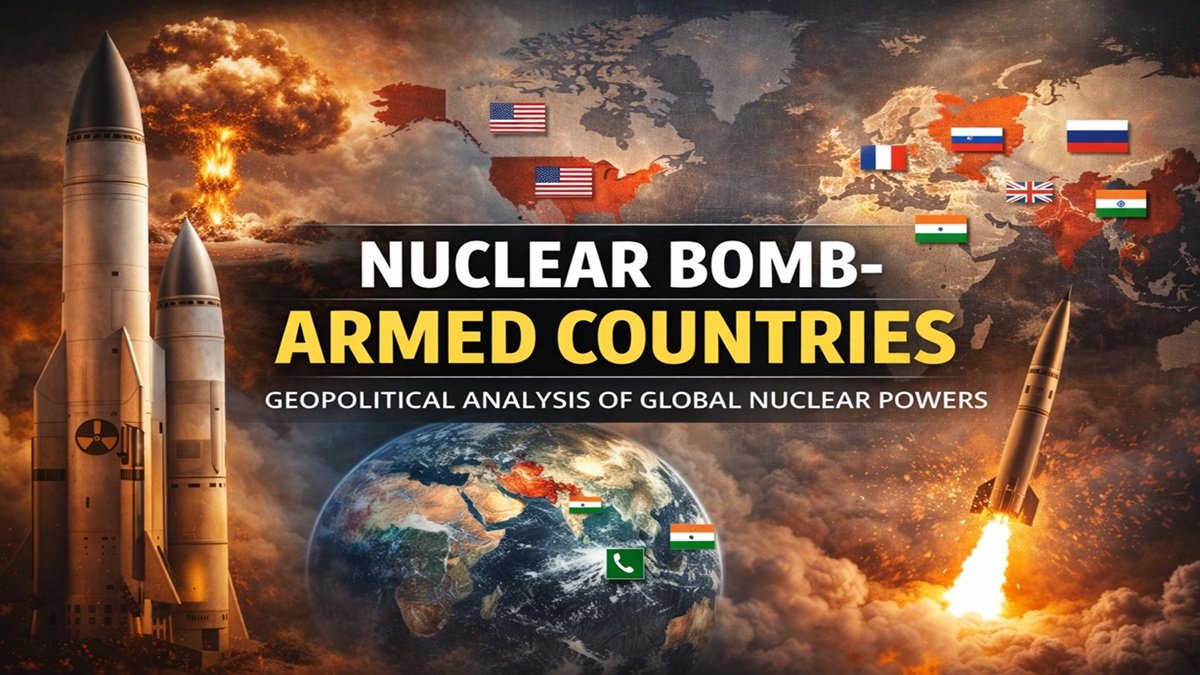
Nuclear Bomb–Armed Countries: A Geopolitical Analysis of Global Nuclear Powers
Nuclear weapons are the most destructive military weapons ever created. Since their first use in 1945, nuclear bombs have reshaped global geopolitics, power balance, deterrence strategies, and international diplomacy. Today, only a handful of countries possess nuclear weapons, but their decisions influence the entire world’s security.
This article explains which countries have nuclear bombs, how they acquired them, their nuclear strategies, and their importance in global geopolitics.
What Is a Nuclear Bomb?
A nuclear bomb is a weapon that releases energy through nuclear fission or fusion, causing massive destruction, radiation, and long-term environmental damage.
Types of Nuclear Weapons:
- Atomic Bomb (Fission-based)
- Hydrogen Bomb (Thermonuclear / Fusion-based)
Modern nuclear arsenals include ICBMs, submarine-launched missiles, and strategic bombers, forming what is known as the Nuclear Triad.
How Many Countries Have Nuclear Weapons?
As of today, 9 countries are known to possess nuclear weapons. These countries can be divided into two groups:
- NPT-recognized nuclear states
- Non-NPT or undeclared nuclear states
1. United States
Nuclear Status:
- First country to develop and use nuclear weapons
- Only country to use nuclear bombs in war (Hiroshima & Nagasaki, 1945)
Nuclear Doctrine:
- Nuclear deterrence
- First-use possible under extreme conditions
Geopolitical Role:
- Global military superpower
- Nuclear umbrella for NATO allies
- Major influence on global arms control
2. Russia
Nuclear Status:
- Largest nuclear arsenal in the world
Nuclear Doctrine:
- Allows nuclear use if state survival is threatened
Geopolitical Role:
- Counterbalance to US power
- Central player in Eastern Europe and Arctic geopolitics
- Nuclear leverage in conflicts like Ukraine
3. China
Nuclear Status:
- Rapidly expanding nuclear arsenal
Nuclear Doctrine:
- No First Use (NFU) policy (official)
Geopolitical Role:
- Rising superpower
- Nuclear deterrence against US, India, and Russia
- Key player in Indo-Pacific geopolitics
4. France
Nuclear Status:
- Independent nuclear force (Force de Frappe)
Nuclear Doctrine:
- Defensive nuclear deterrence
Geopolitical Role:
- European strategic autonomy
- Strong influence within EU and NATO
5. United Kingdom
Nuclear Status:
- Sea-based nuclear deterrent only (submarines)
Nuclear Doctrine:
- Minimum credible deterrence
Geopolitical Role:
- NATO nuclear power
- Strong alignment with US
6. India
Nuclear Status:
- Nuclear weapons tested in 1974 and 1998
Nuclear Doctrine:
- No First Use (NFU)
- Credible Minimum Deterrence
Geopolitical Role:
- Deterrence against China and Pakistan
- Important Indo-Pacific and QUAD partner
- Responsible nuclear power image
7. Pakistan
Nuclear Status:
- Developed nuclear weapons primarily to counter India
Nuclear Doctrine:
- No NFU
- Tactical nuclear weapons included
Geopolitical Role:
- South Asian nuclear flashpoint
- High-risk deterrence model
8. North Korea
Nuclear Status:
- Most unpredictable nuclear power
- Conducted multiple nuclear tests
Nuclear Doctrine:
- Regime survival
- First-use likely in conflict
Geopolitical Role:
- Major security threat in East Asia
- Leverage against US, South Korea, and Japan
9. Israel (Undeclared)
Nuclear Status:
- Policy of “strategic ambiguity”
- Not officially confirmed, but widely acknowledged
Nuclear Doctrine:
- Deterrence for survival
Geopolitical Role:
- Middle East power balance
- Strong deterrent against regional adversaries
Countries Without Nuclear Weapons but Under Nuclear Umbrella
Some countries do not possess nuclear bombs but are protected by allies:
- Japan (US umbrella)
- South Korea (US umbrella)
- NATO countries
This arrangement also plays a major role in geopolitics.
Nuclear Weapons and Geopolitics: Why They Matter
1. Nuclear Deterrence
“Nuclear weapons are not meant to be used, but to prevent war.”
Mutually Assured Destruction (MAD) prevents direct wars between nuclear powers.
2. Power Status
Nuclear weapons = global influence
Countries with nukes sit at top strategic tables.
3. Arms Race & Treaties
- NPT
- START
- CTBT (not fully enforced)
Failure of arms control increases global risk.
Biggest Nuclear Flashpoints Today
- India–Pakistan
- US–China (Taiwan)
- Russia–NATO
- North Korea–South Korea
- Middle East (Iran issue)
Conclusion: Nuclear Weapons in the 21st Century
Nuclear bombs remain the ultimate geopolitical weapons. While they prevent full-scale wars between major powers, they also create constant global tension. The future of global peace depends on:
- Responsible nuclear doctrines
- Arms control agreements
- Crisis management between nuclear states
In geopolitics, nuclear weapons are not just bombs—they are instruments of power, fear, and balance.
