
Holashtak 2026: Meaning, Start Date, Significance & Connection with Holi
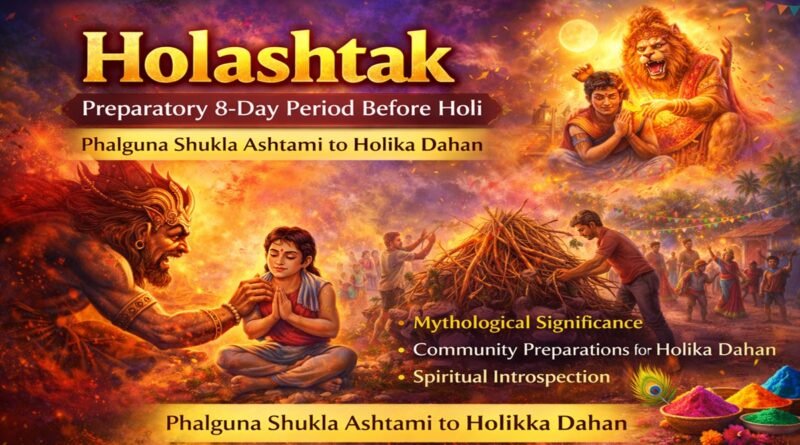
Holashtak marks the beginning of intense spiritual energy leading up to Holi. According to the Hindu lunar calendar, Holashtak starts from the Ashtami Tithi of Shukla Paksha of Phalguna month and continues for eight days until Holika Dahan.
While the main Holi festivities last for two days, the spiritual and ritual preparations begin eight days earlier with Holashtak.
What is Holashtak?
Holashtak begins on Phalguna Shukla Ashtami and ends on the day of Holika Dahan. The word “Holashtak” is derived from:
- Holi (festival of colors)
- Ashtak (eight days)
These eight days are considered spiritually intense and traditionally inauspicious for starting new ventures or performing auspicious ceremonies.
Holashtak & Temple Celebrations in Mathura–Vrindavan
During these eight days of Holashtak, grand Holi programs are organized in temples of Mathura and Vrindavan. Devotional songs (bhajans), flower Holi, and spiritual gatherings attract thousands of devotees.
The atmosphere becomes vibrant with:
- Phoolon ki Holi (flower Holi)
- Temple rituals and kirtans
- Spiritual discourses
- Traditional Holi songs
This period gradually builds up to the grand celebration of Holi.
Why is Holashtak Considered Inauspicious?
It is noteworthy that the time of Holashtak is considered inauspicious for performing auspicious ceremonies such as:
- Marriage
- Griha Pravesh (housewarming)
- Mundan ceremony
- Naming ceremony
- Commencement of education
The belief is that planetary positions during these eight days create unstable energies. Therefore, major life events are postponed until after Holi.
Regions Where Holashtak is Observed Strictly
The impact of Holashtak is traditionally limited to certain regions of North India:
- Areas along the Vyas River
- Areas near the Ravi River
- Regions around the Sutlej River (Punjab)
- Ajmer (Pushkar area)
However, even outside these specific regions, many families across North India avoid auspicious activities during this time. Holashtak is far less popular in South India.
Rituals During Holashtak
Holika Dahan is a community event performed in streets and public squares.
On the First Day of Holashtak:
- A place is chosen for Holika Dahan.
- The place is purified with Ganga water or water from other holy rivers.
- Some dry sticks are placed at the sacred site.
For the next eight days:
- Dry wood that has fallen naturally from trees is collected.
- The woodpile gradually increases.
By the last day of Holashtak, enough wood is gathered to symbolically burn the demon Holika during Holika Dahan.
Mythological Significance of Holashtak
According to Hindu scriptures, during the eight days of Holashtak:
- Demon King Hiranyakashipu tortured his son Prahlada.
- He tried various methods to force Prahlada to abandon devotion to Lord Vishnu.
- Despite torture, Prahlada remained steadfast in his faith.
Finally, to protect his devotee, Lord Vishnu incarnated as Narasimha and killed Hiranyakashipu.
These eight days symbolize:
- The testing of faith
- The triumph of devotion
- The protection of righteousness
Spiritual Meaning of Holashtak
Holashtak teaches that:
- Faith must remain firm during difficulties.
- Devotion overcomes ego and arrogance.
- Divine protection is always present for true believers.
It is a period for:
- Self-reflection
- Chanting and prayers
- Avoiding unnecessary celebrations
- Preparing spiritually for Holi
Conclusion
Holashtak is not merely a preparatory phase for Holi but a spiritually significant eight-day period that emphasizes devotion, discipline, and purification.
From temple celebrations in Mathura–Vrindavan to the symbolic collection of wood for Holika Dahan, Holashtak connects mythology, community participation, and spiritual introspection.
As Holi approaches, Holashtak reminds us that before celebrating colors externally, we must purify ourselves internally.
