
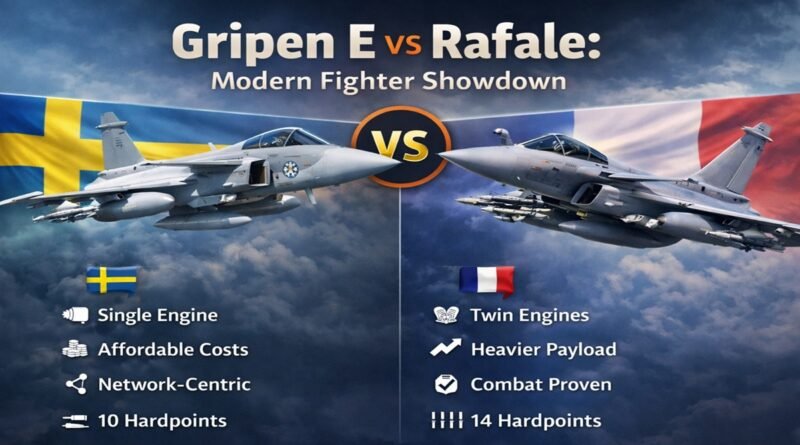
Gripen E vs Rafale: Which Modern Fighter Jet Is Better?
Modern air forces increasingly look for fighter jets that balance combat capability, cost, maintenance, and future-ready technology. Two aircraft that often appear in global defense discussions are the Saab JAS 39 Gripen E from Sweden and the Dassault Rafale from France.
Both are advanced multi-role fighters, but they are designed with different strategic philosophies.
Overview of the Two Fighters
Gripen E
- Manufacturer: Saab AB
- Country: Sweden
- Generation: 4.5 generation
- Engine: Single-engine (GE F414)
- Focus: Cost-effective, network-centric warfare, distributed operations
The Gripen E is built for high efficiency, low operating cost, and advanced electronic warfare while still delivering modern combat capability.
Rafale
- Manufacturer: Dassault Aviation
- Country: France
- Generation: 4.5 generation
- Engine: Twin-engine (Safran M88)
- Focus: Heavy multi-role combat, deep strike, nuclear deterrence
The Rafale is designed as a high-end omni-role fighter capable of handling multiple missions in a single sortie.
Read this: GE F404 vs GE F414 for Tejas — Complete Technical Guide, History & Operational Impact
Design Philosophy
Gripen E: Agile and Affordable
Gripen E is optimized for:
- Quick deployment from short or improvised runways
- Lower lifecycle and maintenance costs
- High digital connectivity with other assets
- Smaller logistics footprint
It suits countries that need modern capability without massive defense budgets.
Rafale: Power and Versatility
Rafale is built for:
- Long-range strike missions
- Heavy payload capacity
- Carrier operations (Rafale M variant)
- Nuclear and strategic deterrence roles
It is meant for nations seeking top-tier combat power and strategic reach.
Technical Comparison
| Feature | Gripen E | Rafale |
|---|---|---|
| Engines | Single | Twin |
| Max Speed | ~Mach 2 | ~Mach 1.8 |
| Range (Ferry) | ~4,000 km (with tanks) | ~3,700+ km |
| Payload | ~7,200 kg | ~9,500 kg |
| Hardpoints | 10 | 14 |
| Radar | AESA Raven ES-05 | AESA RBE2 |
| Operating Cost | Lower | Higher |
Key Insight:
Gripen E is optimized for efficiency, while Rafale is optimized for maximum combat capability.
Avionics and Technology
Gripen E Strengths
- Advanced electronic warfare suite (Arexis EW)
- High data-link capability for network-centric combat
- Open architecture for upgrades
- Designed for future AI-assisted combat systems
Gripen is often described as a “software-defined fighter” because of its flexible architecture.
Rafale Strengths
- Spectra electronic warfare system (very advanced)
- Proven combat record in multiple operations
- Excellent sensor fusion
- Strong air-to-ground strike capability
Rafale is known for its battle-tested avionics and survivability.
Weapons Capability
Gripen E
- Meteor beyond-visual-range missile
- IRIS-T and AIM-9
- Anti-ship and precision-guided bombs
- Emphasis on smart weapons integration
Rafale
- Meteor BVR missile
- MICA missiles
- SCALP cruise missile
- Exocet anti-ship missile
- Nuclear-capable (French doctrine)
Rafale clearly carries heavier and more diverse weapon options.
Operational Costs and Maintenance
Gripen E
- Designed for low operating cost
- Smaller ground crew required
- Fast turnaround time
- Can operate from road bases
This makes it ideal for countries with limited budgets or dispersed airbases.
Rafale
- Higher acquisition and maintenance cost
- Requires more infrastructure
- More complex logistics
However, it delivers higher payload and strategic capability.
Combat Role Comparison
| Role | Better Choice |
|---|---|
| Cost-efficient air defense | Gripen E |
| Heavy strike missions | Rafale |
| Network-centric warfare | Gripen E |
| Strategic deterrence | Rafale |
| High-intensity conflict | Rafale |
| Distributed operations | Gripen E |
Which Is Better for Countries Like India?
- Rafale suits countries needing deep strike, heavy payload, and strategic deterrence.
- Gripen E suits countries needing affordable modernization and large fleet size.
India ultimately selected Rafale because of:
- Twin-engine safety
- Heavy weapon load
- Nuclear delivery compatibility
- Proven combat reliability
But Gripen remains attractive for nations seeking maximum value per dollar.
Final Verdict
There is no universal “winner” between Gripen E and Rafale.
- Gripen E = Smart, efficient, future-ready, budget-friendly
- Rafale = Powerful, versatile, combat-proven, strategically capable
In simple terms:
- If a country wants quantity with advanced tech → Gripen E
- If a country wants maximum combat dominance per aircraft → Rafale
Key Takeaways
- Both are advanced 4.5-generation fighters.
- Gripen E focuses on affordability and network warfare.
- Rafale focuses on heavy multi-role combat power.
- Choice depends more on national strategy and budget than pure performance.
