
Geomagnetic Storm: Meaning, Causes, Effects, and Global Impact
A geomagnetic storm is a temporary but sometimes intense disturbance in the Earth’s magnetic field, primarily caused by powerful solar activity. These storms originate from the Sun and can significantly affect modern technological systems, including satellites, power grids, communication networks, navigation systems, and even human space missions.
In the digital age—where societies depend heavily on electricity, satellites, and wireless communication—geomagnetic storms are no longer just a scientific curiosity but a serious space-weather risk with economic and strategic implications.
What Is a Geomagnetic Storm?
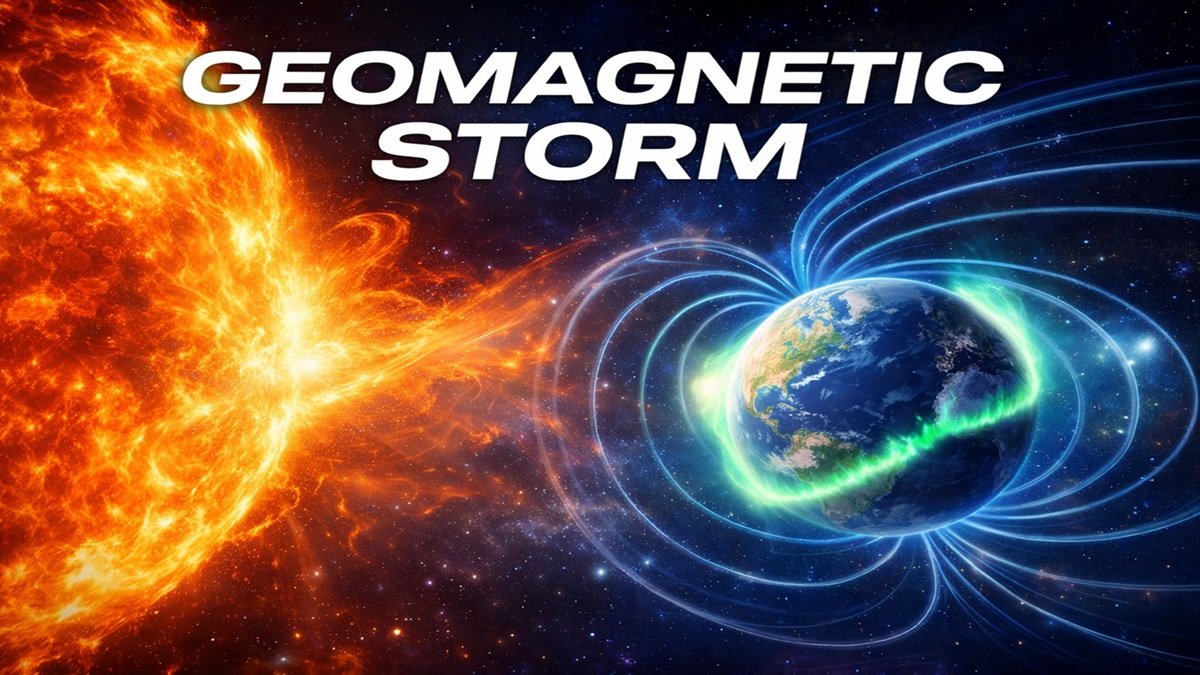
A geomagnetic storm occurs when solar wind disturbances interact strongly with the Earth’s magnetosphere. This interaction disrupts the normally stable magnetic environment surrounding our planet, leading to rapid changes in magnetic field strength and direction.
These disturbances can last from a few hours to several days, depending on the intensity of the solar event that triggered them.
The Science Behind Geomagnetic Storms
Earth’s Magnetosphere
The Earth is surrounded by a magnetic shield called the magnetosphere, which protects the planet from harmful charged particles emitted by the Sun. Under normal conditions, this magnetic shield deflects most solar particles safely into space.
However, when exceptionally strong solar activity occurs, this shield can be compressed and disturbed.
Primary Causes of Geomagnetic Storms
1. Solar Flares
Solar flares are sudden explosions of energy on the Sun’s surface. They release intense radiation and charged particles that travel through space at high speed. While solar flares alone may not always cause geomagnetic storms, they often accompany more dangerous events.
2. Coronal Mass Ejections (CMEs)
The most powerful cause of geomagnetic storms is a coronal mass ejection (CME). A CME is a massive cloud of plasma and magnetic fields expelled from the Sun into space.
If a CME is Earth-directed and its magnetic orientation is opposite to Earth’s magnetic field, a strong interaction occurs—triggering a geomagnetic storm.
3. High-Speed Solar Wind Streams
These streams originate from coronal holes on the Sun. While usually less intense than CMEs, they can still cause moderate geomagnetic storms, especially when persistent over several days.
Phases of a Geomagnetic Storm
1. Initial Phase
- Sudden compression of the magnetosphere
- Minor increase in magnetic field strength
2. Main Phase
- Significant weakening of Earth’s magnetic field
- Maximum energy transfer from solar wind
- Most damaging phase for technology
3. Recovery Phase
- Gradual return of the magnetic field to normal
- Can last several days
Classification of Geomagnetic Storms
Geomagnetic storms are commonly classified using the Kp Index, which measures geomagnetic activity on a scale from 0 to 9.
| Kp Index | Storm Level | Description |
|---|---|---|
| 0–3 | Quiet | No storm |
| 4 | Active | Minor disturbances |
| 5 | G1 | Minor storm |
| 6 | G2 | Moderate storm |
| 7 | G3 | Strong storm |
| 8 | G4 | Severe storm |
| 9 | G5 | Extreme storm |
Effects of Geomagnetic Storms
1. Impact on Power Grids
Strong geomagnetic storms can induce electric currents in long power lines, leading to:
- Transformer damage
- Voltage instability
- Large-scale blackouts
A famous example is the 1989 Quebec blackout, where millions lost electricity for hours due to a geomagnetic storm.
2. Satellite and Space Systems
Geomagnetic storms can:
- Damage satellite electronics
- Increase atmospheric drag, altering satellite orbits
- Cause GPS errors and signal loss
Organizations like NASA actively monitor these effects to protect spacecraft.
3. Communication and Navigation Disruptions
- HF radio blackouts
- Aviation communication issues (especially polar routes)
- GPS positioning errors affecting ships, aircraft, and autonomous systems
4. Effects on Human Spaceflight
Astronauts outside Earth’s protective atmosphere face:
- Increased radiation exposure
- Higher health risks during strong storms
This is a major concern for long-duration missions planned by agencies such as NOAA and international space programs.
5. Auroras: The Beautiful Side Effect
One of the most visible and harmless effects of geomagnetic storms is the aurora:
- Aurora Borealis (Northern Lights)
- Aurora Australis (Southern Lights)
During strong storms, auroras can be seen far beyond polar regions.
Historical Geomagnetic Storms
The Carrington Event (1859)
- Strongest geomagnetic storm ever recorded
- Telegraph systems failed worldwide
- Auroras visible near the equator
If a similar event occurred today, it could cause trillions of dollars in damage globally.
March 1989 Storm
- Caused a major power blackout in Canada
- Damaged satellites
- Highlighted vulnerability of modern infrastructure
Geomagnetic Storms and the Modern World
With increasing dependence on:
- Smart grids
- IoT devices
- Satellite internet
- Autonomous navigation
geomagnetic storms pose growing risks. Space-weather forecasting has therefore become a strategic priority for many countries.
Monitoring and Prediction
Modern geomagnetic storm forecasting relies on:
- Solar observatories
- Space-based satellites
- Ground-based magnetometers
Agencies like NOAA and NASA issue space weather alerts to help governments and industries prepare.
Can Geomagnetic Storms Be Prevented?
Geomagnetic storms cannot be prevented, but their effects can be reduced through:
- Hardened satellite electronics
- Power grid protection systems
- Early-warning space weather alerts
- International cooperation
Importance of Studying Geomagnetic Storms
Understanding geomagnetic storms is critical for:
- National security
- Power infrastructure safety
- Aviation and maritime navigation
- Space exploration
- Global digital connectivity
As humanity moves toward deeper space exploration and increased reliance on satellite-based systems, geomagnetic storms will remain a key challenge of the space-age civilization.
Conclusion
A geomagnetic storm is not just a solar phenomenon—it is a planet-wide event with the power to disrupt modern life. While it can create breathtaking auroras in the night sky, it can also threaten power grids, satellites, and communication systems.
Continuous research, improved forecasting, and resilient infrastructure are essential to minimize the risks posed by these powerful solar-driven events.
