
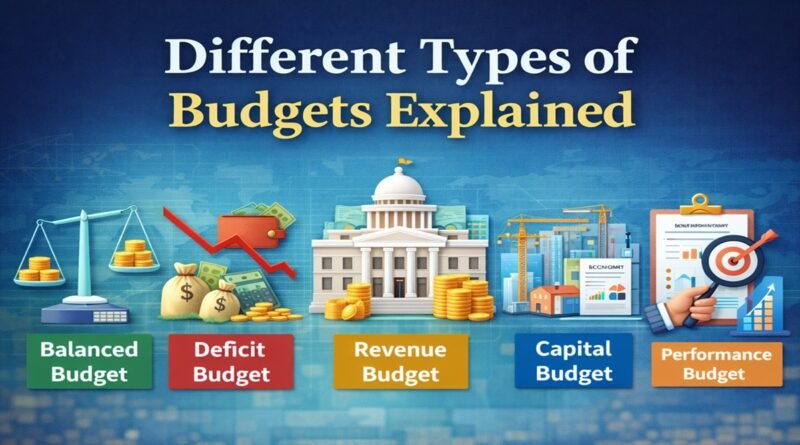
Different Types of Budgets Explained: Meaning, Features and Importance
A budget is one of the most important tools used by governments, organizations, and even households to plan their finances. In economics and public finance, the term “budget” refers to a detailed statement of expected income and expenditure over a specific period, usually one financial year.
Governments use different types of budgets depending on economic conditions, development goals, and policy priorities. Understanding these types helps explain how a country manages growth, welfare, and stability.
What Is a Budget?
A budget is a financial plan that outlines:
- Expected income (receipts)
- Planned expenditure
- Allocation of resources
- Policy priorities for a given year
In the case of a government, the budget reflects its economic vision, social commitments, and fiscal discipline.
Read This: Trade Deficit, Fiscal Deficit and Other Types of Deficits Explained in Detail
Types of Budgets Explained
1. Balanced Budget
Meaning
A balanced budget is one in which total revenue equals total expenditure.
Key Feature
- No deficit
- No surplus
Importance
- Promotes fiscal discipline
- Avoids excessive borrowing
- Ensures stable public finances
Limitation
In developing economies, a perfectly balanced budget may restrict spending on growth and welfare.
2. Surplus Budget
Meaning
A surplus budget occurs when government revenue exceeds expenditure.
When It Is Used
- During economic boom
- To control inflation
- To reduce public debt
Advantages
- Helps repay past loans
- Strengthens government finances
- Builds fiscal buffers
Disadvantage
- May reduce public spending and slow growth
3. Deficit Budget
Meaning
A deficit budget exists when government expenditure exceeds revenue.
Why Governments Use It
- To boost economic growth
- During recession or slowdown
- For infrastructure and welfare spending
Impact
- Leads to borrowing
- Increases public debt
- Can raise inflation if poorly managed
Most modern governments follow a deficit budget, but aim to keep it within sustainable limits.
4. Revenue Budget
Meaning
The revenue budget deals with:
- Revenue receipts (tax and non-tax income)
- Revenue expenditure (day-to-day expenses)
Examples of Revenue Expenditure
- Salaries and pensions
- Subsidies
- Interest payments
- Administrative costs
Importance
It shows whether the government can meet its routine expenses from its regular income.
5. Capital Budget
Meaning
The capital budget relates to:
- Capital receipts (loans, disinvestment)
- Capital expenditure (asset creation)
Examples of Capital Expenditure
- Roads and highways
- Railways and airports
- Power plants
- Schools and hospitals
Importance
- Supports long-term economic growth
- Creates productive assets
- Enhances infrastructure
6. Performance Budget
Meaning
A performance budget links expenditure with outcomes.
Instead of focusing only on how much money is spent, it asks:
What results are achieved?
Features
- Targets and objectives defined
- Performance indicators used
- Improves accountability
Benefit
Ensures efficient use of public funds and better service delivery.
7. Zero-Based Budgeting (ZBB)
Meaning
Under zero-based budgeting, every expense must be justified from scratch, starting at zero.
Key Idea
Past allocations are not automatically continued.
Advantages
- Eliminates wasteful spending
- Encourages efficiency
- Improves resource allocation
Disadvantage
- Time-consuming
- Requires detailed evaluation
8. Gender Budget
Meaning
A gender budget focuses on allocating funds for women-centric schemes and gender equality.
Objectives
- Women empowerment
- Education and health of women
- Employment and safety
Importance
Promotes inclusive growth and social justice.
9. Outcome Budget
Meaning
An outcome budget evaluates the actual results of government spending.
Focus
- Outputs and outcomes
- Impact assessment
- Transparency
It strengthens governance by ensuring that money spent leads to real benefits.
10. Rolling Budget
Meaning
A rolling budget is updated regularly by adding a new budget period while removing the oldest one.
Advantage
- Flexible and adaptive
- Reflects changing economic conditions
Limitation
Less certainty in long-term planning.
Types of Budgets at a Glance
| Budget Type | Main Purpose |
|---|---|
| Balanced Budget | Financial stability |
| Surplus Budget | Debt reduction |
| Deficit Budget | Economic growth |
| Revenue Budget | Daily administration |
| Capital Budget | Asset creation |
| Performance Budget | Efficiency |
| Zero-Based Budget | Cost control |
| Gender Budget | Social inclusion |
| Outcome Budget | Accountability |
Why Understanding Budget Types Matters
Understanding different types of budgets helps:
- Analyze government policies
- Understand economic priorities
- Prepare for competitive exams
- Evaluate fiscal discipline
- Make informed economic judgments
Budgets are not just financial documents—they are policy instruments.
Conclusion
No single type of budget is perfect for all situations. Governments choose different budget approaches depending on economic needs, development goals, and social priorities. A healthy economy balances growth, welfare, and fiscal responsibility through smart budgeting.
Ultimately, a good budget is not about spending more or less—it is about spending wisely.
