
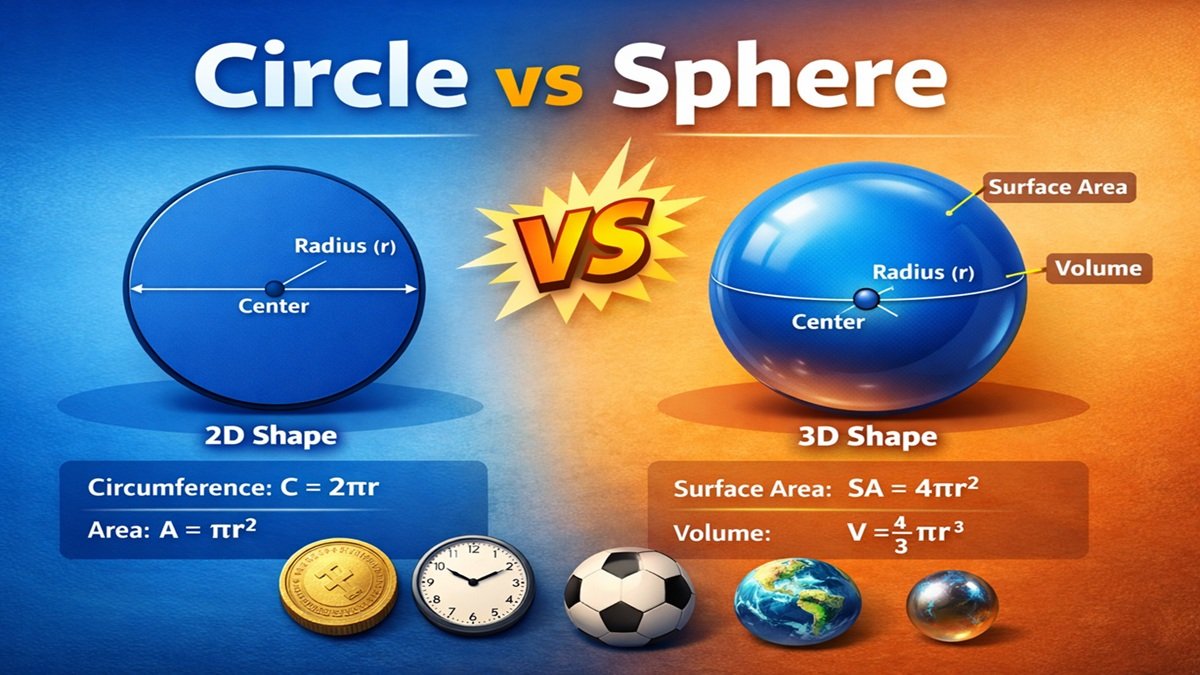
Circle vs Sphere: Understanding the Difference Between 2D and 3D Geometry
Geometry is broadly divided into two-dimensional (2D) and three-dimensional (3D) shapes. Among the most commonly confused shapes are the circle and the sphere. Although they are closely related and share similar properties, they are fundamentally different in structure, dimension, and real-world application.
This article explains the difference between a circle and a sphere in a detailed and systematic manner.
What Is a Circle?
A circle is a two-dimensional geometric figure consisting of all points in a plane that are at a fixed distance from a given point called the center.
Key Characteristics of a Circle
- It lies entirely in a plane (2D shape)
- Has length and width, but no depth
- Defined by a radius (r)
- The distance from the center to any point on the boundary is constant
Important Elements of a Circle
- Radius (r): Distance from center to the boundary
- Diameter (d): Twice the radius (d = 2r)
- Circumference: The perimeter of the circle
- Chord: A line segment joining two points on the circle
- Arc: A part of the circumference
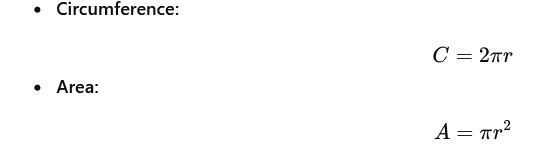
Mathematical Formulas for a Circle
Real-Life Examples of a Circle
- Coin
- Clock face
- Ring
- Wheel (top view)
What Is a Sphere?
A sphere is a three-dimensional geometric solid in which all points on the surface are at an equal distance from a fixed point called the center.
Key Characteristics of a Sphere
- A 3D object
- Has length, width, and height
- Perfectly symmetrical in all directions
- Every cross-section through the center is a circle
Important Elements of a Sphere
- Radius (r): Distance from center to surface
- Diameter: Twice the radius
- Surface: Entirely curved, no flat faces
- No edges or vertices
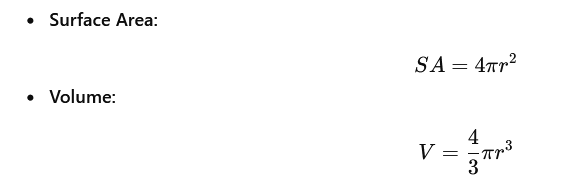
Mathematical Formulas for a Sphere
Real-Life Examples of a Sphere
- Football
- Earth
- Marble
- Water droplet
Circle vs Sphere: Tabular Comparison
| Feature | Circle | Sphere |
|---|---|---|
| Dimension | 2D (Two-dimensional) | 3D (Three-dimensional) |
| Shape Type | Plane figure | Solid figure |
| Has Area | Yes | Yes (surface area) |
| Has Volume | No | Yes |
| Boundary | One curved line | Curved surface |
| Depth | No | Yes |
| Formula Type | Area & Circumference | Surface Area & Volume |
| Cross Section | Not applicable | Always a circle |
Conceptual Difference Between Circle and Sphere
- A circle represents a flat shape, while a sphere represents a solid body.
- A circle can be drawn on paper, but a sphere occupies space.
- A sphere is an extension of a circle into the third dimension.
In simple terms:
If a circle is rotated in space around its diameter, it forms a sphere.
Applications in Science and Engineering
Uses of Circles
- Mechanical gears
- Rotational motion analysis
- Architecture and design
- Road and wheel engineering
Uses of Spheres
- Astronomy (planets, stars)
- Physics (gravitational models)
- Ballistics and fluid dynamics
- Bearings and mechanical components
Common Mistakes Students Make
- Confusing area of a circle with surface area of a sphere
- Using 2πr instead of 4πr² for spheres
- Thinking a circle has volume (it does not)
Summary
- A circle is a 2D shape defined by radius and circumference.
- A sphere is a 3D solid defined by radius, surface area, and volume.
- Both are symmetrical and related but differ fundamentally in dimension and physical existence.
Understanding the difference between a circle and a sphere is essential for mathematics, physics, engineering, and real-world problem solving.
