
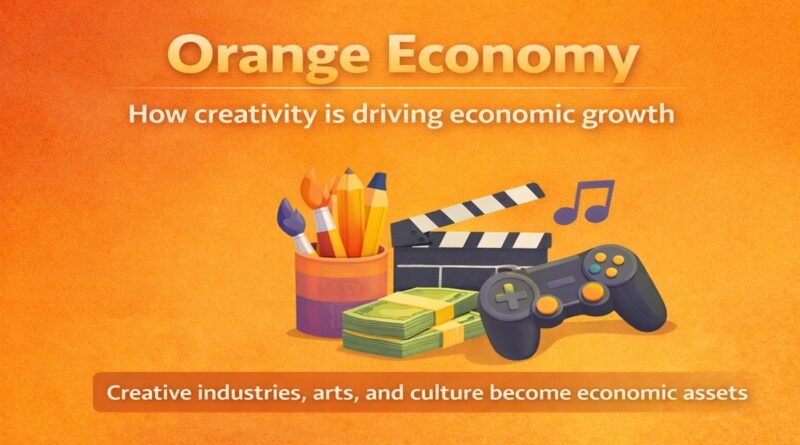
Orange Economy: How Creativity Is Becoming the New Engine of Economic Growth
The Orange Economy, often referred to as the Creative Economy, represents a powerful shift in how modern economies generate value. Instead of relying only on natural resources, heavy industry, or traditional services, the Orange Economy is built on ideas, creativity, culture, design, and intellectual property. In the 21st century, imagination has become an economic asset—and countries that harness it effectively are shaping the future.
For a country like India, with its young population, deep cultural heritage, and rapidly expanding digital ecosystem, the Orange Economy holds transformational potential.
What Is the Orange Economy?
The Orange Economy includes all economic activities where creativity and intellectual capital are the primary inputs. The term gained global recognition through the work of the Inter-American Development Bank, which highlighted creative industries as key drivers of inclusive and sustainable growth.
In simple terms:
When ideas, art, stories, design, music, games, and digital content create economic value, they form the Orange Economy.
Unlike traditional sectors, this economy is not limited by geography. A creator sitting in a small town can reach global markets through digital platforms.
Key Sectors of the Orange Economy
The Orange Economy is not a single industry—it is a network of creative sectors working together.
1. Animation, VFX, Gaming and Comics (AVGC)
- Animated films and series
- Visual effects for cinema and OTT platforms
- Video game development
- Comics and graphic storytelling
This is one of the fastest-growing segments globally, driven by streaming platforms, gaming culture, and immersive technologies.
2. Media and Entertainment
- Films and OTT content
- Television and digital news
- Podcasts, web series, and short-form content
India’s content consumption boom has made this sector central to the Orange Economy.
3. Design Economy
- Product and industrial design
- Fashion and textile design
- UI/UX and digital product design
- Architecture and interior design
Design today is not just about aesthetics—it improves usability, competitiveness, and innovation.
4. Music, Arts and Performing Arts
- Music production and live performances
- Theatre and dance
- Digital art and creative technologies
These sectors increasingly generate revenue through streaming, licensing, and global collaborations.
5. Crafts, Handloom and Cultural Industries
- Handicrafts and handmade products
- Traditional art forms
- GI-tagged regional products
This segment directly connects rural livelihoods with the global creative marketplace.
Global Importance of the Orange Economy
Across the world, the Orange Economy is gaining strategic importance:
- It contributes significantly to GDP and exports
- It is among the largest employers of youth
- It grows faster than many traditional industries
Organizations like UNESCO recognize creative industries as vital for preserving cultural diversity while generating economic opportunity.
India and the Orange Economy: A Natural Fit
India has three major strengths that position it uniquely in the Orange Economy:
- Demographic advantage – a young, creative, tech-savvy population
- Cultural richness – centuries of art, music, crafts, and storytelling
- Digital scale – affordable internet, smartphones, and platforms
These factors together make India a strong contender to become a global creative hub.
AVGC and India’s Creative Future
India’s AVGC sector is emerging as a global powerhouse. Industry estimates suggest:
- The sector could generate around 2 million jobs by 2030
- Demand for Indian animation, VFX, and gaming talent is rising worldwide
Recognizing this, the Indian government has announced support for:
- AVGC Content Creator Labs in 15,000 secondary schools
- AVGC labs in 500 colleges
This early exposure integrates creativity with education and prepares students for future-ready careers.
Design, Innovation and Manufacturing
Design is becoming the bridge between creativity and industry. In India:
- Startups rely on design for user experience and branding
- MSMEs use design to compete globally
- Manufacturing is moving toward design-led innovation
The proposal to establish a new National Institute of Design (NID) in eastern India reflects the growing importance of design within the Orange Economy.
Employment and the Rise of the Creator Economy
One of the biggest strengths of the Orange Economy is its job-creation potential.
It supports:
- Freelancers and gig workers
- Women entrepreneurs and home-based creators
- Youth-led startups and independent professionals
Roles such as content creators, animators, game designers, digital artists, UX designers, and creative marketers are now mainstream careers.
Digital platforms have given rise to the Creator Economy, where individuals monetize creativity directly through global audiences.
Role of Technology and Digital Platforms
Technology has amplified the Orange Economy:
- Streaming platforms distribute content worldwide
- Social media enables personal brands
- AI and creative tools improve productivity
Today, intellectual property—scripts, designs, music, games—is often more valuable than physical assets.
Challenges Facing the Orange Economy
Despite its promise, the Orange Economy faces key challenges:
- Skill gaps and lack of formal training
- Limited awareness of intellectual property rights
- Access to finance for small creators
- Market linkages for traditional artists
Addressing these issues requires collaboration between government, industry, and educational institutions.
Why the Orange Economy Matters for India
For India, the Orange Economy is strategically important because it:
- Encourages knowledge- and talent-driven growth
- Generates high value with relatively low capital
- Connects rural culture with global markets
- Shifts the narrative from Make in India to Create in India
The Road Ahead: Creating for the World
In the coming decade, the Orange Economy can:
- Become a major contributor to India’s GDP
- Absorb millions of young workers
- Strengthen India’s cultural and digital soft power
With the right mix of policy support, education, digital infrastructure, and global outreach, India can emerge as a Creative Powerhouse for the World.
Conclusion
The Orange Economy represents the future of economic growth—where ideas are assets, creativity is capital, and culture becomes commerce. For India, it is not just an opportunity but a natural pathway to inclusive, sustainable, and globally relevant development.
By investing in creativity today, India is investing in an economy that speaks the language of the future.
