
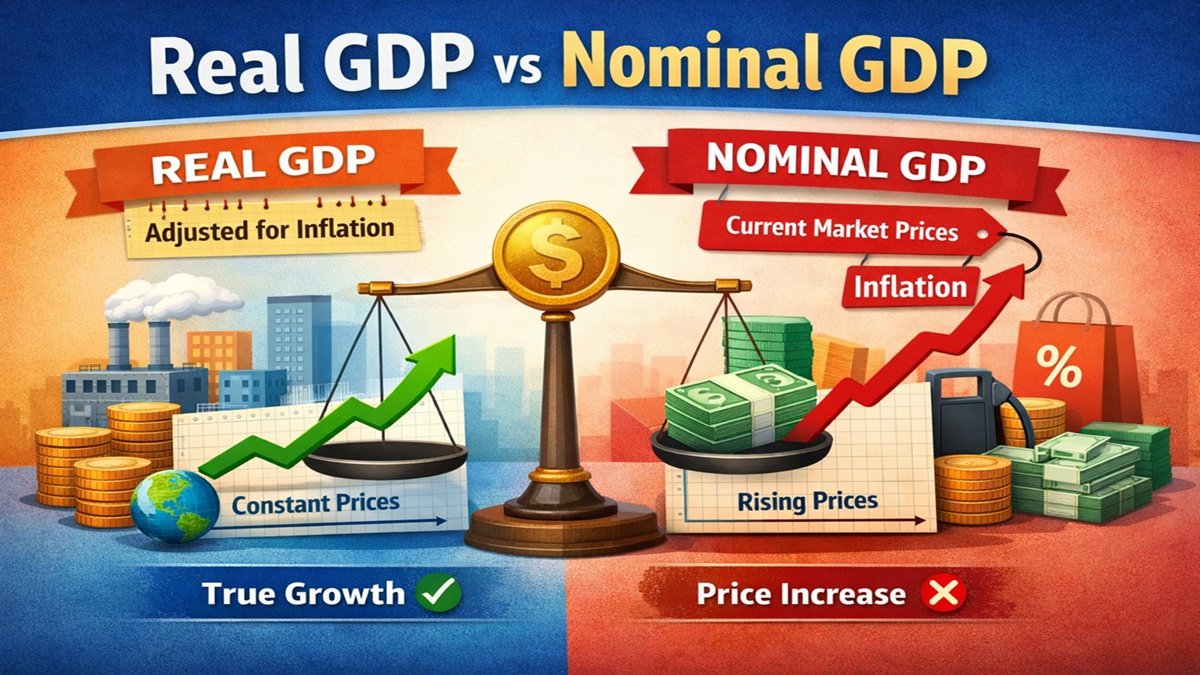
Real GDP vs Nominal GDP: Meaning, Differences, Formula, and Examples
What is GDP?
Gross Domestic Product (GDP) measures the total monetary value of all final goods and services produced within a country’s borders during a specific period (usually a year).
GDP is mainly measured in two ways:
- Nominal GDP
- Real GDP
Understanding the difference between Real GDP vs Nominal GDP is crucial for economics students, competitive exams, policymakers, and investors.
What is Nominal GDP?
Nominal GDP is the value of goods and services calculated at current market prices, without adjusting for inflation.
Key Features of Nominal GDP
- Uses current-year prices
- Includes the effect of inflation or deflation
- Easier to calculate
- Can be misleading when prices change sharply
Nominal GDP Formula
Nominal GDP = Σ (Current Price × Current Quantity)
Example
If a country produces:
- 100 units of a product at ₹100 each
- Nominal GDP = ₹10,000
If price rises to ₹120 next year (same production):
- Nominal GDP = ₹12,000
(Even though production didn’t increase)
What is Real GDP?
Real GDP measures the value of goods and services at constant prices (base year prices), removing the effect of inflation.
Key Features of Real GDP
- Adjusted for inflation
- Shows true economic growth
- Best indicator of living standards
- Used for long-term economic analysis
Real GDP Formula
Real GDP = Nominal GDP ÷ GDP Deflator × 100
Example
Using the same data:
- Nominal GDP = ₹12,000
- Inflation = 20%
- Real GDP = ₹10,000
This shows no real growth, only price rise.
Real GDP vs Nominal GDP: Key Differences
| Basis | Nominal GDP | Real GDP |
|---|---|---|
| Price Level | Current prices | Constant (base year) prices |
| Inflation Impact | Included | Removed |
| Growth Measurement | Can be misleading | Accurate |
| Best Used For | Short-term comparison | Long-term analysis |
| Economic Reality | Distorted by inflation | Reflects true output |
Why Real GDP Is More Important Than Nominal GDP
- Removes inflation distortion
- Shows actual increase in production
- Better comparison across years
- Used by governments and central banks
For example, a country like India may show high nominal GDP growth, but real GDP reveals whether citizens are actually better off.
GDP Deflator Explained
The GDP Deflator is a price index used to convert nominal GDP into real GDP.
GDP Deflator = (Nominal GDP ÷ Real GDP) × 100
- Measures overall inflation in the economy
- Broader than CPI (Consumer Price Index)
Which GDP Is Used Where?
Nominal GDP is used for:
- International rankings
- Market size comparison
- Debt-to-GDP ratio
Real GDP is used for:
- Economic growth analysis
- Policy decisions
- Living standard measurement
Institutions like IMF and World Bank often use both, depending on context.
Real GDP vs Nominal GDP in Exams
Frequently asked in:
- UPSC
- SSC
- Banking exams
- State PCS
- Economics optional
Exam Tip:
If inflation is high and nominal GDP rises, real GDP may still remain stagnant.
Conclusion
- Nominal GDP shows output at current prices
- Real GDP shows output adjusted for inflation
- Real GDP is the true indicator of economic growth
Understanding the difference between Real GDP vs Nominal GDP helps avoid false conclusions about a country’s economic performance.
